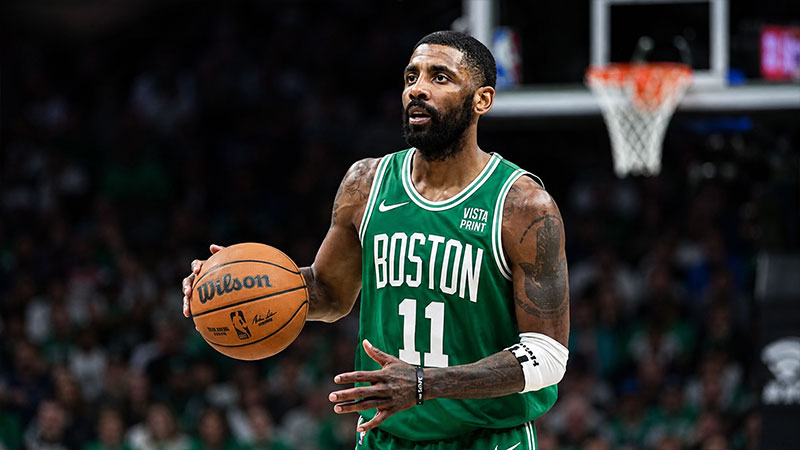
Kyrie Irving is widely celebrated as the most skilled individual to ever play the game of basketball, a sentiment echoed by elite peers and seasoned coaches alike.
His dominance is not a product of overwhelming physical size or explosive verticality, but rather a profound mastery of biomechanics, technical fundamentals, and psychological manipulation.
By blending world-class ball-handling with historically elite finishing, Irving has created an offensive profile that defies traditional defensive logic.
To understand his greatness is to look beyond the highlights and analyze the scientific precision of his movement and the strategic depth of his scoring.
The Biomechanical Foundation of Unmatched Handles
Kyrie Irving’s ball-handling is considered the gold standard in the NBA, serving as a functional weapon to dismantle defensive schemes rather than merely providing visual flair.
His ability to navigate tight spaces and weave through multiple defenders stems from a unique understanding of body mechanics and leverage.
Unlike many guards who rely on pure speed, Irving utilizes a sophisticated system of balance and pace to keep opponents in a constant state of recovery.
Mastering the Low Center of Gravity
Irving maintains a remarkably low, loaded hip level that serves as the anchor for his entire offensive repertoire.
This biomechanical advantage allows him to shift angles instantly without losing his center of gravity, making his crossovers more lethal because he can change direction while remaining fully balanced.
By keeping his hips low, he can react to a defender’s lead foot or shoulder tilt in real-time, executing un-rehearsed combinations that are impossible to scout.
This “anti-gravity” balance allows him to remain stable even when making sharp, high-speed lateral movements.
The Strategic “Float” Dribble and Pace Control
One of Irving’s most unique technical tools is the “float” dribble, where he allows the ball to spin loosely against his palm at the apex of its bounce.
This creates a brief “freeze-frame” effect, forcing the defender to guess his next move while he gathers information on their positioning. Additionally, Irving weaponizes deceptive pace control by rapidly changing his height and speed.
He often stands tall to lull a defender into a false sense of security before dropping his shins and stopping on a dime to create immediate separation for a jump shot.
Functional Wizardry and Throw-Ahead Techniques
While most point guards are taught to keep the ball as close to their body as possible to prevent steals, Irving takes a counter-intuitive approach by often throwing the ball in front of himself.
This technique confuses defenders, as Irving is able to react to their defensive shifts on the fly and determine where the ball should go next based on their reaction.
Every movement in his handle has an intent, focused entirely on reaching a specific spot on the floor to initiate a high-efficiency shot. He does not waste movement; he calculates the shortest path to a scoring opportunity through elaborate but purposeful dribbling.
Finishing Mastery and Below-the-Rim Innovation
Despite standing only 6’2″, Irving is arguably the most creative and efficient paint finisher for a guard in the history of the sport.
Because he lacks the traditional vertical leap of a high-flyer, he has developed a sophisticated suite of finishing techniques that utilize every inch of the backboard.
His ability to score against 7-footers in the paint is not a matter of luck, but a result of rigorous training in unconventional angles and ball rotation.
Ambidexterity and the Art of “English”
Irving possesses total ambidexterity, allowing him to finish with equal comfort on either side of the rim with either hand. This versatility prevents defenders from shading him to one side, as there is no “weak” hand to exploit.
To overcome height disadvantages, he utilizes extreme “spin” or “English” off the backboard. He regularly employs high-arcing finger rolls and reverse layups where the ball hits the very top of the glass before dropping perfectly into the basket.
This meticulous timing and spin make his layup package almost impossible to block.
Disruptive Launch Angles and Body Control
Standard basketball training dictates jumping off the left foot to shoot with the right hand, but Irving has completely deconstructed this rule.
He trains to launch off any foot-and-hand combination, which completely disrupts the timing of help-side defenders who are looking to block his shot. Furthermore, he displays elite body control by often jumping into a defender’s chest.
This tactic prevents the defender from getting full extension on their leap, effectively negating their height advantage and allowing Irving to finish over them at a closer range.
| Technical Skill | Biomechanical Implementation | Competitive Advantage |
|---|---|---|
| Launch Variations | Off-hand/Off-foot jumps | Disrupts defensive block timing |
| Ambidexterity | 50/50 hand usage | Prevents defensive shading |
| Backboard Use | Extreme spin/High arc | Finishes over 7-foot defenders |
| Body Contact | Initiating contact mid-air | Negates shot-blocker’s verticality |
World-Class Shot-Making and Offensive Efficiency
While his ball-handling and finishing provide the highlight reels, Irving’s underlying shooting metrics place him in the upper echelon of all-time greats. He is a “three-level” scorer, meaning he is equally dangerous from the perimeter, the mid-range, and the rim.
His efficiency is a testament to his refined shooting mechanics, which remain consistent regardless of the defensive pressure applied.
The 50/40/90 Shooting Standard
Irving is one of the rare guards in NBA history to record a 50/40/90 season, a benchmark requiring 50% field goal accuracy, 40% from three-point range, and 90% from the free-throw line.
This historical level of efficiency demonstrates that his flashy style is backed by substance. His open pull-up jumper is often cited as textbook, characterized by a wide base, a perfectly vertical rise, and a square two-foot landing.
This mechanical consistency allows him to maintain high scoring averages even when defenses focus their entire game plan on stopping him.
Isolation Dominance and Three-Dribble Proficiency
Kyrie Irving is an isolation master who does not require a complex offensive system or a series of screens to find a high-quality shot. He thrives in “three dribbles or less” scenarios, using his elite footwork to get to his preferred mid-range spots under tight duress.
His ability to read a defender’s balance allows him to create just enough space to get his shot off, often against much taller opponents. This isolation proficiency makes him a devastating “closer” in late-game situations where team sets often break down.
The Contextual Challenge of Franchise Leadership
While Irving’s individual skill is beyond reproach, a common debate among analysts and fans is why this mastery has not always translated into the same level of team success seen by peers like James Harden or Damian Lillard.
The distinction often made is between a “floor raiser”—someone who can carry an average team to the playoffs—and a “ceiling raiser”—someone who makes a championship-caliber team unbeatable.
Irving is frequently categorized as the ultimate “second option” or “1B” player who excels when paired with a primary leader.
Assessing the Playmaking and Defensive Gaps
Critics often point to Irving’s playmaking as a limiting factor when he is the primary option on a team. While he is an elite scorer, his play is often geared toward finding points for himself rather than consistently creating easy looks for his teammates.
In comparison, players like Harden or Westbrook are viewed as being in a different stratosphere regarding their ability to find roll-men and open shooters.
Additionally, Irving’s defensive shortcomings and a tendency to engage in “hero ball” rather than team-oriented basketball are often cited as reasons why he struggles to lead “average” rosters to high win totals.
The Impact of Injuries and Availability
A significant factor in the “leadership” debate is Irving’s inability to stay healthy for a full season as a primary option.
Injuries have frequently interrupted his rhythm and the continuity of the teams he has led, such as his early tenure with the Brooklyn Nets and his time in Boston.
Some analysts argue that we have rarely seen a fully healthy Irving have the opportunity to lead a team through a complete season and postseason as the undisputed number one option.
This lack of availability “fucks his rhythm” and makes it difficult to cultivate a consistent locker room culture.
Frequently Asked Questions
What makes Kyrie Irving’s handles better than other NBA players?
Irving’s handles are unique because they are entirely functional and based on reading a defender’s biomechanics in real-time. He uses tools like the “float” dribble and pace control to manipulate a defender’s balance rather than just using speed.
Is Kyrie Irving considered a good leader?
This is a point of contention. While he is a “tremendously talented” player, critics often describe him as an “average playmaker” and a “bad defender” who struggles to cultivate a winning culture without a more vocal “alpha” leader like LeBron James.
Why does Kyrie struggle to lead teams like James Harden or Damian Lillard?
Analysts suggest that while Kyrie is an “assassin” who can score against anyone, he lacks the “General” qualities of playmaking and floor leadership that allow Harden or Lillard to carry average rosters to the playoffs.
How does Kyrie finish so well despite being shorter than most defenders?
He utilizes extreme spin off the backboard, irregular launch angles off either foot, and initiates body contact mid-air to negate the reach of shot-blockers.
The Mastery of the Game’s Most Unique Artist
In the final assessment, Kyrie Irving remains a unique specimen in the history of professional basketball. He is a player who has traded raw athleticism for a deep, scientific understanding of movement and skill.
While the debates regarding his status as a “first option” or a franchise leader will likely continue, his status as a biomechanical wizard is undisputed.
He is a player who turns the basketball court into an art studio, using his handles and finishing to paint masterpieces that we may never see replicated.
Whether he is the “magic man” or a misunderstood genius, Irving’s impact on the technical evolution of the game is permanent.