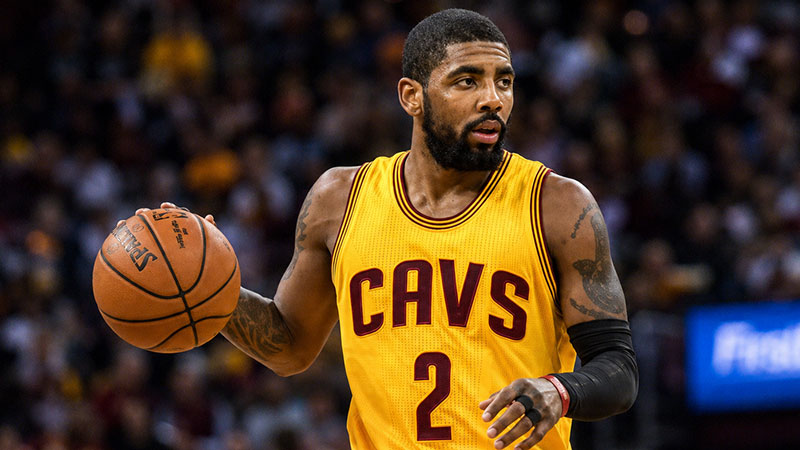
Kyrie Irving is a player whose brilliance on the court is matched only by the depth of his off-court philosophy. While his identity is often synonymous with the number 11, the number 2 has played a pivotal role in his legacy.
From his championship-winning shot in Cleveland to his mid-season transition in Dallas, the “deuce” is far more than a placeholder. Understanding why Irving chose this digit requires peeling back layers of NBA history, team politics, and personal numerology.
This deep dive explores the tactical and spiritual reasons behind one of basketball’s most discussed jersey numbers.
The Cleveland Era: A Choice Born of Circumstance
When Kyrie Irving entered the NBA as the first overall pick in the 2011 NBA Draft, he didn’t initially set out to wear the number 2. In fact, his first choice was a number that had defined his early life and his family’s basketball heritage.
However, the internal landscape of the Cleveland Cavaliers at the time forced a pivot that would eventually define one of the most iconic eras in modern basketball history.
To Irving, the number 2 was initially a “completely random” selection made under the pressure of team restrictions.
The Retirement of Number 11
Irving’s primary desire was to wear number 11, the digit he donned during his high school years at St. Patrick High School in New Jersey.
This number held significant weight because it was an homage to his father, Drederick Irving, who scored 1,931 points at Boston University wearing the same number.
Unfortunately, the Cleveland Cavaliers had already made plans to retire the number 11 to honor two-time All-Star Zydrunas Ilgauskas. Respecting the legacy of the big man, Irving was forced to look elsewhere for his professional identity.
The Million-Dollar Negotiation with Boobie Gibson
With number 11 off the table, Irving turned his sights toward number 1, which he had recently worn during his brief but impactful tenure at Duke University. However, that number was already claimed by veteran guard Daniel “Boobie” Gibson.
In a story Irving recalls vividly, he asked Gibson if he could take the number 1. Gibson jokingly—or perhaps half-seriously—responded that Irving would have to pay him $1 million for the privilege.
Lacking that kind of capital as a rookie, Irving declined the offer, further narrowing his options.
Rejecting the “Big Man” Number 15
The Cavaliers organization didn’t leave Irving without suggestions. They initially offered him number 15, a digit with its own history in the league.
However, Irving felt the number didn’t fit his style of play or his physical profile on the court. He noted that number 15 felt like a “big man’s number” and simply wasn’t “really for me”.
Faced with a dwindling list of available options that suited a dynamic point guard, Irving “just went with number 2,” effectively birthing the “Uncle Drew” persona under that digit.
The Dallas Mavericks Transition: A Return to Roots
After years of wearing 11 in Boston and Brooklyn, Irving’s trade to the Dallas Mavericks in 2023 presented a familiar dilemma. Upon his arrival in Dallas, he found that his preferred number 11 was already being worn by Tim Hardaway Jr..
Instead of seeking a brand-new number, Irving chose to revert to his “original NBA number,” the number 2, for the remainder of that season.
This choice signaled a “full-circle” moment, connecting his veteran leadership in Dallas back to his championship beginnings in Cleveland.
The Roster Shifts and the Return to Eleven
Irving’s second stint with number 2 was relatively brief compared to his time in Cleveland. The opportunity to return to his signature number 11 arose following roster changes within the Mavericks organization.
When Tim Hardaway Jr. decided to switch his own jersey to number 10—an homage to his own father—the number 11 became vacant.
This shift, facilitated by other trades like that of Dorian Finney-Smith, allowed Irving to reclaim the digit that carries his most personal family connections and numerological significance.
The Professionalism of Jersey Transitions
The way Irving handled the number 2 in Dallas reflects his evolution as a leader.
While a younger player might have insisted on their brand-defining number immediately, Irving showed a level of professional maturity by wearing the number 2 while waiting for a natural opening.
This period reminded fans that while he is often viewed as a “colorful character” with “out-of-the-world thinking,” he remains a disciplined student of the game who understands the respect owed to veteran teammates.
Decoding the Mathematical Identity: The Sacred Geometry of 2
While the initial choice of number 2 in Cleveland was described as “random,” Irving later revealed that he found a profound, spiritual connection to the number.
Known for his “curious personality” and deep interest in how the world operates beyond the surface, Irving began to apply his own brand of mathematics to the digits he wears.
He eventually transformed number 2 from a backup choice into a symbol of partnership and destiny.
Relationship Math: The Power of 21
Irving shared a deeply personal calculation that explains the symbolic weight of the number 2 in his private life. He links the number to his relationship with his wife through a unique mathematical formula.
He takes her birth month (November, the 11th month) and combines it with a reference to the 10th month (October). By adding these together, he reaches the number 21.
He views the “2” in this “21” as a representation of the “two of them finding each other,” making the number 2 a constant reminder of their bond and shared journey.
The Universal Synchronization of Number 11
To understand Irving’s connection to any number, one must understand his obsession with the number 11, which often informs his perspective on number 2. The synchronization he finds in his life is staggering:
- Name Length: The name “Kyrie Irving” consists of exactly 11 letters.
- Alphabetical Order: The letter “K” is the 11th letter of the alphabet.
- Birth Time: He was born at exactly 1:11.
- College Career: He played exactly 11 games at Duke University.
- Career Milestones: He reached 11,000 career points on March 11th.
This level of detail suggests that when Irving wears a number, he isn’t just picking a jersey; he is aligning himself with what he perceives to be the geometric truths of his life.
Defining Career Milestones: Number 2 vs. Number 11
The debate over which number defines Kyrie Irving best is a common topic among basketball historians. While he has spent more years in number 11, his most high-pressure, legacy-defining moments are split between the two digits.
His “legend of the game” status is cemented by the fact that he has performed at an elite level regardless of what is printed on his back.
| Feature/Milestone | Number 2 Highlights | Number 11 Highlights |
|---|---|---|
| Key Team(s) | Cleveland Cavaliers, Dallas Mavericks (Initial) | Celtics, Nets, Mavericks (Current) |
| Championships | 2016 NBA Champion (Cleveland) | Western Conference Champion (Dallas) |
| Signature Moment | Game 7 Three-Pointer (2016 Finals) | 60-Point Game (Brooklyn Nets) |
| Personal Symbolism | “Relationship Math” & Partnership | Homage to Father (Drederick Irving) |
| Draft Identity | Selected #1 overall in 2011 | Reached 11,000 points on March 11 |
The Iconic Game 7 Three-Pointer
The strongest argument for the importance of number 2 is the 2016 NBA Finals. Wearing the number 2 jersey for the Cleveland Cavaliers, Irving hit what many consider the most important shot in the franchise’s history.
His pivotal three-pointer in the closing minute of Game 7 against the Golden State Warriors gave Cleveland the lead and eventually their first-ever NBA title.
For many fans, the image of Irving celebrating in a wine-and-gold #2 jersey remains the definitive visual of his career.
The Masterclass 60-Point Performance
Conversely, his time in number 11 has seen some of the most efficient scoring outbursts in the history of the league. During his tenure with the Brooklyn Nets, Irving delivered a 60-point performance that left the basketball world in awe.
This game served as a reminder that “Uncle Drew” is an icon of the game who can provide “some of the best numbers” regardless of the jersey he wears. Whether it is the championship grit of #2 or the scoring clinic of #11, Irving’s impact is undeniable.
Frequently Asked Questions
Why did Kyrie Irving wear #2 instead of #11 in Cleveland?
Irving could not wear #11 in Cleveland because the team was retiring the number to honor Zydrunas Ilgauskas. He chose #2 after failing to negotiate for #1 and feeling that #15 was a “big man’s number”.
Is Kyrie Irving currently wearing number 2?
No, as of his most recent seasons with the Dallas Mavericks, Irving has switched back to his signature number 11. He briefly wore #2 when he first arrived in Dallas because #11 was occupied by Tim Hardaway Jr..
What is the “math” Kyrie uses for number 2?
Irving uses a calculation he calls “relationship math.” He combines his wife’s birth month (11) with a referenced month (10) to get 21, which he simplifies to the “2” representing the two of them finding each other.
Did Kyrie Irving ever wear number 1?
Yes, Kyrie Irving wore number 1 during his college career at Duke University. He was the first player to wear the number after Bobby Hurley’s #11 was retired by the school.
Conclusion: The Duality of a Legend
The story of why Kyrie Irving wears number 2 is a testament to his complex identity. It began as a secondary choice—a result of retired jerseys and million-dollar jokes—but it transformed into a symbol of his greatest professional achievement and his most cherished personal relationships.
Whether he is donning the #11 to honor his father or the #2 to celebrate his partnership with his wife, Irving uses his jersey as a canvas for his beliefs.
Ultimately, the number on his back is secondary to the “nasty dribbles” and “out-of-the-world thinking” that have made him a staple of NBA culture.
As he continues his journey with the Dallas Mavericks, the legacy of the number 2 remains a foundational chapter in the story of a player who refuses to be defined by a single digit.