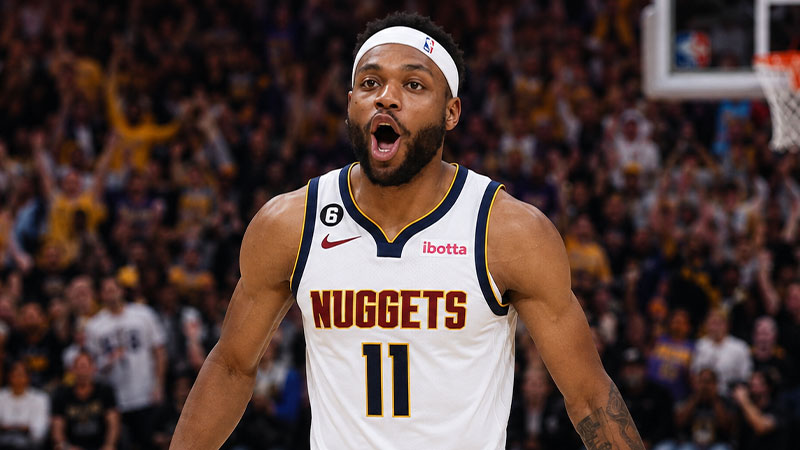
Bruce Brown is widely recognized as a premier “glue guy,” a player whose impact is felt far beyond the traditional box score through defensive versatility and high-energy hustle.
While he is not a primary scoring star, his ability to fit into nearly any lineup makes him an invaluable asset for championship-contending teams.
Brown played a vital role in the Denver Nuggets’ 2023 NBA Championship run and proved his durability by appearing in all 82 games during the 2025–26 season.
His unique blend of toughness, basketball IQ, and adaptability ensures he remains one of the most respected role players in the league.
The Defensive Engine: Why Bruce Brown’s Versatility Matters
In modern basketball, the ability to switch defensively is a non-negotiable trait for elite teams, and Bruce Brown excels in this role despite his 6’4″ frame.
He possesses a remarkably strong base and a significant wingspan, allowing him to effectively guard positions 1 through 4.
This versatility is rare for a guard and allows coaches to deploy him in various tactical schemes without creating mismatches that opponents can easily exploit.
A Swiss Army Knife on the Perimeter
Brown is frequently tasked with guarding quick point guards on the perimeter, yet he is strong enough to “bang” with larger wings under the basket.
Fans often compare his disruptive defensive style to a “wired” version of Russell Westbrook—high energy with lower risk—or a version of Gary Payton II who offers slightly more offensive upside.
He is considered to be in the top 25% of defenders in the NBA, characterized by a smart, tough approach that disrupts an opponent’s rhythm.
Performance in High-Stakes Matchups
His reputation as a lockdown defender was cemented during the 2022 Nets vs. Celtics playoff series, where his defensive tenacity was highlighted as a standard for high-level play.
Whether he is playing point guard on offense or guarding a power forward on defense, his active hands and athletic length make him a constant threat to force turnovers, as evidenced by his 1.7 steals per game during the 2025–26 playoffs.
Offensive Adaptability: Thriving in the “Short-Roll”
While many role players struggle when they aren’t the primary ball-handler, Bruce Brown has mastered the art of playing off the ball.
He does not require high usage to be effective, instead relying on elite cutting and specialized screening to create scoring opportunities for himself and his teammates.
This adaptability was a cornerstone of his success in Brooklyn and Denver, where he often operated next to elite playmakers.
The Evolution of the Short-Roll Specialist
In Brooklyn, Brown carved out a unique niche as an undersized “short-roll” screener, often acting as a release valve for superstars when they faced double teams.
He excels at catching the ball in the middle of the floor and making quick decisions—either finishing at the rim or finding an open teammate.
His secondary playmaking skills are evidenced by his career average of 2.4 assists per game and his peak of 3.4 assists per game during the 2022–23 season.
Elite Cutting and Finishing
One of Brown’s greatest offensive strengths is his timing as a cutter. He has a natural feel for finding gaps in the defense, particularly when playing alongside a visionary passer like Nikola Jokic.
Unlike many guards who drift to the perimeter, Brown is comfortable playing in the paint, using his strength to finish through contact. This “big man in a guard’s body” style of play makes him difficult for traditional defenses to track.
Analyzing the Statistical Profile of a Champion
To truly understand if Bruce Brown is good, one must look at the consistency of his production across multiple franchises. His career spans seven years and over 500 regular-season games, during which he has maintained a high level of efficiency.
| Statistic | Career Average | 2025–26 Regular Season | 2025–26 Playoffs |
|---|---|---|---|
| Points Per Game (PPG) | 8.7 | 7.9 | 6.3 |
| Rebounds Per Game (RPG) | 4.2 | 3.9 | 2.7 |
| Assists Per Game (APG) | 2.4 | 2.1 | 1.7 |
| Field Goal % (FG%) | 47.6% | 47.5% | 44.1% |
| Three-Point % (3P%) | 34.4% | 38.5% | 27.3% |
| Steals Per Game (SPG) | N/A | 1.0 | 1.7 |
Deciphering the Numbers
During the 2025–26 regular season, Brown’s three-point shooting saw a significant uptick to 38.5%, well above his career average of 34.4%.
This improvement made him a more potent spacing threat, although his playoff shooting dipped to 27.3%, highlighting some historical inconsistency from the perimeter. Despite these fluctuations, his efficiency remains high, with a career field goal percentage of 47.6%.
The Journey: From Second-Round Pick to NBA Reliable
Bruce Brown’s career arc is a testament to development and finding the right system. Drafted 42nd overall by the Detroit Pistons in 2018, he transitioned from a low-scoring rookie to a primary starter in just his second year.
A Tour of the League
Brown has been a productive asset for several franchises, including the Indiana Pacers, where he achieved a career-high scoring average of 12.1 points per game in 2023–24.
His journey through Detroit, Brooklyn, Indiana, Toronto, and New Orleans eventually led him back to Denver, where he serves as a reliable anchor for the second unit.
This “journeyman” status is not a reflection of a lack of talent, but rather a high demand for his specific “glue guy” skill set across the league.
Reliability and the “82-Game” Standard
One of the most impressive feats of Brown’s 2025–26 season was his durability. In an era of frequent load management, Brown was the only player on the Nuggets roster to appear in every single regular-season game.
This reliability, combined with what fans call his “awesome aura,” makes him a favorite among teammates and coaching staff alike.
Identifying the Gaps: Where Bruce Brown Faces Challenges
No player is without limitations, and Bruce Brown’s game is defined by what he is not as much as what he is. To accurately answer “is Bruce Brown good,” we must acknowledge the contexts where he might struggle if asked to do too much.
Limits of Self-Creation
Brown is not a player who can consistently break down a defense in isolation or carry a team’s scoring load independently.
He relies heavily on being set up by elite playmakers and thrives in systems with high ball movement. In a vacuum, without a star to draw gravity, his offensive impact would likely diminish significantly.
Perimeter Consistency
While he has shown flashes of being a reliable outside shooter—such as his 38.5% clip in 2025–26—his career has been marked by fluctuations from beyond the arc.
His playoff dip in 2026 suggests that while he is a capable shooter, he is not yet a consistent “knockdown” threat that defenses must respect at all times.
The “Glue Guy” FAQ: Expert Insights on Bruce Brown
Is Bruce Brown an All-Defense caliber player?
While he is an exceptionally smart and tough defender, most analysts do not consider him an “All-Defense” type player.
He is highly switchable and disruptive, ranking in the top 25% of the league, but he typically does not “lock down” opponents in the way a perennial All-Defensive selection might.
How does he contribute to a winning culture?
Brown brings a “high motor” and energy every night. His willingness to perform the “dirty work”—setting screens, cutting, and defending larger players—sets a standard for the rest of the roster.
His ability to anchor a second unit and provide stability across all 82 games is a key trust signal for any championship organization.
What is his “Short-Roll” role exactly?
In this role, Brown acts as a screener for the ball-handler. When the defense traps or doubles the ball-handler, Brown rolls to the “short” area (the free-throw line or elbows), catches the pass, and utilizes his secondary playmaking or finishing ability to punish the 4-on-3 advantage.
Conclusion: The Final Verdict on Bruce Brown
When evaluating if Bruce Brown is good, the answer is a definitive yes, provided he is viewed through the lens of a high-impact role player.
He is a championship-proven asset who provides elite defensive versatility, unique offensive adaptability, and unmatched durability.
While he may never be a primary scoring option, his ability to provide the “glue” that holds a contender together makes him one of the most valuable non-stars in the NBA today.
For any team looking to move from “good” to “championship-caliber,” a player like Bruce Brown is often the missing piece.