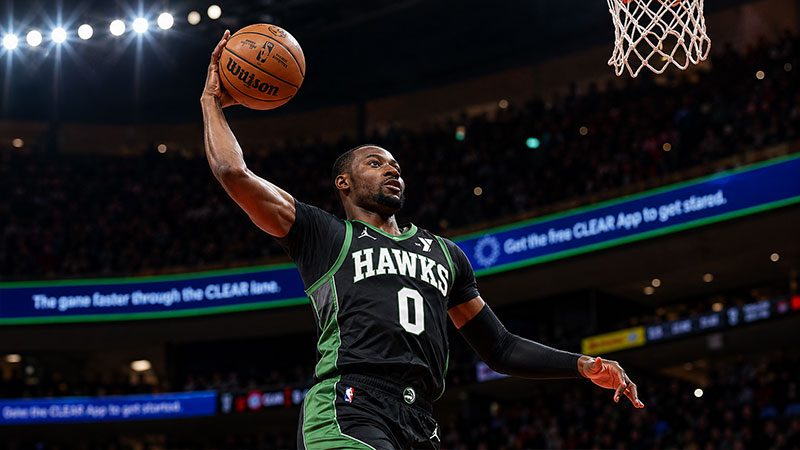
Jonathan Kuminga is an elite, high-upside athletic wing who oscillates between star-level flashes and role-player inconsistency.
Currently with the Atlanta Hawks, he provides exceptional rim pressure and defensive versatility but is hampered by a ~30% three-point percentage and occasional “tunnel vision” in half-court sets.
While his 2025-26 stats reflect a stabilizing floor of 12.2 points and 5.6 rebounds per game, his true value lies in his physical tools.
He remains a volatile asset whose ultimate ceiling depends on refining his decision-making speed to match his world-class athleticism and “leveled up” defensive maturity.
The Statistical Reality: Breaking Down the Numbers
To understand how good Jonathan Kuminga truly is, one must look past the highlight reels and examine the raw data.
Over 294 regular season games, he has established himself as a prominent, high-volume frontline scorer, yet his efficiency has seen significant fluctuations depending on his role and team environment.
| Season | Team | PPG | RPG | APG | FG% | 3P% |
|---|---|---|---|---|---|---|
| 2021–22 | GSW | 9.3 | 3.3 | 0.9 | 51.3% | 33.6% |
| 2022–23 | GSW | 9.9 | 3.4 | 1.9 | 52.5% | 37.0% |
| 2023–24 | GSW | 16.1 | 4.8 | 2.2 | 52.9% | 32.1% |
| 2024–25 | GSW | 15.3 | 4.6 | 2.2 | 45.4% | 30.5% |
| 2025–26 | GSW / ATL | 12.2 | 5.6 | 2.3 | 46.3% | 33.3% |
| Career | Total | 12.2 | 4.2 | 1.8 | 49.8% | 33.1% |
Key Career Milestones
- Championship Pedigree: 2022 NBA Champion with the Golden State Warriors.
- Scoring Ceiling: Career-high of 31 points achieved against the Sacramento Kings.
- Glass Crashing: Career-high of 12 rebounds in a single contest.
- Elite Efficiency Flashes: Early in the 2025 season, he averaged 15.7 points on .655 eFG% over a selective stretch.
Defining the “Downhill” Force: Elite Strengths
Kuminga’s primary appeal to professional scouts and analysts lies in his physical profile. Standing at 6’7″ and weighing 225 lbs, he possesses the lateral quickness and explosive leaping ability that make him a nightmare in transition and a versatile weapon on the defensive end.
Elite Rim Pressure and Transition Mastery
Kuminga is often described as a “downhill” point forward. He uses his bruising frame to absorb contact at the rim, finishing at a remarkable rate—frequently exceeding 70% when he gets directly to the restricted area.
This physical dominance is best seen in the open court, where his pure speed makes him nearly impossible to stop without committing a foul.
Highlights of his tenure include powerful windmill dunks and mid-air hand-switches that underscore his rare verticality.
Defensive Versatility and Ball Containment
Beyond his scoring, Kuminga has “leveled up” as a legit defender. He has shown the ability to use his athleticism to close out on shooters and block jump shots from the weak side.
During the 2026 playoffs with the Atlanta Hawks, he served as a crucial defensive specialist against physical wings, proving his worth as a multi-positional stopper.
This evolution from a raw prospect to a disciplined on-ball defender has been a significant part of his professional maturation.
The Paradox of Potential: Critical Weaknesses
Despite his physical gifts, Kuminga’s journey has been marred by inconsistencies that have occasionally led to benchings and friction with coaching staffs.
These limitations are largely tactical and mental rather than physical, often manifesting as “tunnel vision” during high-pressure half-court sets.
Inconsistent Perimeter Shooting
A major factor holding Kuminga back from true stardom is his unreliable outside shot. During the 2024-25 season, his three-point percentage dipped to a career-low 30.5%.
This lack of gravity allows defenders to sag off him, effectively clogging driving lanes for his teammates and disrupting offensive flow.
While he has shown flashes of improved shooting, such as a brief stint hitting 50% from deep, he has struggled to maintain that efficiency over a full 82-game calendar.
Tactical Decision-Making and Processing Speeds
Critics and analysts have frequently pointed to Kuminga’s slow processing speeds when faced with double teams.
In his earlier years with the Warriors, if he wasn’t closely guarded, he would often force a move or a shot rather than probing the defense and continuing the ball movement.
This “low IQ” narrative became a point of contention among fans, though supporters argue he has improved significantly in “letting the game come to him”—a phrase signifying better patience and playing within the flow of a motion offense.
The Atlanta Transition: A Career at a Crossroads
The trade to the Atlanta Hawks in February 2026 marked a pivotal moment in Kuminga’s career. While his camp was reportedly “shocked” by the move, it provided a fresh start away from the high-pressure “two timelines” era of the Golden State Warriors.
The Impact of the February Trade
Kuminga made an immediate splash in his Hawks debut, scoring 27 points in just 24 minutes off the bench on 9-of-12 shooting.
This performance briefly silenced doubters and showcased the “potential star” that Warriors head coach Steve Kerr had struggled to fully trust.
In the 2026 postseason with Atlanta, his scoring average rose to 13.7 PPG, illustrating his ability to elevate his game in high-stakes environments.
Contract Implications and Future Volatility
As of mid-2026, Kuminga’s status remains highly volatile. The Atlanta Hawks hold a $24.3 million team option for the 2026-27 season.
Rumors persist that Atlanta is exploring the trade market, as his high price tag has not yet consistently aligned with his production as a winning basketball player.
Kuminga himself remains ambitious, stating that his priority is to be a player a team relies on, with the ultimate goal of becoming a multi-time All-Star.
The “Letting the Game Come to Him” Philosophy
A recurring theme in the analysis of Kuminga’s growth is his ability to play within a team’s offensive scheme.
For much of his early career, he was accused of forcing shots and struggling with “small brain” play, but his more recent stretches have shown a higher level of maturity.
- Patience on Offense: Learning that giving up the ball often leads to getting it back in a better position.
- Enhanced Passing: His assist numbers have seen slight upticks (reaching 2.3 APG in 2026), reflecting better vision out of drives.
- Rebounding Intensity: Using his physical tools to “inhale” boards, reaching a career-best 5.6 RPG in the 2025-26 season.
- Screen Setting: While historically a weak point, he has shown flashes of effective pick-and-roll play, particularly when paired with elite gravity players like Stephen Curry.
Advanced Actionable FAQ
Is Jonathan Kuminga currently considered a star player?
Based on the latest performance data, Kuminga is viewed as a high-upside role player rather than an established star.
While he has the physical tools of an All-Star and has delivered 20+ point performances in the playoffs, his lack of consistent outside shooting and occasional lapses in decision-making keep him in the “potential” category for now.
Why did the Golden State Warriors trade Kuminga?
The trade followed an extended contract standoff and tactical friction. Kuminga reportedly lost faith in coach Steve Kerr’s rotation decisions, and the Warriors’ front office was hesitant to meet his high salary demands given his inconsistent fit within their motion offense. The move to Atlanta was seen as a way for both parties to move forward.
How does Kuminga’s defense compare to other elite wings?
Kuminga possesses elite on-ball defensive versatility. His combination of size (6’7″) and lateral quickness allows him to guard multiple positions effectively.
While he has improved his off-ball awareness and weak-side shot-blocking, he is still developing the consistent discipline required to be ranked alongside the league’s top-tier defensive stoppers.
What is the current outlook for Kuminga’s contract?
The Atlanta Hawks hold a $24.3 million team option for the next season. His future is uncertain; while he has the talent to justify a significant contract, his consistency remains a concern for front offices.
There are ongoing rumors that he could be moved again if Atlanta decides his production doesn’t match the financial commitment.
Can Jonathan Kuminga fix his three-point shooting?
There is hope for improvement, as he has had stretches of shooting 37% from deep in the past. However, his most recent full season saw him struggle at 30.5%.
Improving his shooting mechanics and shot selection is the single most important factor in unlocking his ceiling as a primary scoring option in the NBA.
Conclusion: A Final Verdict on the Kuminga Experience
Jonathan Kuminga remains one of the most fascinating enigmas in professional basketball. He is a player of extreme polarities: a 2022 Champion with elite physical tools who can dominate a quarter with rim pressure and defense, yet can just as easily disappear due to foul trouble or poor spacing.
His transition to the Atlanta Hawks has proven that a change of scenery can spark immediate production, but the long-term question of his consistency remains unanswered.
Whether he becomes the multi-time All-Star he envisions or settles in as a high-tier athletic specialist depends entirely on his mental approach to the game.
If he can consistently “let the game come to him” and stabilize his perimeter shot, the “volatile ascent” may finally reach its peak.
What do you think about Kuminga’s future? Is he a future All-Star in the making, or has he already hit his ceiling? Drop a comment below and let’s discuss his trajectory!