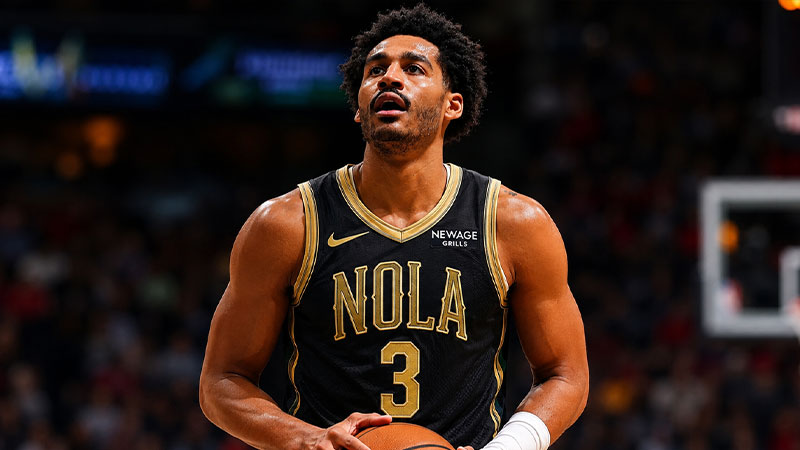
Jordan Poole is statistically and visually considered one of the most significant defensive liabilities in the modern NBA.
While he offers elite offensive gravity and space creation, his defensive profile is marked by high ratings and negative impact metrics across every professional season.
Historically, his career defensive rating sits at a poor 117.2, with recent performances plummeting to a staggering 128.3 during high-stakes play.
Despite sporadic flashes of defensive playmaking and high steal rates, Poole remains a primary target for opposing offenses due to structural mechanical flaws and lapses in off-ball attentiveness.
Is Jordan Poole Legally the Worst Defender in the NBA?
The debate regarding Jordan Poole’s defensive standing often transcends simple statistics, entering the realm of league-wide reputation where fans and analysts alike question his fundamental engagement.
Within basketball communities, Poole is frequently labeled as a “zero effort” defender whose presence on the floor often necessitates a complex defensive shell to prevent total structural collapse.
The Public Narrative and Effort Concerns
Public perception of Poole’s defense reached a critical low point during his final years with the Golden State Warriors and his subsequent transition to the Washington Wizards.
Many observers have described him as the “most frustrating player in the league,” specifically noting that his defensive issues appear to be rooted in a lack of consistent effort rather than purely physical limitations.
Critics point to his tendency to stand “straight up as an arrow” while guarding the ball, lacking the necessary defensive stance to react to quick drives or changes in direction.
This perceived apathy has led many to argue that he is among the worst defenders for players who receive starter-level minutes.
Comparative Deficits and League Standings
When compared to other players often cited as defensive liabilities, such as Duncan Robinson or Trae Young, Poole frequently emerges as the more polarizing figure.
While Trae Young has shown documented improvements in defensive engagement, Poole’s trajectory has often trended in the opposite direction, with fans noting “appalling levels of effort” and constant “ball-watching”.
Even comparisons to younger players like Bones Hyland suggest that while others may share his physical limitations, Poole’s high usage and defensive lapses make him a more visible target for opposing game plans.
Tracking the Analytical Decline of Jordan Poole’s Defense
A rigorous analysis of Poole’s defensive impact requires moving beyond the “eye test” to examine the concrete data that illustrates a career-long regression.
Defensive rating, which estimates the number of points a player allows per 100 possessions, provides a clear timeline of his diminishing effectiveness on that end of the floor.
Jordan Poole Career Defensive Performance Data
| Season | Team | Defensive Rating | D-BPM | Key Insight |
|---|---|---|---|---|
| 2021–22 | Golden State Warriors | 111.4 | Negative | Career-best rating during championship season. |
| 2022–23 | Golden State Warriors | 116.3 | Negative | Significant drop in efficiency and consistency. |
| 2023–24 | Washington Wizards | 121.1 | Negative | Transition to a primary option role with high liability. |
| 2025–26 | New Orleans Pelicans | 122.7 | Negative | Career-worst full-season rating; removal from rotation. |
| Late 2026 | New Orleans Pelicans | 128.3 | Negative | Drastic decline during the final stretch run of play. |
The Reality of Defensive Plus-Minus (D-BPM)
Advanced metrics like Defensive Box Plus-Minus (D-BPM) reveal a troubling consistency: Poole has posted a negative D-BPM in every single season of his career.
This suggests that regardless of the team environment or the quality of his defensive teammates, his individual presence routinely drags the team’s defensive floor below the league average.
On-off splits further corroborate this, showing that opposing teams consistently score at a drastically higher rate when Poole is active on the floor compared to when he is on the bench.
Classification as a “Hidden” Defensive Asset
Player tracking models, such as those utilized by CraftedNBA, have officially categorized Poole’s defensive role as “Hidden”.
In professional scouting, this designation is a significant red flag; it indicates that coaching staffs must actively structure their entire defensive scheme to “hide” him from being isolated by the opposition’s top scorers.
Being a “hidden” defender places an immense burden on the rest of the unit, as it effectively forces four players to cover the ground and responsibilities of five.
What Are the Core Mechanical Flaws in Poole’s On-Ball Defense?
Understanding why the analytics are so poor requires a breakdown of the specific mechanical failures evident in Poole’s game film.
His struggles are not merely a result of his 6’4″ frame but are rooted in fundamental issues regarding hip mobility, footwork, and discipline.
Mechanical Deficits in Lateral Movement
Scouting reports consistently highlight Poole’s lack of the necessary hip mobility and functional strength to stay in front of elite NBA guards.
Instead of sliding his feet laterally to cut off an opponent’s angle, he has a recurring habit of turning his hips and chasing from behind.
This “turn and chase” mechanic is catastrophic in one-on-one situations, as it allows explosive ball-handlers like Cade Cunningham or Dyson Daniels to bypass him and reach the rim with minimal resistance.
Screen Navigation and Discipline Gaps
Navigation through screens remains one of the most glaring weaknesses in Poole’s defensive repertoire.
He consistently gets “caught” on pick-and-rolls, which leaves his team’s interior defenders—such as Jonas Valanciunas or Alex Sarr—in the impossible position of having to defend two players at once.
Furthermore, his lack of discipline is frequently exposed during shot contests; rather than closing out with a balanced stance and “chopping” his feet, he tends to recklessly jump at shooters, leading to unnecessary fouls or easy drives for the offense.
Analyzing the Defensive Playmaking Mirage in Washington
During the early stages of his tenure with the Washington Wizards, a narrative began to emerge that Jordan Poole was making a “defensive leap”.
This was fueled by a sudden spike in high-variance playmaking statistics that temporarily masked his deep-seated structural issues.
Record-Breaking Steal and Block Rates
In a surprising turn for a player often labeled as a non-defender, Poole posted career-best numbers in defensive takeaways early in his Wizards stint.
His 3.2% steal rate and 1.7% block rate were unprecedented jumps for his career, nearly doubling his previous averages.
This “rejuvenated” effort saw him sinking down to take away passing lanes and utilizing his quick reflexes to deflect passes intended for big men in the post. Analysts noted that his intensity and attentiveness to detail seemed “leagues ahead” of his previous seasons.
The Trade-Off: Gambling vs. Positional Integrity
Despite the impressive volume of blocks and steals, his overall defensive impact remained negative because of the high cost of his defensive “gambling”.
This “steel-heavy” style often leaves the team vulnerable when a gamble fails, forcing teammates like Alex Sarr to clean up the mess at the rim.
Furthermore, contesting metrics showed that opponents still shot 5.5% better than their average when defended by Poole, proving that the occasional highlight block did not offset the constant high-percentage looks he surrendered.
Why Is Jordan Poole’s Off-Ball Awareness a Major Concern?
Beyond the physical and mechanical aspects of on-ball defense, Poole frequently struggles with the mental side of the game, particularly off-ball awareness and communication.
This leads to what analysts call “battery dying” moments where he completely zones out of the active play.
The Problem with “Ball-Watching”
Poole is highly prone to “ball-watching,” a habit where his eyes and head follow the flight of the ball while he loses track of his direct assignment. This lapse in focus allows opponents to execute easy backdoor cuts for wide-open layups and dunks.
In several documented instances, players like Bruce Brown and Lu Dort have capitalized on Poole’s stationary, eyes-locked-on-the-ball posture to score without resistance.
Rotational Lapses and Communication
While he has shown potential as a low-man rotation defender, his consistency in these high-IQ situations is lacking. Even when he is positioned correctly, his limited physical tools as a 6’2″ or 6’3″ guard hinder his ability to be a true paint protector.
When defensive coverages are not perfect, Poole’s mistakes become “damning,” as he often finds himself caught between assignments, leading to open looks for elite passers like Darius Garland.
The Impact of Defensive Liabilities on Career Longevity
The ultimate consequence of these persistent defensive shortcomings has been a significant reduction in Poole’s team role and market value.
While his offensive explosiveness was a key factor in the Golden State Warriors’ 2022 championship run, his inability to guard anyone has made him a difficult fit for any team with playoff aspirations.
Removal from the Rotation and Trade Rumors
The New Orleans Pelicans eventually made the difficult decision to remove Poole from their primary rotation during the 2025–26 season.
This decision was driven by the reality that he could not be included in “closing five” lineups because opposing teams would relentlessly “hunt” him on every possession during crunch time.
When combined with an offensive slump where he shot just 37.2% from the field, his defensive deficits made him an unplayable asset for a competitive roster.
Can Jordan Poole Ever Become a Winning Defender?
For Jordan Poole to salvage his defensive reputation, he must find a way to maintain the high-level attentiveness seen during his early Wizards tenure while fixing his mechanical footwork.
The potential for effort is there—as seen in his improved body language and passing lane deflections—but the lack of technical discipline continues to be his undoing.
Until he can navigate a screen or contest a shot without compromising team integrity, he will likely remain an enigma: an offensive star who is too much of a defensive risk to play when it matters most.
Frequently Asked Questions (FAQ)
Does Jordan Poole have a good defensive rating?
No. His career average is a poor 117.2, and it has recently spiked to as high as 128.3 during late-season stretches with the New Orleans Pelicans.
Why do teams target Jordan Poole on defense?
Teams “hunt” Poole because of his poor hip mobility and his tendency to turn and chase rather than sliding laterally, making him an easy target for isolation.
Has Jordan Poole ever been a good defender?
Even during his championship run with Golden State, he was considered a below-average defender who was often “hidden” within a scheme featuring elite defenders like Draymond Green.
What are the main issues with Poole’s off-ball defense?
He is prone to “ball-watching” and “battery dying” moments, where he loses track of his man, leading to easy backdoor cuts and open shots.
Final Verdict: Is There Hope for Poole’s Defensive Development?
Jordan Poole’s defensive journey has been a cautionary tale of how elite offensive talent can be marginalized by a lack of defensive discipline.
The data and the film both suggest that while he is capable of high-intensity playmaking, his fundamental mechanical flaws make him a liability in a modern, switch-heavy NBA.
For Poole to regain his status as a championship-level contributor, the shift from “hidden” defender to a neutral one is the most critical hurdle he faces.
What do you think about Jordan Poole’s defensive future? Do you believe his playmaking flashes are a sign of real growth, or is he destined to remain a liability? Drop a comment below and let us know your thoughts!