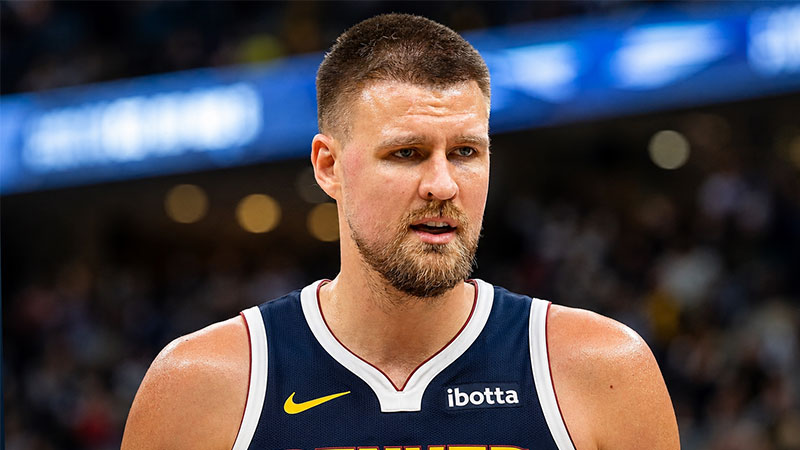
Kristaps Porziņģis is an elite basketball player when healthy, offering a rare combination of shot-blocking and perimeter shooting. Known as “The Unicorn,” the 7’2″ center maintains a career average of 19.5 points and 1.8 blocks per game.
His defensive impact ranks among the league’s top 20 players, effectively anchoring the paint while stretching defenses to the three-point line.
However, his reputation is complicated by chronic availability issues and a recent POTS diagnosis that has limited his recent production. Despite these hurdles, he remains a championship-level contributor capable of transforming any modern NBA rotation.
Analyzing the Unicorn’s Rare Offensive Skill Set
To understand if Kristaps Porziņģis is good, one must look at the specific tactical advantages he provides on the offensive end.
He possesses a “Unicorn” skill set, a term coined to describe a player with the height of a traditional center but the shooting touch and range of an elite wing.
This duality forces opposing coaches to make difficult decisions regarding their defensive schemes. Because he can score from almost anywhere on the floor, he creates a level of “gravity” that opens up the entire court for his teammates.
High-Volume Three-Point Shooting and Range
Porziņģis is an exceptionally efficient floor spacer for a player of his stature, boasting a career three-point average of 36.4%.
Unlike many “stretch bigs” who only take stationary shots from the corner, Porziņģis is known for his ability to pull up from deep range, often launching shots from 25 feet or further.
This deep range is a significant problem for opposing centers who are uncomfortable guarding so far away from the basket.
During his peak stretches, his shooting efficiency reaches elite levels. For instance, he finished one season averaging 27 points while shooting 37% from beyond the arc.
His high-volume shooting is not just about the percentage; it is about the “quick release” he possesses, which is nearly impossible to contest given his 7’2″ frame.
This ability to “rain 3s” is a primary reason why teams continue to view him as a top-tier offensive weapon.
Exceptional Mid-Post and Free Throw Efficiency
Beyond the three-point line, Porziņģis excels in the mid-post, where he can easily face up and shoot over almost any defender. If an offensive play breaks down, his ability to simply rise up and hit a jumper provides a vital safety valve for his team.
While some critics point to a lack of traditional “post-up toughness,” his efficiency in these isolation looks often offsets those concerns.
Furthermore, his proficiency at the free-throw line is a rare and highly valuable trait for a center. He routinely shoots over 80% from the stripe, with a career average of 83.0%.
This reliability makes him a safe option to have on the floor during late-game situations, as opponents cannot resort to “Hack-a-Shaq” tactics to slow down the offense. His effective field goal percentage (eFG%) of 52.4% further highlights his overall offensive value.
How Good is Kristaps Porzingis on Defense?
While his shooting often dominates the highlights, many analysts argue that Porziņģis is actually at his best when anchoring a team’s interior defense.
His length and instincts make him one of the most effective rim protectors in the NBA, capable of erasing shots and discouraging opponents from even entering the paint.
He has a unique ability to act as a primary help defender, rotating quickly to cover for teammates who have been beaten off the dribble.
| Metric | Career Regular Season Average | Career Playoff Average |
|---|---|---|
| Blocks Per Game (BPG) | 1.8 | 1.4 |
| Steals Per Game (SPG) | 0.7 | 0.6 |
| Defensive Rebounds | 5.8 | 4.3 |
| Total Career Blocks | 981 | — |
Advanced metrics consistently place him as a top-tier paint defender who severely depresses opponents’ field goal percentages at the rim. The following factors contribute to his elite defensive standing:
- Elite Rim Protection: His 1.8 blocks per game average is supported by a high total of 981 career blocks, showing sustained defensive excellence.
- Paint Deterrence: His mere presence often forces players to kick the ball out rather than attempting a layup, serving as a vital “anchor” for his team’s defense.
- Versatile Height: Whether he is listed at 7’1″, 7’2″, or 7’3″, his immense length is undeniable and allows him to contest shots that other centers simply cannot reach.
- Help Defense: He was cited as the main reason the Dallas Mavericks’ defense remained competitive during his tenure, proving his value beyond just individual blocks.
The Impact of Injuries and the POTS Diagnosis
The primary argument against Porziņģis being “elite” is not a lack of talent, but a lack of availability. His career has been heavily defined by severe health issues that have forced him to miss significant portions of multiple seasons.
Some fans even suggest that if an NBA season were only 40 games long, Porziņģis would be an All-NBA selection every single year.
A History of Chronic Lower Body Injuries
Porziņģis has a lengthy history of lower body injuries, which is a common concern for players of his extreme height. Throughout his decade in the league, he has dealt with everything from a torn ACL to chronic Achilles tendinitis and recurring ankle soreness.
These issues have led to a sharp decline in his regular-season appearances in recent years.
In the 2025-26 regular season, for example, he was only able to suit up for 32 games. This inconsistency makes it difficult for teams to build long-term chemistry around him, as he is frequently in and out of the lineup.
The “best ability is availability,” and this is the one area where Porziņģis has consistently struggled to meet expectations.
Managing the POTS Diagnosis and Fatigue
In addition to traditional basketball injuries, Porziņģis recently faced a significant health challenge in the form of Postural Orthostatic Tachycardia Syndrome (POTS).
This condition affects the nervous system, leading to rapid heart rates and extreme fatigue, particularly when standing or performing physical activity.
During the 2025-26 season, Porziņģis publicly noted that he was often playing at just 60% of his physical capacity due to these symptoms.
The diagnosis followed a period where he reportedly suffered from a virus that sapped his energy and required him to use IVs and immune boosters just to remain active.
While some team officials, like Steve Kerr, initially downplayed the diagnosis, the reality of his diminished stamina was evident in his limited minutes and missed games.
This systemic health issue adds a new layer of complexity to his value, as teams must now manage his workload even more carefully than before.
Career Statistics: A Decade of High-Level Production
Despite the time missed due to injury, the statistical legacy Porziņģis has built is remarkably productive.
He has successfully transitioned between six different franchises, maintaining a high baseline of scoring and rebounding regardless of the team’s system or his role.
| Team | Games Played | PPG | RPG | BPG |
|---|---|---|---|---|
| New York Knicks | 186 | 17.8 | 7.1 | 2.0 |
| Dallas Mavericks | 134 | 20.0 | 8.8 | 1.7 |
| Washington Wizards | 82 | 22.9 | 8.5 | 1.5 |
| Boston Celtics | 99 | 19.8 | 7.0 | 1.7 |
| Atlanta Hawks | 17 | 17.1 | 5.1 | 1.3 |
| Golden State Warriors | 15 | 16.1 | 5.3 | 1.1 |
His career totals—including over 10,000 points and nearly 1,000 blocks—show a player who makes a profound impact whenever he is on the court.
While his minutes are now more carefully managed (averaging around 27–30 minutes per game), his per-minute production remains elite, as evidenced by his career Player Efficiency Rating (PER) of 20.8.
This consistency is why teams like the Golden State Warriors are still willing to commit millions in contract extensions to keep him in their rotation.
Is Kristaps Porzingis a Championship-Level Star?
One of the final tests for any “good” NBA player is whether their talent translates to winning at the highest level. Porziņģis answered this question emphatically in 2024 when he helped lead the Boston Celtics to an NBA Championship.
This achievement proved that he could serve as a vital “missing piece” for a contender, providing the rim protection and floor spacing necessary to win a title.
The Role of a Secondary Superstar
Throughout his career, there has been debate about whether Porziņģis is a true #1 option or a high-level #2 star. In Dallas, some argued he was “neutered” by playing next to a high-usage player like Luka Dončić.
However, others pointed out that while his usage may have decreased, his fit as a secondary star was excellent, as he could thrive in the space created by a dominant playmaker.
His success in Boston and later with the Warriors suggests that he is perhaps the league’s most overqualified “second fiddle.”
When healthy, he can carry an offense for stretches, as seen when he averaged 30 points and 3 blocks in a single game for the Warriors against the Wizards.
He has shown a willingness to adapt his game, focusing more on defense and spacing when playing alongside other stars like Steph Curry or Jayson Tatum.
Value in the Modern NBA Ecosystem
In the modern NBA, which prioritizes “three-and-D” versatility, Porziņģis is a tactical “cheat code”. He allows a team to play a “five-out” offense without sacrificing any interior defense—a combination that very few other players in league history have offered.
This makes him a championship-caliber asset, even if he only plays 50–60 games a year. The “Unicorn’s Paradox” is that while he may not be reliable for an entire 82-game season, he is often the difference-maker in a seven-game playoff series.
Enhanced FAQ: Answering Common Fan Questions
How tall is Kristaps Porzingis exactly?
The NBA and the player himself have occasionally disagreed on his exact height, with listings ranging from 7’1″ to 7’3″. Most official modern sources list him at 7’2″.
Is he a better defender than C.J. McCollum or Jamal Murray?
Many fans and analysts argue that he is more valuable than guards like McCollum or Murray because of his ability to anchor an entire defense at an elite level, a skill that is much rarer in the NBA.
What is the current status of his health?
As of the most recent season, he is managing a POTS diagnosis and general illness, which has led to significant time away from the court. However, he remains active and recently signed a two-year extension with the Warriors.
Did he win a championship?
Yes, Kristaps Porziņģis won an NBA Championship with the Boston Celtics in 2024.
Final Verdict: Does the Talent Outweigh the Risk?
Kristaps Porziņģis remains one of the most polarizing and fascinating figures in professional basketball. When we ask “is he good,” the answer is a resounding yes—his statistical output, defensive impact, and championship ring all point to a player of exceptional caliber.
He is a “min-max god” who can single-handedly break an opponent’s game plan by simply existing on the court.
However, the “Unicorn’s Paradox” means that any evaluation of his game must be tempered by the reality of his physical fragility. For a championship contender, he is the ultimate high-reward gamble.
He may miss thirty games a season, but in the twenty games that matter most, he provides a level of impact that very few humans on earth can replicate. Whether his body will allow him to finish his career on his own terms remains the biggest question in the league.