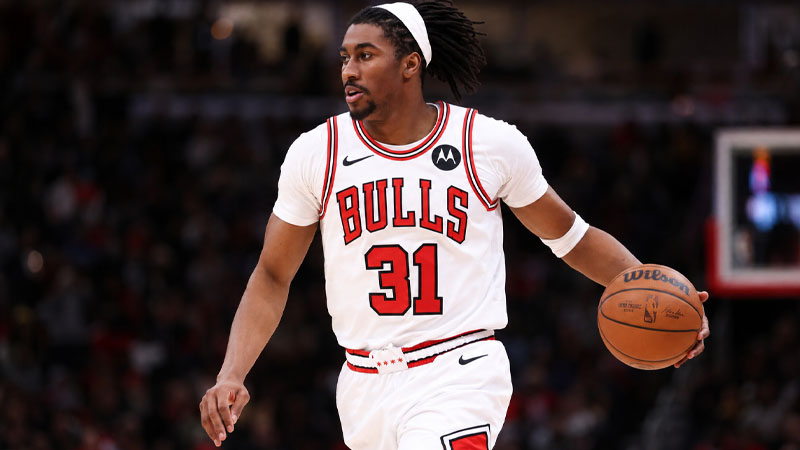
Jaden Ivey’s vertical jump is recorded at a staggering 41.5 inches, a metric that places him among the most explosive guards in professional basketball history.
While he opted out of physical testing at the 2022 NBA Draft Combine, this figure was verified through Purdue University’s internal metrics and closely monitored pre-draft workouts for NBA personnel.
Standing 6’4″ with a 6’9″ wingspan, Ivey combines this elite verticality with a “nuclear” first step, allowing him to dominate the paint and finish above the rim with ease. This jump ranks him in the top 7% of all-time recorded NBA athletes.
What Is the Data Behind Jaden Ivey’s Vertical Jump?
The 41.5-inch maximum vertical jump is the centerpiece of Jaden Ivey’s athletic identity, but understanding its significance requires looking at the broader data set that defines his physical ceiling.
To appreciate how a player of his size can generate such force, we must analyze the relationship between his raw leaping ability and his foundational strength.
The Breakdown of Maximum vs. Standing Vertical
While the 41.5-inch maximum vertical captures the headlines, his standing vertical jump is approximately 36 inches.
The distinction between these two metrics is critical for professional scouts; the standing vertical measures raw power from a stationary position, whereas the maximum vertical accounts for the momentum gained during a “step-in” or a running start.
Ivey’s 5.5-inch increase from a standing start to a maximum leap indicates a highly efficient conversion of horizontal speed into vertical displacement. This efficiency is what allows him to sky over defenders during fast-break opportunities.
Verification and Pre-Draft Testing Context
Because Ivey was a projected top-5 pick in 2022, he chose to skip the physical testing portion of the official NBA Draft Combine.
In professional basketball, elite prospects often skip these sessions to avoid injury or because their athleticism is already “proven” on tape.
However, the 41.5-inch figure is not merely an estimate; it is rooted in internal athletic metrics from Purdue University and verified by NBA personnel during private workouts.
This ensures that the data is anchored in professional-grade measurement standards, confirming his status as a premier athlete in the 2022 draft class.
Comparing Ivey to the NBA Standard and Elite Peers
To understand the rarity of a 41.5-inch leap, one must compare it to the baseline metrics of professional basketball. The average guard in the league possesses significant athleticism, but Ivey exists in a tier that is statistically anomalous.
| Player / Category | Vertical Jump (Inches) | Position |
|---|---|---|
| Jaden Ivey | 41.5″ | Combo Guard |
| Ja Morant | 44.0″ | Point Guard |
| Russell Westbrook | 36.5″ | Point Guard |
| NBA Guard Average | 31.0″ | Point/Shooting Guard |
As shown in the data, the average NBA guard possesses a vertical leap of roughly 30 to 32 inches. Ivey’s mark of 41.5 inches places him 10 inches above the league average, a massive disparity at the professional level.
While he trails generational leapers like Ja Morant, he significantly outpaces elite athletes like Russell Westbrook in terms of pure vertical testing.
This discrepancy illustrates why Ivey is considered a “nuclear” athlete; he is not just fast for a guard, he is vertically dominant in a way that very few players in history have achieved.
The Functional Mechanics of Ivey’s On-Court Flight
In professional basketball, a high vertical jump is only useful if it can be applied during the flow of a game.
Ivey’s athleticism is often described as “functional,” meaning he can access his maximum leaping power in various game situations rather than just in a controlled testing environment.
The Versatility of One and Two-Foot Leaping
A rare trait in Ivey’s profile is his “fluid jumping” ability. Many elite leapers are either “one-foot jumpers” (who need a running start to take off) or “two-foot jumpers” (who need to plant both feet to generate power).
Ivey is a rare hybrid who can explode above the rim with equal force regardless of his footwork.
Whether he is finishing a transition layup off a dead sprint or rising for a contested rebound after a two-foot plant in a crowded paint, his ability to access that 41.5-inch ceiling remains consistent.
Body Control and Mid-Air Adjustments
Beyond the peak height of the jump, Ivey possesses exceptional hang time and body control. This allows him to absorb contact from taller rim protectors, contour his frame in mid-air, and still complete complex finishes.
This “functional” verticality means his jump isn’t just about dunking; it is about creating windows of opportunity to score that are inaccessible to players with average leaping ability.
By staying in the air longer, he forces defenders to commit to their blocks early, allowing him to adjust the ball’s trajectory at the last possible second.
The Impact of the “Nuclear” First Step
Ivey’s vertical is amplified by what scouts call a “nuclear” first step. This refers to his elite horizontal acceleration. Because he can reach his top speed almost instantly, he forces defenders into a retreating position.
Once the defender is off-balance, Ivey’s ability to convert that horizontal momentum into a vertical explosion allows him to turn a standard drive into a high-impact “poster dunk” before the help defense can rotate.
This synergy between speed and leap is the foundation of his offensive pressure.
Analyzing the Full Physical Blueprint of Jaden Ivey
While the vertical jump is the headlining statistic, Ivey’s effectiveness is bolstered by a physical frame that is perfectly suited for the modern guard position. Athleticism in the NBA is a combination of height, reach, and weight, all of which complement his 41.5-inch leap.
Wingspan and Its Role in Two-Way Performance
At 6’4″, Ivey has solid height for a guard, but his 6’9″ wingspan is a significant force multiplier. This long reach allows him to play “taller” than his actual height.
When combined with his vertical jump, this wingspan enables him to execute high-impact defensive plays, such as chase-down blocks that are typically reserved for forwards or centers.
Offensively, the wingspan allows him to finish over the outstretched arms of defenders, effectively increasing the “height” of his 41.5-inch jump.
The Power of a 200-Pound Frame
Weighing in at 200 lbs, Ivey possesses the necessary bulk to withstand the physical nature of professional basketball. This weight is crucial because it provides the “base” from which he generates his explosive power.
A 41.5-inch vertical jump requires immense leg strength and fast-twitch muscle fiber activation. Ivey’s frame is built to handle the torque and impact of landing after high-altitude plays, ensuring that his athleticism remains sustainable over a grueling 82-game season.
Why Ivey’s Athleticism Defined His Draft Value
Leading up to the 2022 NBA Draft, Ivey was widely regarded as the best athlete in his class. His vertical testing confirmed what the game film already suggested: he was a player with an elite physical ceiling.
Matching the Best of the 2022 Draft Class
In the 2022 combine, the highest official maximum vertical leap was recorded by Tennessee guard Kennedy Chandler at 41.5 inches. By matching this mark in his own verified testing, Ivey solidified his status as the pinnacle of his draft class.
This parity with the class’s top tester, despite being significantly larger and heavier than Chandler, highlighted the sheer power Ivey possesses.
The Scouting Perspective on Athletic Ceiling
For NBA front offices, a 41.5-inch vertical is more than just a number; it represents a “margin for error.” Players with Ivey’s level of athleticism can often overcome technical mistakes or poor positioning through sheer physical recovery.
Whether it is recovering to block a shot from behind or leaping to snag a wayward pass, his athletic profile provides a safety net that most guards do not have. This high floor of physical capability is why he was a consensus top-5 pick.
Frequently Asked Questions About Jaden Ivey’s Vertical
How does Jaden Ivey’s vertical compare to the NBA average?
The average NBA guard has a maximum vertical jump between 30 and 32 inches. Jaden Ivey’s 41.5-inch leap is approximately 10 inches higher than the average, placing him in the top 7% of all NBA athletes ever recorded.
Did Jaden Ivey jump at the NBA Combine?
No, Jaden Ivey chose not to perform physical testing at the official NBA Draft Combine. His 41.5-inch vertical jump was instead verified through Purdue University’s internal testing and pre-draft workouts monitored by NBA personnel.
What is Jaden Ivey’s standing vertical jump?
Ivey’s standing vertical jump is approximately 36 inches. This measures his ability to explode from a stationary position without the benefit of a running start.
Who had the highest vertical in the 2022 NBA Draft class?
Jaden Ivey and Kennedy Chandler both shared the top mark of the 2022 class with 41.5-inch maximum vertical jumps. While Chandler set the official combine record, Ivey’s verified data matched that mark exactly.
Conclusion: A Generational Athletic Talent
Jaden Ivey’s 41.5-inch vertical jump is not just a statistic; it is a fundamental component of his impact on the court.
By combining this elite leaping ability with a 6’9″ wingspan and a 200-pound frame, Ivey has established himself as one of the most physically gifted guards in the modern era.
His ability to explode off one or two feet, coupled with his “nuclear” first step, makes him a constant threat to finish above the rim and a highlight-reel defender in transition.
For fans and analysts alike, these metrics provide a window into why Ivey was such a highly-touted prospect.
As he continues to refine his game, his 41.5-inch leap will remain his most potent weapon, allowing him to defy gravity and redefine the expectations for what a 6’4″ guard can achieve on the professional stage.
In a league defined by elite physical tools, Ivey’s vertical profile remains in a class of its own.