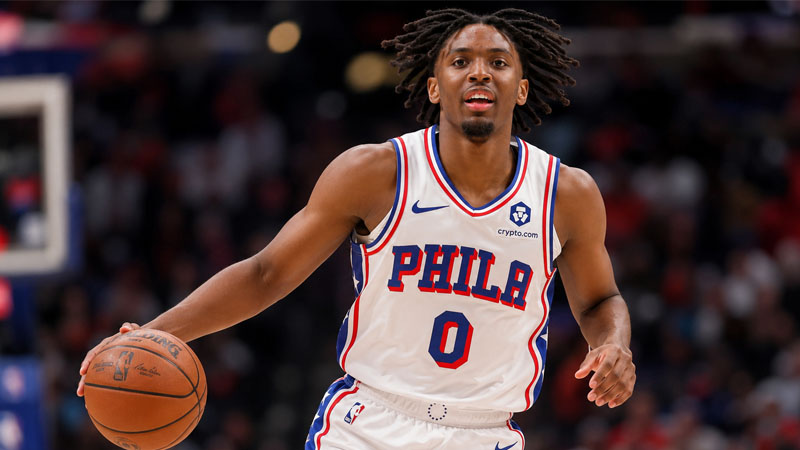
Tyrese Maxey has evolved into a highly competitive and disruptive defender, successfully shedding his early-career reputation as a liability.
Currently, he functions as a legitimate perimeter playmaker for the Philadelphia 76ers, blending elite speed with active hands. In the 2025–26 season, he averaged 1.86 steals and 0.79 blocks, ranking among the top NBA guards for defensive “stocks.”
While his 6-foot-2 height presents inherent physical limitations against larger wings, his rapid progression under head coach Nick Nurse makes him a firmly net-positive asset whose defensive growth is essential to his All-NBA trajectory and overall superstar impact.
The Transformation of a Perimeter Playmaker
The narrative surrounding Tyrese Maxey has shifted dramatically since his entry into the league. Once viewed primarily as an offensive sparkplug who struggled to navigate screens or maintain defensive consistency, Maxey has leveraged his world-class work ethic to become a two-way threat.
This evolution was not accidental but a calculated result of offseason strength training and a tactical shift in how the Philadelphia 76ers utilize his unique athletic profile.
By focusing on “high-event” defense, Maxey has found a way to influence the game even when his elite scoring is not the primary focus.
From Defensive Liability to High-Event Asset
In his initial seasons, Maxey’s defensive impact was often neutral or negative as he adjusted to the speed and physicality of NBA veterans. However, the 2025–26 campaign served as a definitive turning point.
He transformed into a “high-event disruptor,” a player who actively hunts for deflections and uses his recovery speed to erase mistakes.
This transition is reflected in his career-high production of 1.86 steals and 0.79 blocks per game, proving that he can impact the box score on both ends of the floor.
The Influence of the Nick Nurse Defensive System
The arrival of head coach Nick Nurse provided the perfect framework for Maxey’s defensive leap. Nurse’s system prioritizes aggression, ball pressure, and opportunistic gambling in passing lanes.
Under this tutelage, Maxey was encouraged to weaponize his lightning-fast reflexes rather than playing a passive, conservative style.
This aggressive stance has allowed him to lead the 76ers’ fastbreak offense by converting his own steals and blocks into immediate scoring opportunities at the other end.
How Good is Tyrese Maxey’s Defense by the Numbers?
To understand the scope of Maxey’s improvement, one must look at the advanced metrics that track his efficiency and impact.
While individual defensive ratings can sometimes be influenced by team performance, Maxey’s year-over-year trajectory shows a player who is consistently becoming more effective at containing opponents and creating turnovers.
The data indicates that the 76ers operate at a significantly higher defensive baseline when Maxey is fully engaged as a primary disruptor.
| NBA Season | Defensive Rating (DRtg) | Steals Per Game | Blocks Per Game | Role Description |
|---|---|---|---|---|
| 2025–26 | 115.7 | 1.86 | 0.79 | Primary Star / High-Event Disruptor |
| 2024–25 | 119.4 | 1.75 | 0.40 | Injured Lineups / Fragmented Core |
| 2023–24 | 116.2 | 0.99 | 0.47 | Full-Time Lead Guard Transition |
| 2022–23 | 116.2 | 0.82 | 0.13 | Off-Ball Guard (with James Harden) |
| 2021–22 | 116.2 | 0.73 | 0.43 | Rising Starter |
| 2020–21 | 110.8 | 0.43 | 0.21 | Rookie Season |
The Physical Blueprint: Leveraging Speed and Length
Despite being undersized by modern NBA standards for a wing, Maxey possesses a physical profile that allows him to play “bigger” than his 6-foot-2 frame suggests.
His success as a defender is rooted in his ability to combine a sturdy 200-pound build with elite lateral quickness.
This combination makes it difficult for opposing guards to simply “bully” him on the perimeter, as he has the functional strength to absorb contact and hold his ground during drives to the basket.
The Advantage of a Plus-Five Wingspan
One of the most underrated aspects of Maxey’s defensive toolkit is his 6-foot-7 wingspan. This represents a “plus-five” reach relative to his standing height, allowing him to contest shots and poke away dribbles that opponents assume are out of his range.
This length is particularly effective when he is trailing a play or closing out on shooters, as it provides a wider margin for error when he is slightly out of position.
It is this wingspan that fuels his high “stocks” (steals + blocks) production, placing him near the top of all NBA guards in these categories.
Elite Recovery Speed and Chase-Down Blocks
Maxey is widely considered one of the fastest players in basketball, and this speed is his greatest defensive equalizer. He excels at the “chase-down,” using his burst to track down opponents in transition and block shots from behind.
This ability to recover after a screen or a blown rotation ensures that he is never truly out of a play. His league-leading recovery speed allows the 76ers to play a more aggressive front-line defense, knowing that Maxey can sprint back to cover ground if the initial pressure is bypassed.
Fighting Through the Screen Navigation
Modern NBA offenses rely heavily on the pick-and-roll to create mismatches, but Maxey has become adept at fighting through these screens.
Rather than conceding an immediate switch and leaving a big man on an island against a guard, Maxey uses his lower-body strength to stay attached to his primary assignment.
This tenacity limits the number of “easy” shots opponents get through simple screening actions and forces teams to work deeper into the shot clock to find a viable opening.
Examining the Challenges and Situational Limitations
While the growth is undeniable, no player is without flaws, and Maxey’s defensive profile is still subject to the realities of his physical stature and his massive offensive responsibilities.
He is a “good” defender within the context of his role, but he is not a “shutdown” isolation defender in the mold of a larger wing. Understanding these limitations is key to appreciating how the 76ers hide his weaknesses and maximize his playmaking strengths.
The Physics of Size Mismatches
At 6-foot-2, Maxey faces unavoidable challenges when switched onto elite, physical forwards or “jumbo” guards. In isolation settings, larger scorers can often shoot directly over his maximum contest, regardless of how well he times his jump.
This makes him vulnerable in late-game situations where teams hunt for mismatches to exploit height advantages. While his 6-foot-7 wingspan helps, it cannot entirely negate the three-to-four-inch height deficit he faces against many of the league’s top wings.
The “Energy Tax” of a Superstar Workload
Maxey is a foundational offensive piece, averaging 28.3 points and 38.0 minutes per game during his All-NBA Third Team campaign.
Carrying such an immense offensive load creates a physical “energy tax” that makes it nearly impossible to maintain 100% defensive intensity on every single possession.
There are moments where he must prioritize staying on the floor and leading the offense, which can lead to occasional lapses in off-ball awareness or perimeter containment.
The Risks of High-Volume Gambling
Because the current defensive system encourages him to be a disruptor, Maxey occasionally takes high-risk angles to jump passing lanes.
When these gambles succeed, they result in spectacular dunks and momentum shifts; however, when they fail, it leaves the 76ers’ backline defense vulnerable.
If Maxey gets caught out of position, the rim protectors are forced to collapse, often leading to open corner threes for the opposition. Balancing this aggression with disciplined positioning remains an ongoing area of focus for his development.
FAQ: Deep Dive into Maxey’s Comparative Value
Is Tyrese Maxey better than Jalen Brunson?
This is a frequent debate among fans looking at elite Eastern Conference guards. While both are offensive powerhouses, Maxey’s defensive “event creation”—specifically his ability to generate blocks and steals at a high rate—gives him a different utility on the defensive end.
Maxey’s superior speed and length typically allow him to be a more disruptive force in passing lanes, whereas Brunson often relies on positioning and taking charges.
Is Tyrese Maxey a top 10 player in the NBA?
With career totals exceeding 8,000 points and a trophy case featuring Most Improved Player and All-NBA honors, Maxey is firmly in the conversation for elite status. His leap to becoming a net-positive defender is the final piece of that puzzle.
If he continues to average near 2 steals and 1 block per game while scoring at a superstar clip, his “two-way” impact will make him a perennial candidate for top 10 consideration.
Conclusion: The Verdict on Maxey’s Defensive Identity
Tyrese Maxey is no longer a player that opposing offenses can simply “target” in a playoff series. He has transformed himself into a disruptive, high-motor defender who weaponizes his elite speed and surprising length to create chaos.
While he will likely always be limited by his 6-foot-2 frame in certain switch situations, his ability to generate “stocks” and fuel the transition game makes him an invaluable asset to a championship-caliber roster.
As he enters the prime of his career with over 388 regular-season games of experience, his defensive evolution serves as a testament to his professional growth.
Maxey has proven that with the right coaching and physical conditioning, an offensive superstar can also be a meaningful contributor on the defensive end.
For the Philadelphia 76ers, Maxey is not just a scorer; he is a two-way foundational piece who continues to defy expectations.