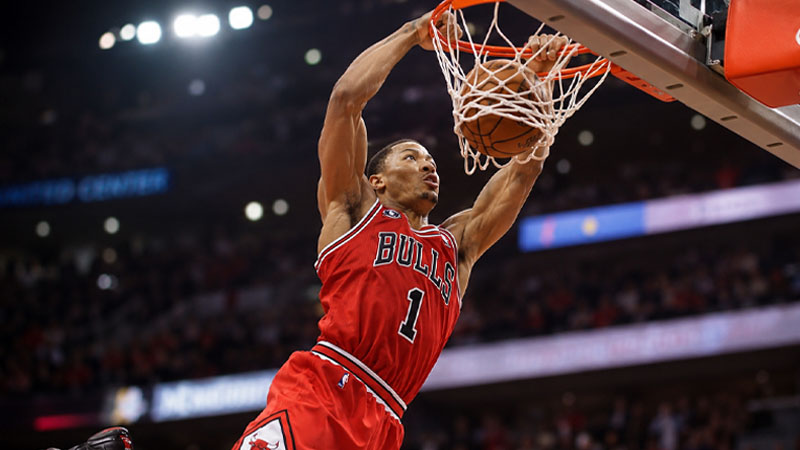
Derrick Rose stopped dunking to preserve his career following a series of devastating knee injuries, including a 2012 ACL tear and subsequent meniscus surgeries.
By eliminating high-impact plays, he successfully transformed from the league’s most explosive athlete into a disciplined, high-IQ veteran. This strategic shift allowed him to extend his professional tenure to 16 seasons, retiring in September 2024.
Instead of relying on a 40-inch vertical, Rose mastered below-the-rim finishes like floaters and improved his outside shooting.
Ultimately, his decision to stop dunking was a “business decision” focused on energy management and protecting his long-term physical health.
The Anatomy of the NBA’s Most Explosive Point Guard
During his ascent with the Chicago Bulls, Rose redefined the physical expectations of the point guard position through a combination of elite verticality and unprecedented horizontal speed.
His game was built on a foundation of raw, violent athleticism that pressured defenses from the moment he crossed half-court.
Unprecedented Vertical and Horizontal Power
The physical metrics recorded during his prime remain some of the most impressive in professional basketball history. Standing at 6-foot-3, Rose possessed an official 40-inch vertical leap, with some game-condition estimates suggesting he could reach as high as 42 inches.
This verticality allowed him to achieve a maximum rim reach of over 11 feet 6 inches, effectively neutralizing the height advantage of elite centers.
Furthermore, his speed was recorded at a baseline-to-baseline sprint of just 3.05 seconds. This velocity allowed him to generate massive horizontal momentum, which he would then convert into explosive upward launches that few defenders could track.
The Technical Signatures of the Two-Handed Back-Clutch
Unlike traditional guards who utilized finesse, Rose approached the rim with an aggressive, technical mindset. His signature move, the two-handed back-clutch, involved exploding off two feet and cocking the ball entirely behind his head to shield it from shot-blockers.
He rarely jumped off a single-leg stride, preferring a two-foot launch that allowed him to absorb mid-air contact while maintaining his balance and power.
To avoid rim protectors, he would frequently execute violent mid-air twists, contorting his torso up to 180 degrees to finish reverse dunks with overwhelming force.
The Biomechanical Blueprint of a Physical Decline
While his explosive style captivated audiences, the very mechanics that made him spectacular were contributing to a mounting structural toll on his lower extremities.
Sports scientists later identified specific movement patterns that made his “Air” era playstyle inherently unsustainable over a long-term horizon.
The Critical Error of Single-Leg Landing
A primary catalyst for his injury history was a recurring biomechanical flaw: landing hard on a single, locked leg. After soaring for rim-rocking dunks, Rose frequently failed to absorb the impact across both feet, instead placing the full force of his momentum on a single joint.
This structural stress, combined with the violent changes of direction required by his playstyle, was a major factor in his catastrophic 2012 ACL tear.
The landing impact was described as a “bad habit” that put extreme pressure on his knees, eventually necessitating two separate meniscus surgeries in the years following his initial recovery.
Managing the Cumulative Toll of Chronic Inflammation
As his career progressed, the physical cost of explosive leaping became a barrier to consistent availability. Beyond the major surgeries, Rose dealt with chronic back and ankle issues that required a shift in energy management.
He eventually admitted that the exertion required for breakaway slams took an immense physical toll that hindered his effectiveness in other areas of the game.
To stay on the court, he had to prioritize his health over the fans’ desire for highlights, recognizing that every high-impact landing was a risk to his career longevity.
Why Derrick Rose Stopped Dunking: Key Strategic Factors
The decision to move away from his hallmark athleticism was not a failure of ability, but a calculated business decision aimed at professional survival. The following table illustrates the stark contrast between his early-career output and his veteran adaptation.
| Career Phase | Dunk Statistics & Usage | Primary Finishing Technique | Physical Focus |
|---|---|---|---|
| Peak Years (2008–2012) | 121 Regular Season Dunks | Aggressive two-handed slams and posters | Raw power and maximum verticality |
| Veteran Years (2013–2024) | 12 Regular Season Dunks | High-arcing floaters and layups | Joint preservation and energy management |
| Transition Logic | 90% reduction in dunking volume | Elimination of high-impact landings | Mastering “below-the-rim” efficiency |
Transitioning from Raw Power to Calculated Preservation
Following his retirement in 2024, it became clear that his transformation was a masterclass in athletic adaptation.
By intentionally suppressing his urge to dunk, Rose was able to prolong his tenure in the league to 16 years, a feat many thought impossible after his third knee surgery.
Mastering the High-Arcing Floater
To replace the points he once generated at the rim, Rose developed one of the most effective floaters in the history of the game.
These “teardrops” allowed him to finish over much taller rim protectors without needing to jump more than a few inches off the ground.
By using touch and arc rather than raw verticality, he removed the need for the dangerous high-impact landings that had previously threatened his knees.
He famously stated in 2021 that his floaters were the only “vintage” part of his game remaining, signaling his complete acceptance of this new offensive identity.
Redefining Value Through Perimeter Shooting
Another pillar of his reinvention was a significant improvement in his outside shooting. Early in his career, Rose was criticized for his inconsistent jumper, but as he aged, he developed a fluid shooting motion that required less leg lift.
This evolution led him to set career highs in three-point percentages during his later years with the Detroit Pistons and New York Knicks.
By becoming a perimeter threat, he forced defenders to close out on him, which opened up driving lanes that he could exploit with craftiness and speed changes rather than vertical force.
Strategic Energy Conservation and Playmaking
Rose transitioned from a primary scoring engine into a high-IQ playmaker who understood the nuances of the pick-and-roll.
He mastered the art of “feints”—using changes in speed and direction to manipulate defenders rather than simply trying to out-sprint them in a straight line.
This shift in energy management allowed him to remain effective during the half-court phase of the game, preserving his stamina for late-game situations rather than wasting it on transition dunks that provided little statistical advantage over a simple layup.
Closing the Circle: The Final Career Highlights
Even as he embraced a below-the-rim game, there were rare moments when Rose reminded the world of his former flight.
These final dunks were significantly different in character than the “violent” slams of his youth, serving as markers of his journey from a superstar athlete to a respected veteran.
The Sparse Transition Slams of the 2020s
Between 2013 and 2024, Rose recorded only 12 official dunks, a tiny fraction of the 121 he threw down in his first four seasons. These rare highlights typically occurred during wide-open fast breaks where he could control his approach and landing entirely.
During his resurgence as an elite bench contributor for the Pistons and Knicks, these slams were strictly effortless, two-handed transition buckets designed for safety rather than spectacle.
They represented a disciplined athlete who only used his “turbo” button when the risk to his joints was at its absolute minimum.
A Poetic Farewell to the United Center
One of the most emotional moments of his later career occurred during a return to Chicago as a visiting player. Finding himself on a breakaway in the United Center, Rose chose to elevate for a smooth, safe, two-handed dunk.
It was the last time he would ever dunk a basketball in the city where his career began, effectively bringing his professional arc full-circle.
This dunk was not a display of dominance, but a nostalgic nod to the fans who had witnessed his rise, executed with the careful mechanics of a man who had learned the value of preservation.
Frequently Asked Questions Regarding the Legacy of Derrick Rose
Why did Derrick Rose stop dunking?
He stopped dunking to protect his knees after suffering a torn ACL and multiple meniscus tears. He also realized that his early-career habit of landing on one leg with locked knees was physically unsustainable and made a “business decision” to transition to layups and floaters to extend his career.
When was Derrick Rose’s last dunk?
His final regular-season dunks occurred in the early 2020s while playing for the Detroit Pistons and New York Knicks. His last dunk in Chicago was a particularly significant moment, occurring on a breakaway during a return visit to his original home arena.
What are the statistical differences in his dunking volume?
In his first four seasons, Rose recorded 121 dunks. Over the remaining 12 years of his career, he recorded only 12 total dunks, highlighting the drastic shift in his offensive philosophy.
How did he change his game to stay in the NBA?
Rose evolved by mastering the “teardrop” floater, improving his three-point shooting, and using strategic feints in the pick-and-roll rather than relying on pure speed. This transition allowed him to play 723 career games despite his injury history.
Did Derrick Rose ever address the “vintage” comments from fans?
Yes, in 2021, he released a statement asking fans to stop calling him “vintage” because he had worked for a decade to reinvent himself. He noted that only his floaters were “vintage,” while the rest of his game was a result of athletic maturity and the humility to change.
The Final Verdict on a Career of Transformation
Derrick Rose’s legacy is defined by more than just his 2011 MVP trophy or his 40-inch vertical. It is defined by his resilience and the intelligence required to abandon the very skill that made him a global icon in order to continue his journey.
By choosing “Earth” over “Air,” Rose provided a blueprint for future athletes on how to navigate catastrophic injuries.
His 16-year career is a testament to the fact that while raw athleticism is a gift, the ability to adapt and reinvent oneself is a true professional masterpiece.