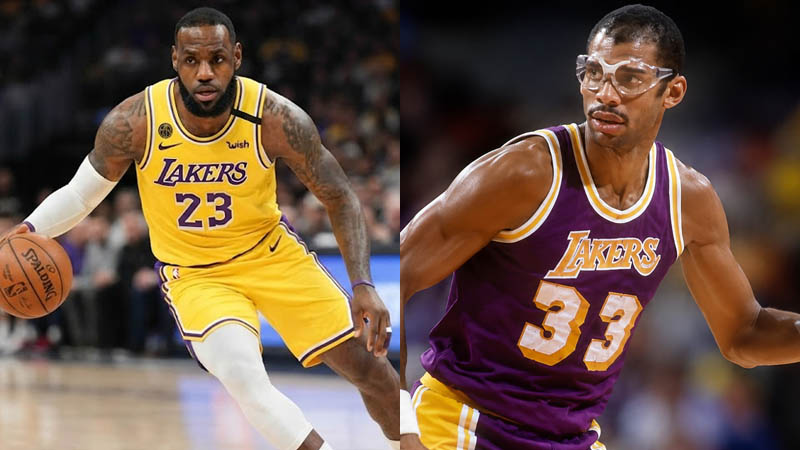
LeBron James has officially passed Kareem Abdul-Jabbar across all major career benchmarks, completing a statistical takeover once thought impossible.
While the scoring record fell on February 7, 2023, the final significant hurdle—the all-time field goals made record—was surpassed on March 5, 2026. LeBron now leads in total points (43,440+), total wins (1,229+), and total minutes played.
He currently holds a lead of over 5,000 career points. While Kareem maintains historical advantages in blocks and rebounds, LeBron has cemented his status as the most prolific statistical force in professional basketball history.
When Did LeBron James Pass the Scoring Record?
The journey to the top of the scoring mountain reached its apex on February 7, 2023, a date that reconfigured the league’s history books.
Facing the Oklahoma City Thunder, LeBron James used a signature fadeaway jumper to surpass the 38,387-point mark that Kareem Abdul-Jabbar had held for nearly 39 years.
This moment was not just about a single game but the culmination of two decades of elite performance. Since that historic night, James has not slowed down, pushing his regular-season total past 43,440 points as of July 2026.
By maintaining an All-Star level of production well into his 40s, James has widened the gap between himself and the retired Abdul-Jabbar to a staggering 5,053 points. This cushion ensures that the record will likely remain untouched for several generations, much like Kareem’s previous reign.
The significance of this achievement lies in the context of Kareem’s own takeover; he had held the title of scoring king since April 1984, when he originally moved past Wilt Chamberlain.
How Many Field Goals Does LeBron James Have Compared to Kareem?
While the scoring title was secured in 2023, the record for most career field goals made—the actual number of times a player puts the ball in the basket—remained in Abdul-Jabbar’s hands for three additional years.
On March 5, 2026, during a game against the Denver Nuggets, LeBron James hit a turnaround baseline jumper over Zeke Nnaji to record his 15,838th made bucket. This shot officially moved him past Kareem’s long-standing total of 15,837 made field goals.
| Statistical Category | LeBron James | Kareem Abdul-Jabbar | Margin of Difference |
|---|---|---|---|
| Total Points | 43,440 | 38,387 | +5,053 (LeBron) |
| Field Goals Made | 15,860 | 15,837 | +23 (LeBron) |
| 3-Pointers Made | 2,648 | 1 | +2,647 (LeBron) |
| Minutes Played | 58,421 | 57,446 | +975 (LeBron) |
| Total Assists | 11,438 | 5,660 | +5,778 (LeBron) |
| Total Steals | 2,330 | 1,160 | +1,170 (LeBron) |
| Total Blocks | 1,146 | 3,189 | +2,043 (Kareem) |
| Total Rebounds | 11,544 | 17,440 | +5,896 (Kareem) |
Why Did the Field Goal Record Take Longer to Break?
The three-year disparity between LeBron breaking the scoring record (2023) and the field goal record (2026) serves as a fascinating case study in the evolution of professional basketball.
Underneath the raw totals, the methodology of scoring has shifted dramatically between the 1970s and the 2020s.
The Impact of the Three-Point Line
The primary reason James reached the scoring summit before the field goal summit is the three-point shot.
Kareem Abdul-Jabbar played in an era where the three-pointer was either non-existent or a peripheral part of the game; he famously finished his legendary career with only one made three-point shot.
In contrast, LeBron James has integrated the long ball into his offensive repertoire, accumulating over 2,600 career three-pointers.
Because each of these shots is worth 50% more than a standard basket, James was able to pile up points much faster than Abdul-Jabbar despite having fewer total made field goals for many years.
Free Throw Frequency and Game Style
Another contributing factor to the timing of these records was the frequency of free throws. Throughout his career, LeBron has consistently drawn fouls and reached the charity stripe at a higher rate than Abdul-Jabbar.
By securing 4,724 more career points than Kareem while still trailing in made field goals as of early 2026, James demonstrated how modern efficiency—combining perimeter shooting with aggressive drives to the rim—optimizes point production.
This evolution highlights the different physical demands of the two legends: Kareem’s dominance was defined by the interior skyhook, while LeBron’s legacy is built on multi-dimensional perimeter versatility.
Is Lebron James Now the All-Time Leader in Wins?
Yes, LeBron James has eclipsed Abdul-Jabbar to become the winningest player in the history of the league when combining regular-season and playoff successes.
This milestone was reached on March 31, 2026, when James earned his 1,229th total victory, officially breaking Kareem’s historical wins benchmark.
A Journey of Unprecedented Longevity
Achieving the most wins in history requires more than just being a great player; it requires being a great player on competitive teams for over two decades. James has now played 23 professional seasons, surpassing Kareem’s 20-season marathon.
This longevity has allowed him to accumulate a massive volume of “Win Shares,” a metric where he also took the all-time lead from Abdul-Jabbar in early 2026.
The Milestone of 60,000 Minutes
Physical durability is perhaps the most impressive aspect of this statistical takeover. In January 2026, LeBron became the first player in history to surpass 60,000 regular-season minutes.
When you combine regular-season and playoff action, James had already overtaken Kareem for the total minutes landmark back in November 2023. This incredible workload has not resulted in the typical “washed” phase seen in other legends.
At age 41, James continued to produce All-Star numbers, averaging roughly 22 points, 6 rebounds, and 7 assists per game on 50% shooting—stats that many players fail to reach in their physical prime.
Side-by-Side: All-Time Accolades and Impact
When moving beyond the raw counting statistics, the comparison between these two icons remains remarkably close, though their dominance manifested in different ways.
Abdul-Jabbar’s era was defined by individual MVP dominance and defensive rim protection, while James has defined the era of the elite “point-forward” and sustained peak performance.
Championship and MVP Totals
Kareem Abdul-Jabbar still holds the edge in traditional MVP awards, with six regular-season MVPs compared to LeBron’s four. Kareem also maintains a lead in total championships, with six rings to LeBron’s four.
However, James has the advantage in Finals MVPs (4 to 2) and has more All-Star selections (22 to 19) and All-NBA Team selections (21 to 15), illustrating a longer window of being the definitive best player in the world.
Defensive and Specialized Roles
The statistical comparison also highlights the specific roles these players occupied. Kareem was a traditional center and remains the superior interior force, holding massive leads in blocks (3,189 to 1,146) and total rebounds (17,440 to 11,544).
Conversely, LeBron’s role as a primary playmaker and perimeter defender gives him the lead in assists (11,438 to 5,660) and steals (2,330 to 1,160).
Frequently Asked Questions About the LeBron-Kareem Records
Did LeBron skip college to get these records?
Yes, one of the primary “traditional insights” often discussed by fans is that Kareem Abdul-Jabbar played four years of college basketball at UCLA before entering the professional ranks. LeBron James entered the league directly from high school.
This gave LeBron a four-year head start in accumulating professional statistics, though he has now played three more total professional seasons than Kareem (23 to 20) to fully secure these records.
How does LeBron’s 40-year-old season compare to other greats?
LeBron’s longevity is statistically an anomaly. For example, in his age-41 season, James recorded more dunks than Kobe Bryant did in his final four professional seasons combined.
His ability to maintain a high field goal percentage (50.7% career) while transitioning from a power-based game to a more perimeter-oriented style is a testament to his adaptability.
Are there any records Kareem still holds?
Kareem Abdul-Jabbar remains the historical leader in total rebounds and blocked shots. Additionally, he holds the record for most regular-season MVP awards.
While LeBron has surpassed him in scoring, wins, minutes, and field goals, Kareem’s defensive legacy as a premier rim protector remains statistically superior.
What was the final shot that broke the field goal record?
LeBron James broke the record on March 5, 2026, with a turnaround baseline jumper over Denver Nuggets player Zeke Nnaji. This was his 15,838th made field goal.
Conclusion: A Legacy Defined by Unmatched Productivity
The transition of LeBron James from a “chaser” to the holder of almost every major statistical record marks a new era in basketball history.
By systematically removing Kareem Abdul-Jabbar from the top spot in scoring, field goals, minutes, and wins, James has redefined the expectations for professional longevity.
While the debate over the greatest player of all time will always include personal preferences for style—such as Kareem’s unstoppable skyhook—the raw data now presents a clear picture of James as the most productive player to ever step onto the court.
He has not just passed Kareem; he has established a new statistical baseline that may never be challenged again.