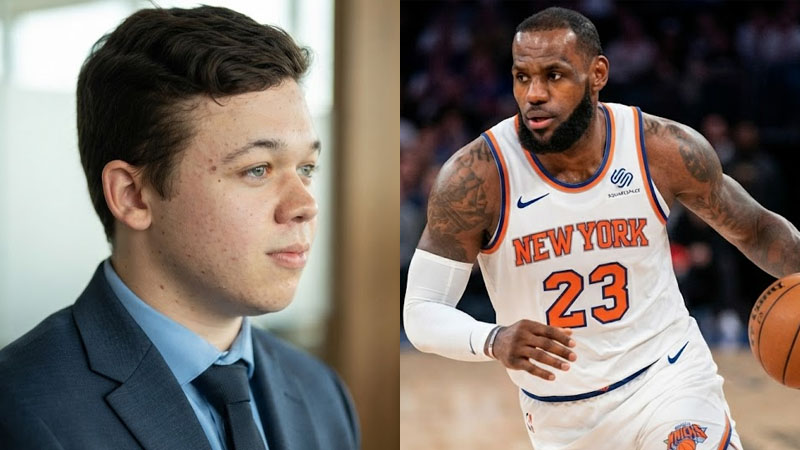
Kyle Rittenhouse is not currently suing LeBron James, and no court has ever awarded him damages against the NBA star.
Viral social media claims stating a federal magistrate approved a $110 million defamation suit are entirely false, having originated from a satire website.
While Rittenhouse publicly threatened legal action following mocking comments James made during the 2021 trial, no official lawsuit was ever filed in any court.
The persistent rumors remain an artifact of internet misinformation, fueled by satirical headlines that were mistakenly shared as legitimate breaking news by social media users.
Why is Kyle Rittenhouse Suing LeBron James? Fact vs. Fiction
The question of why Rittenhouse is pursuing legal action against the professional athlete is based on a fundamental misunderstanding of current legal events.
While there is a documented history of friction between the two individuals, the narrative of an active, multimillion-dollar lawsuit is a complete fabrication.
To understand how this rumor gained such immense traction, one must look at the intersection of satirical internet culture and the high-speed nature of social media reporting.
The Satirical Origins of the $110 Million Claim
The specific figure of $110 million and the claim of a “federal magistrate’s approval” did not come from a legal filing or a legitimate news organization.
Instead, these details originated on a website known for publishing fictional content under the guise of news. This platform explicitly states on its “about” page that everything it publishes is fiction.
Despite this disclaimer, screenshots of the headline were shared tens of thousands of times across Facebook, X, and TikTok, where audiences frequently engaged with the content as if it were a factual report.
Official Denials from the Rittenhouse Legal Team
In the wake of the viral spread of these claims, official representatives for the Rittenhouse family were forced to issue public clarifications. A spokesperson for the family explicitly stated that the rumors were “absolutely not true”.
At the time the rumors first peaked, the legal team confirmed that no legal actions had been taken against any specific organization or person, including the Los Angeles Lakers star.
This lack of filing remains the status quo, as no court records exist to support the idea that a defamation case was ever initiated.
The Origin of the Conflict: The “Lemon Heads” Incident
To understand why the public so easily believed a lawsuit was happening, it is necessary to examine the genuine animosity that developed during Rittenhouse’s 2021 homicide trial.
The tension began when the athlete utilized his massive social media platform to comment on Rittenhouse’s emotional state during his testimony.
This single post created a rift that Rittenhouse and his supporters would later cite as grounds for a potential legal challenge.
LeBron James’s Controversial 2021 Tweet
During the trial for the Kenosha, Wisconsin shootings, Rittenhouse broke down in tears while testifying on the witness stand. In response, James posted a mocking message on X (formerly Twitter) suggesting the emotional display was a performance.
The athlete wrote, “What tears????? I didn’t see one. Man knock it off! That boy ate some lemon heads before walking into court”.
This implication—that Rittenhouse used sour candy to induce tears—went heavily viral, accumulating millions of views almost instantly.
Rittenhouse’s Emotional and Public Response
Following his acquittal on all charges, Rittenhouse addressed the tweet during various media appearances, expressing deep personal disappointment.
He noted that he had previously been a fan of the basketball player, but the mocking comments during his trial changed his perspective entirely.
In a televised interview, he reacted with significant hostility, making it clear that the athlete’s comments had caused lasting resentment.
This public display of anger provided the perfect backdrop for misinformation creators to craft a story about an impending legal battle.
The Role of the Media Accountability Project (TMAP)
While the $110 million lawsuit was a hoax, Rittenhouse did take concrete steps to organize a legal front against his critics.
He used his platform to announce the creation of an initiative specifically designed to hold media outlets and celebrities accountable for what he termed “lies”.
This project became the primary vehicle through which he issued threats of litigation, further blurring the lines between actual lawsuits and public relations campaigns.
Fundraising for Future Litigation
In early 2022, Rittenhouse appeared on national television to announce the launch of the Media Accountability Project.
The primary goal of this organization was to raise funds to support potential defamation lawsuits against those who labeled him a “murderer” or a “white supremacist” despite his acquittal.
By framing his legal strategy as a fundraising effort, he was able to maintain public interest and financial support from his base, even without filing actual paperwork in court.
Identifying Potential Targets in the Media
During his media tour for the new project, Rittenhouse mentioned several high-profile individuals who were on his “list” for potential legal action.
He specifically named television hosts and even the President of the United States as people his team was looking at. In these interviews, he claimed that LeBron James would definitely be “getting a letter” of intent to sue.
These public statements were often misinterpreted by the public as the beginning of a formal legal filing, though “getting a letter” is a far cry from a court-approved judgment.
Why a Defamation Lawsuit Faces Extreme Legal Hurdles
Despite the public bravado surrounding the potential for a lawsuit, legal experts have consistently pointed out that such a case would likely fail in a court of law. Defamation, especially involving public figures, requires a very specific set of criteria that are difficult to satisfy.
The following table outlines the primary legal elements and the specific hurdles Rittenhouse would face in a hypothetical case against the athlete:
| Legal Element | Hurdles in a Potential Defamation Case |
|---|---|
| Defamation Standard | To win, the plaintiff must prove a false statement of fact was made. Calling tears “fake” or “lemon heads” is generally viewed as protected opinion or hyperbole. |
| Public Figure Status | As a prominent figure in a national trial, Rittenhouse must prove “actual malice.” This requires showing the defendant knew the statement was false. |
| Measurable Damages | The plaintiff must demonstrate specific financial or reputational harm caused directly by the tweet, separate from general media coverage. |
| Protected Speech | Courts protect the right of individuals to express skepticism or mockery regarding public events, especially in the context of social media. |
The Distinction Between Fact and Protected Opinion
A core tenet of defamation law is that the statement in question must be a provable false statement of fact. Legally, expressing the opinion that someone is “fake crying” or “acting” is not the same as accusing them of a specific crime.
Because the athlete’s tweet was a form of mockery and skepticism regarding an emotional display, it falls under the umbrella of protected speech.
A judge would likely view the “lemon heads” comment as a rhetorical flourish rather than a factual claim that Rittenhouse had smuggled candy into the courtroom.
The Burden of Proving Actual Malice
Because Rittenhouse became a highly prominent public figure during his trial, the legal bar for defamation is significantly higher for him than it would be for a private citizen.
His legal team would have to prove “actual malice,” meaning they would need evidence that James knew the tears were real and deliberately lied about them to cause harm.
Proving the internal thoughts and motivations of a person at the time they posted a tweet is an almost impossible standard to meet in a courtroom setting.
How Satire and Misinformation Fueled the Narrative
The case of the Rittenhouse and James “lawsuit” serves as a textbook example of how modern misinformation cycles operate.
It highlights a process where a fictional story is created for entertainment or satire but is then stripped of its context as it moves across various social media ecosystems. This section explores the mechanics of how the hoax was amplified to a global audience.
The Role of Fictional News Networks
The rumor didn’t just appear out of nowhere; it was a deliberate creation of a network of websites that specialize in “parody” and satirical content. These sites often use sensational headlines involving controversial figures to drive traffic.
While the creators may argue they are providing entertainment, the lack of media literacy among many internet users means these stories are frequently taken at face value.
Once the story moves from the original site to a screenshot on a social media platform, the satirical context is completely lost.
Social Media Amplification and the Feedback Loop
Once the hoax was posted to social media, it was picked up by users who wanted the story to be true. This created a feedback loop where the more a claim was shared, the more legitimate it appeared to casual observers.
Even after legitimate news organizations and fact-checkers published debunking articles, the original fake headline continued to circulate. This persistent nature of digital rumors is why, years later, people still search for the status of a lawsuit that never existed.
Frequently Asked Questions About the LeBron James Rumors
Has Kyle Rittenhouse won a $110 million judgment?
No. No court has ever awarded Rittenhouse any amount of money from LeBron James.
Is there an active lawsuit between the two?
No official defamation lawsuit has been filed by Rittenhouse against the athlete.
What was the “Media Accountability Project”?
It was an initiative launched by Rittenhouse to fundraise for potential lawsuits, though it did not result in a filing against James.
Why did LeBron James mock Rittenhouse?
James posted a tweet during the trial suggesting Rittenhouse was faking his tears while testifying.
Who confirmed the lawsuit was a hoax?
Rittenhouse’s own spokesperson and various independent news organizations confirmed no legal action was taken.
Conclusion: The Reality of the Legal Situation
The narrative surrounding a legal battle between Kyle Rittenhouse and LeBron James is a prime example of the “defamation hoax” phenomenon. While there was real-world tension and public threats of litigation, the actual courtroom reality is that no such case exists.
Rittenhouse used the athlete’s comments to fuel a fundraising and media campaign, but the steep legal hurdles associated with defamation and the protection of opinion-based speech prevented any formal filing from moving forward.
As of now, the $110 million lawsuit remains entirely a work of internet fiction.