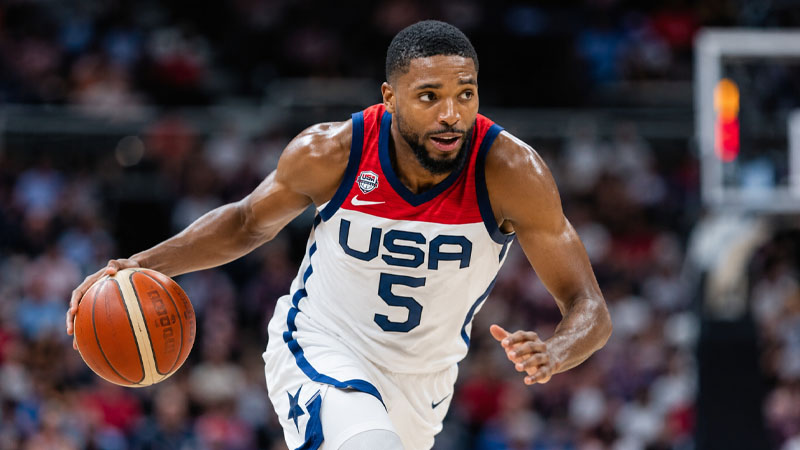
The Philadelphia 76ers traded Mikal Bridges to the Phoenix Suns during the 2018 NBA Draft to prioritize asset accumulation and “star-hunting” strategies.
Despite selecting Bridges 10th overall, the front office, led by interim GM Brett Brown, moved him for the 16th pick, Zhaire Smith, and a highly coveted 2021 unprotected first-round pick from Miami.
This decision was driven by internal scouting that placed Smith and Bridges in the same talent tier.
Philadelphia intended to use the additional first-round pick as leverage in a blockbuster trade for an established superstar, viewing the extra asset as more valuable than Bridges.
Why did the Sixers trade Mikal Bridges on Draft Night?
The decision to move Mikal Bridges remains one of the most debated moments in the modern era of the Philadelphia 76ers.
While Bridges was a local favorite who had just won two national championships at Villanova, the team’s leadership was operating under a philosophy that prioritized high-end assets over immediate roster fit.
The trade was not a spur-of-the-moment lapse in judgment but a calculated move based on the team’s long-term championship window and the perceived value of future draft capital.
Prioritizing Asset Accumulation and Talent Tiers
The primary driver for the trade was the 76ers’ internal scouting board. Interim General Manager Brett Brown and the front office had Mikal Bridges and Zhaire Smith graded in the same talent tier, often referred to as “1A and 1B”.
Because the organization viewed both players as having similar professional potential, they believed it was a logical business move to trade down six spots to acquire Smith while also gaining a premium future asset.
At the time, Smith was viewed as a high-upside, raw prospect compared to Bridges’ high-floor, 3&D profile.
The Search for a Third Maximum-Contract Star
In 2018, the 76ers were focused on “star-hunting,” a term explicitly used by Brett Brown to describe their pursuit of a third superstar to pair with Joel Embiid and Ben Simmons.
The front office believed that an unprotected first-round pick from the Miami Heat was the exact kind of “blue chip” asset needed to pry a superstar like Kawhi Leonard or LeBron James away from their respective situations.
By choosing the pick over the player, Philadelphia was betting that the flexibility to trade for an MVP-level talent outweighed the benefits of keeping a high-quality role player.
Analyzing the Value of the 2021 Miami First-Round Pick
The centerpiece of the transaction for Philadelphia was the 2021 unprotected first-round pick originally belonging to the Miami Heat. In the landscape of NBA trades, unprotected picks are exceptionally rare and carry immense weight in negotiations.
At the time of the trade, there was a widespread belief that the Heat might struggle by 2021, potentially making the pick a lottery selection.
Furthermore, many league insiders speculated that 2021 would be the “double draft” year where high school players were once again eligible, further inflating the pick’s perceived value.
| Asset Component | Original Value Perception | Final Outcome |
|---|---|---|
| Zhaire Smith (Pick 16) | High-upside “Kawhi-like” prospect | Played 13 games; career ended by health crisis |
| Miami 2021 1st (Unprotected) | Premium trade chip for an MVP star | Traded for Tobias Harris; became pick #18 |
| Roster Flexibility | Necessary to land Leonard or James | Used to acquire Harris and Jimmy Butler later |
Why Unprotected Picks are Premium Commodities
Unprotected picks provide a team with a “lottery ticket” that has no ceiling. Unlike protected picks that might convert into second-rounders or late first-rounders if a team performs well, the Miami pick was guaranteed to be delivered regardless of where the Heat finished in the standings.
This lack of protection made it a cornerstone piece in the 76ers’ pursuit of a blockbuster trade, as other teams viewed it as a high-value insurance policy against their own rebuilding efforts.
The Miami Pick’s Role in the Tobias Harris Trade
Ultimately, the 76ers did not use the Miami pick to land a top-tier MVP candidate like Kawhi Leonard. Instead, in February 2019, the pick was packaged to the Los Angeles Clippers as part of the trade for Tobias Harris.
By the time the pick was actually used in 2021, the Miami Heat had improved significantly, and the selection fell to 18th overall.
It was eventually traded again and used by the Oklahoma City Thunder to select Tre Mann, illustrating how the “premium asset” eventually diluted into a standard mid-first-round selection.
The Tragic Outcome: Zhaire Smith vs. Mikal Bridges
The legacy of this trade is often defined by the disparate paths taken by the two primary players involved.
While Mikal Bridges became an “Iron Man” who never missed a game, Zhaire Smith’s career was derailed by a series of unprecedented medical misfortunes.
This contrast has fueled the narrative that the trade was a disaster, though much of the outcome was determined by unpredictable health factors rather than purely basketball decisions.
Zhaire Smith’s Medical Battle and Health Crisis
Shortly after the draft, Zhaire Smith suffered a severe foot injury during a summer workout, which was a significant setback for a player who relied on elite athleticism.
However, his situation turned life-threatening when he suffered an extreme allergic reaction to sesame seeds.
The reaction was so severe that it required multiple surgeries and a lengthy hospital stay, causing Smith to lose a significant amount of weight and muscle mass.
These health issues effectively robbed him of the developmental years needed to succeed in the NBA, and he was eventually waived after playing just 13 games for the 76ers.
The Rise of Mikal Bridges as a Defensive Stalwart
In stark contrast to Smith’s struggles, Mikal Bridges flourished in Phoenix. He quickly established himself as a premier 3&D wing, a archetype that the 76ers desperately needed during the Embiid-Simmons era.
Bridges’ durability became legendary, as he maintained a streak of over 500 consecutive games played since his debut. He eventually earned All-Defensive First Team honors and played a pivotal role in the Suns’ 2021 NBA Finals run.
The realization that Philadelphia traded a perfect-fit, durable starter for a player who could not stay on the court remains a painful point for the fanbase.
Is the Bridges-Smith Trade Defensible in Retrospect?
While the trade is widely criticized today, many analysts argue that the move was defensible at the time it was made. Evaluating the trade requires stripping away the knowledge of future injuries and focusing on the logic used in the draft room on that night in 2018.
The 76ers were attempting to maximize their championship window by accumulating enough value to acquire a true superstar, a strategy that had worked for other franchises in the past.
Addressing Hindsight Bias in NBA Personnel Decisions
Hindsight bias often obscures the fact that the Suns were the ones criticized by some on draft night for “overpaying” with an unprotected first-round pick to move up only six spots.
At the time, few projected Bridges would become an elite offensive contributor, and Zhaire Smith was a consensus top-20 talent with immense physical tools.
The medical tragedies that befell Smith were essentially “black swan” events that no front office could have reasonably predicted when evaluating the trade’s risk.
The “5D Chess” Approach to Franchise Building
Critics of the trade point out that the 76ers were guilty of over-complicating a simple decision. By trying to play “5D chess”—trading a player who fit their needs for a future pick and a project player—they ignored the immediate value of a high-floor wing defender.
The trade serves as a cautionary tale about the dangers of prioritizing theoretical asset value over actual on-court chemistry and fit, especially when a team is already in its winning window.
Frequently Asked Questions about the Mikal Bridges Trade
Why was the Mikal Bridges trade so emotional for the fans?
Beyond his talent, Bridges was a local product who played for Villanova and grew up in the area. Most significantly, his mother, Tyneeha Rivers, was an HR executive for the 76ers’ parent organization at the time of the draft.
Did the 76ers have a General Manager when the trade happened?
No, the team was between GMs following the departure of Bryan Colangelo. Brett Brown was serving as the interim GM and led the collaborative draft effort alongside the ownership group.
What happened to the Miami 2021 pick?
The pick was traded to the Clippers for Tobias Harris. It was later moved to the Thunder and used to draft Tre Mann at 18th overall.
How did Mikal Bridges react to the trade?
Bridges was initially thrilled to be drafted by his hometown team and had already completed press interviews wearing a 76ers hat. He later admitted he was “really mad” when he found out he had been traded just minutes later.
Would Mikal Bridges have made the 76ers a champion?
While impossible to know for sure, Bridges’ elite defense and three-point shooting are the exact traits Philadelphia has struggled to find in a consistent wing player for years.
Conclusion: A Legacy of Strategy vs. Reality
The Mikal Bridges trade remains a defining moment of the post-Process era for the Philadelphia 76ers. It represents the tension between clinical asset management and the unpredictable reality of human health and player development.
While the strategy of “star-hunting” was a logical extension of the team’s goals at the time, the execution resulted in a significant loss of talent that might have altered the franchise’s championship trajectory.
Ultimately, the trade is a reminder that in the NBA, sometimes the best asset is the one you already have on your roster.