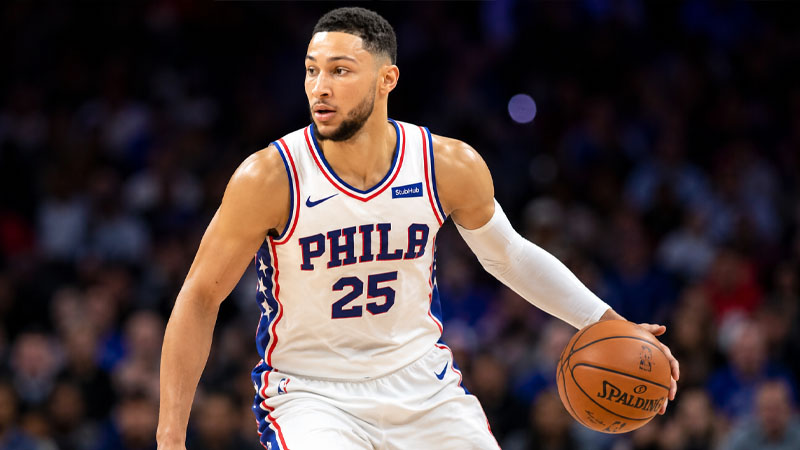
Ben Simmons played point guard because his elite court vision, lightning-fast transition speed, and high basketball IQ allowed him to orchestrate offenses like a floor general despite his 6-foot-10 frame.
His massive size created extreme defensive mismatches, as smaller guards could not contest his passes or stop him in transition. By placing the ball in his hands, coaches maximized his playmaking utility without requiring a perimeter jump shot to stretch the floor.
This unconventional role turned him into a three-time All-Star and a defensive powerhouse before physical injuries shifted his professional career trajectory.
Why Did Coaches Play Ben Simmons at Point Guard?
The decision to utilize a player with the physical profile of a traditional power forward at the point guard position was a calculated strategic move designed to exploit unique physical advantages.
At 6’10” and 240 pounds, Simmons offered a combination of size and speed that few players in league history have matched.
The Strategic Advantage of Size and Vision
Simmons possesses natural court vision and passing accuracy that are often compared to elite, traditional floor generals. His height allows him to see over opposing defenses, identifying passing lanes that are physically inaccessible to shorter players.
In transition, his speed is particularly devastating; he can secure a defensive rebound and instantly ignite a fast break before the opposing defense can establish their set.
This “one-man fast break” capability was a primary reason former coach Brett Brown transitioned him permanently to the perimeter role during his rookie season.
Maximizing Impact Without a Perimeter Shot
A significant factor in his positional placement was his lack of a reliable outside jump shot. In a traditional forward role, a non-shooter can sometimes clog the paint and hinder spacing.
However, by making Simmons the primary decision-maker and ball-handler, coaches kept him highly impactful.
With the ball in his hands, his inability to stretch the floor became less of a liability because he was the one initiating the action, driving to the rim, or facilitating for others.
This allowed the team to surround him with shooters while he operated as the engine of the offense.
Career Milestones: Accomplishments as a Primary Guard
During his tenure as a listed point guard, Simmons achieved high-level success that validated the unconventional experiment for several seasons.
His ability to defend all five positions while leading the team in assists made him one of the most versatile players in the league.
| Achievement | Year(s) | Context |
|---|---|---|
| NBA Rookie of the Year | 2018 | Dominant debut season as a full-time point guard. |
| NBA All-Star | 2019, 2020, 2021 | Recognized as an elite guard for three consecutive years. |
| All-Defensive First Team | 2020, 2021 | Utilized size to smother perimeter guards and switch onto bigs. |
| NBA Steals Leader | 2020 | Led the league in steals, showcasing elite defensive anticipation. |
| Career Assist Average | 2017–2025 | Averaged 7.2 APG, peaking at 7.7 during the 2018-19 season. |
The Half-Court Dilemma and Positional Gaps
While Simmons excelled in transition, his role as a point guard faced intense scrutiny during half-court offensive sets.
The paradox of his playstyle is that while he is a guard in name, his functional utility often mirrored that of a “point forward” or a passing big man in slower environments.
The Pick-and-Roll and Spacing Limitations
In the modern game, the pick-and-roll is the most common offensive play. Critics argue that a point guard must be a shooting threat to run this play effectively; otherwise, the defense can simply “drop” and dare the ball-handler to shoot.
Because Simmons famously avoided outside attempts—averaging only 0.1 three-point attempts per game—his effectiveness as a primary perimeter creator diminished in playoff scenarios where the game slows down.
In these moments, he often operated more like a center, handing the ball off or positioning himself in the post.
Comparisons to Traditional Point Forwards
Many analysts and fans have argued that Simmons should have always been classified as a great passing power forward rather than a guard.
Unlike traditional guards who create from the perimeter, Simmons does most of his scoring near the rim and facilitates through post-ups or high-low passing.
While players like Magic Johnson proved that tall guards can succeed, Johnson was a more versatile offensive threat.
The debate remains whether Simmons’ “guard” designation was a revolutionary tactic or a misclassification that ignored his natural fit as a versatile forward.
A Timeline of Positional Shifts and Team Roles
The career of Ben Simmons is marked by a clear evolution from a full-time floor general to a more flexible, hybrid player. This shift was necessitated by both roster changes and significant physical challenges.
- Philadelphia 76ers (2017–2021): Served as the primary point guard, starting every game at the position. During this era, he was the main ball-handler alongside shooters and center Joel Embiid.
- Brooklyn Nets (2021–2025): Though still listed as a point guard, his role became more fluid. Injuries and the presence of other ball-handlers forced him to split time as a point forward and occasionally a small-ball center.
- Los Angeles Clippers (2024–2025): Played a reduced role as a versatile depth piece, continuing his transition away from being a primary perimeter-only guard.
- Free Agency (Present): Following a year away from the game to address health issues, he is currently seeking a comeback as a versatile interior playmaker.
Future Outlook: Transitioning to the Point-Forward Role
As Simmons prepares for the next chapter of his career, the days of him being a 40-minute-per-game perimeter point guard appear to be over. His evolution is now focused on longevity and adapting his elite skill set to a more physically sustainable role.
The Path to a Successful Comeback
Simmons has spent his recent hiatus training with the specific goal of becoming “bulletproof”. This involves intensive rehabilitation to address the back and nerve issues that have hampered his mobility and explosiveness.
Reports indicate that his shooting mechanics are feeling improved, and he is working on a “simple hook shot” to become more effective as an interior scorer.
By developing a reliable post-scoring game, he can remain a threat even when he isn’t the primary ball-handler.
Defining a New Interior Playmaking Identity
Any team signing Simmons in the future is likely to view him as a versatile point-forward or a playmaking small-ball center. This role leverages his greatest strengths—passing and rebounding—while mitigating the pressure to act as a traditional perimeter guard.
By operating out of the high post or the “dunker spot,” he can facilitate ball movement and provide elite defensive versatility without the burden of running the half-court offense as a floor general.
This transition aligns him more closely with players like Draymond Green or Nikola Jokic, who act as “point centers”.
Frequently Asked Questions
Is Ben Simmons still considered a point guard?
Officially, Simmons has been listed as a point guard for most of his career, including his stints with the 76ers and Nets. However, functionally, his role has evolved into that of a point-forward or versatile interior playmaker due to injuries and team needs.
How tall is Ben Simmons?
He is most commonly listed at 6-foot-10, though some reports and team updates have occasionally listed him at 6-foot-11. This height, combined with his 240-pound frame, made his tenure at point guard a physical anomaly.
Why did he stop playing for the 76ers?
After several years as their primary guard, a combination of playoff struggles, public criticism regarding his shooting, and a breakdown in the team relationship led to his eventual trade to the Brooklyn Nets.
What are his career averages?
Over seven active seasons, he has averaged 13.1 points, 7.2 assists, and 7.4 rebounds per game. His high field goal percentage of 55.8% reflects his efficiency near the rim, while his 0.1 three-point attempts per game highlight his avoidance of perimeter shooting.
What is his current status?
Following a hiatus during the 2025–26 season to address mental and physical health, he is a free agent training for an NBA return. He aims to contribute as a “bulletproof” veteran who can defend multiple positions and facilitate the offense.
The Legacy of the Point Guard Paradox
Ben Simmons remains one of the most polarizing figures in modern basketball because he challenged the very definition of a “position”. By playing point guard at 6’10”, he proved that elite playmaking is not restricted by height or a jump shot.
While his career has been slowed by physical setbacks, his peak performance provided a blueprint for the “positionless” era of the league.
Whether he is remembered as a guard or a forward, his impact as a versatile defensive anchor and transition engine has left an indelible mark on how teams evaluate size and skill.
Moving forward, his ability to adapt to a hybrid role will determine the success of his next professional chapter.