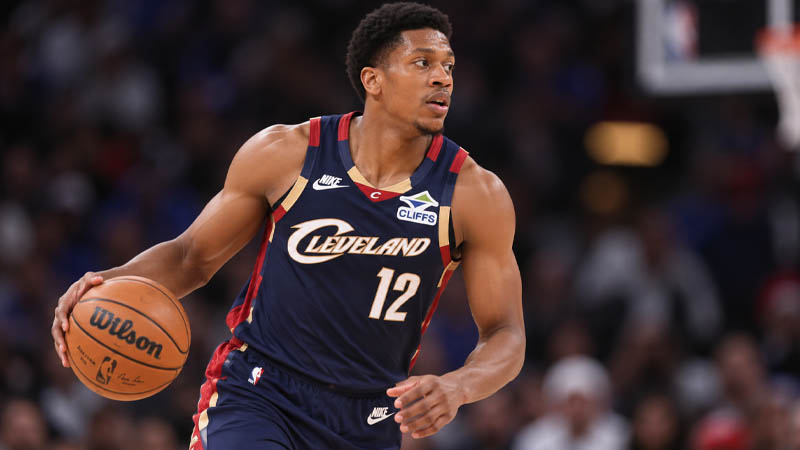
De’Andre Hunter is a solid, starter-level NBA rotation wing who provides consistent value as an individual perimeter stopper and mid-range scorer.
While he excels at on-ball isolation defense—ranking in the 96th percentile—his overall impact often falls short of his #4 overall draft pedigree and lucrative $22.5 million annual salary.
He is widely considered a reliable role player but lacks the elite playmaking, disruptive defensive statistics, and durability to reach stardom.
Ultimately, he is “good” for specific team roles but remains a polarizing asset due to his production-to-contract ratio and recurring injury setbacks.
Career Statistical Breakdown and 2025–26 Performance
To evaluate if an NBA player is effective, one must first analyze the hard data. De’Andre Hunter has maintained remarkably stable baseline metrics throughout his career, consistently hovering between 13 and 15 points per game.
However, his most recent campaign across the Cleveland Cavaliers and Sacramento Kings showed signs of efficiency regression that complicated his market perception.
| Statistic | Career Regular Season Average | 2025–26 Season Average |
|---|---|---|
| Points Per Game (PPG) | 14.7 | 13.7 |
| Rebounds Per Game (RPG) | 4.1 | 4.1 |
| Assists Per Game (APG) | 1.6 | 2.0 |
| Field Goal Percentage (FG%) | 44.7% | 41.5% |
| Three-Point Percentage (3P%) | 36.4% | 30.8% |
| Free Throw Percentage (FT%) | 82.5% | 86.7% |
| True Shooting % (TS%) | 57.1% | 54.5% |
The data indicates that while his scoring volume remained respectable, his efficiency from the field and beyond the arc took a significant hit during the 2025–26 season.
Despite these struggles, his elite free-throw shooting improved to a stellar 86.7%, proving he remains a reliable asset when he can get to the charity stripe.
Is De’andre Hunter Good at Defense?
The question of defensive utility is perhaps the most debated aspect of Hunter’s profile. He was drafted out of Virginia primarily for his defensive upside, having won the ACC Defensive Player of the Year award.
In the professional ranks, however, his impact is far more specialized than general box scores might suggest.
Elite On-Ball Isolation Mastery
Hunter’s primary calling card in the NBA is his ability to match up against elite, athletic wing players in one-on-one scenarios.
He possesses a massive 7’2″ wingspan and the physical strength required to cleanly impede the progress of the league’s most dominant scorers. In early 2026, tracking metrics ranked him in the 96th percentile as an isolation defender.
This makes him a vital tool for coaching staffs who need a “stopper” to mirror an opponent’s primary offensive engine throughout a playoff series.
He does not shrink under pressure and maintains high levels of discipline, rarely falling for fakes or committing unnecessary fouls.
The Team Defense and Statistical Gap
While he is a lockdown individual defender, analytical metrics like DBPM (Defensive Box Plus-Minus) and DRAPTOR frequently grade Hunter as a net-negative team defender.
This discrepancy arises from his “stay-at-home” style, a remnant of his collegiate training that prioritizes sticking to a single man over roaming for help-side disruptions.
Consequently, he generates almost zero “stocks”—the combination of steals and blocks. During the 2025–26 season, he averaged just 0.7 steals and 0.1 blocks per game.
For a 6’7” forward with a large wingspan, this lack of disruptive activity limits his ability to anchor a team-wide defensive scheme, even if he wins his individual matchups.
Assessing His Offensive Impact and 3-Point Shooting
Offensively, Hunter is often described as a “play-finisher” rather than a “play-creator.” He operates primarily in straight lines and lacks the advanced secondary playmaking skills required to be a focal point of a modern offense. His value is tied to his ability to exploit the spacing created by star teammates.
Mid-Range Comfort and Interior Finishing
One of Hunter’s most underrated traits is his reliability in the mid-range and at the rim. When the shot clock winds down or team offenses stall, he is capable of creating his own look over smaller defenders in the high post.
He is an efficient finisher inside 10 feet, converting roughly 54% of his looks around the rim. This interior efficiency provides a necessary release valve for offenses, ensuring that he isn’t entirely dependent on the perimeter jump shot to remain a scoring threat.
The Inconsistent Deep Ball Struggle
Is De’Andre Hunter a good 3-point shooter? The answer has fluctuated throughout his seven-year career.
While he holds a respectable 36.4% career average from deep and has cleared 42% on catch-and-shoot looks in the past, his 2025–26 campaign was a struggle.
His efficiency plummeted to a career-low 30.8% during his time with Cleveland and Sacramento. This volatility makes him a difficult player to scheme for; when he is “on,” he is a lethal floor-spacer, but when he is “off,” he can become a liability that defenses are willing to leave open in favor of doubling other stars.
Is De’andre Hunter Good for Fantasy Basketball?
For fans of the statistical side of the game, Hunter represents a unique challenge. His real-life utility as a disciplined wing often fails to translate into the categories that drive fantasy success.
- Low “Stock” Production: As previously noted, his steal (0.7) and block (0.3) rates are among the lowest in the league for a starting forward, providing a significant “zero” in two crucial fantasy categories.
- Minimal Rebounding and Assists: Despite his 6’7″ frame, he averages only 4.1 rebounds and 2.0 assists, meaning he does not provide “out-of-position” value in peripheral stats.
- Specialized Value: He is only a viable fantasy pick in deep-league formats where a manager specifically needs a stable free-throw percentage (86.9%) and 13–14 points of baseline scoring.
- High Minutes, Low Ceiling: While he plays heavy starter minutes (roughly 30 per night), his lack of category-stuffing ability caps his upside, making him a “high-floor, low-ceiling” option that most competitive managers avoid.
The Financial Dilemma: Contract vs. Production
The lens through which Hunter is viewed is often skewed by his financial standing. In the NBA, a player’s “goodness” is frequently weighed against their salary cap hit and the opportunity cost of that roster spot.
The Burden of a $22.5 Million Price Tag
Hunter’s rookie contract extension pays him an average of $22,500,000 annually through 2027. By the 2026–27 season, he is scheduled to earn $24.9 million. This salary tier is typically reserved for high-end core starters or borderline All-Stars.
Because Hunter produces like a league-average role player—14 points and 4 rebounds—he is often labeled as overpaid. This financial reality turns him into a “luxury trade piece” rather than an indispensable pillar of a franchise.
Pedigree vs. Practical Utility
Being the #4 overall pick in a draft that featured stars like Zion Williamson and Ja Morant brings a level of expectation that Hunter has struggled to meet consistently.
While he has a championship pedigree from his time at Virginia and has performed well in past NBA playoff runs, his ceiling appears to be that of a high-end rotation wing.
For teams like the Sacramento Kings or Cleveland Cavaliers, he is a valuable asset who can solidify wing depth, but he is rarely the player who will single-handedly elevate a team’s ceiling to championship contention.
Health and Durability Concerns
A significant factor in the “is he good” debate is availability. Hunter has consistently struggled to remain on the court for a full NBA calendar, frequently sidelined by persistent knee issues.
His 2025–26 season was particularly tragic, ending abruptly after just two games with the Sacramento Kings due to an unlucky detached retina that required season-ending surgery in February 2026.
These recurring injuries prevent him from finding a consistent rhythm and often force his teams to adjust their rotations mid-season, further complicating his value as a reliable starter.
Final Verdict: The Multi-Positional Asset
In summary, De’Andre Hunter is an effective, albeit flawed, professional basketball player. If your definition of “good” is a physical, 6’7″ forward who can play within a system, hit open shots when healthy, and guard the opponent’s best perimeter scorer, then Hunter is an undeniable asset.
However, if you require a player to justify a $22.5 million price tag through diverse statistical production and elite help-side defense, he likely falls short.
He remains a prototypical example of the modern 3-and-D wing whose ultimate value depends entirely on the specific needs of the team around him.
Common Questions About De’Andre Hunter
Is De’Andre Hunter a good defensive player?
Yes, but his strength is localized. He is an elite on-ball isolation defender (96th percentile) but a below-average team and help-side defender who records very few steals and blocks.
What happened to De’Andre Hunter in 2026?
His 2025–26 season was cut short after he was traded to the Sacramento Kings. After just two games with his new team, he suffered a detached retina that required season-ending eye surgery.
Is Hunter worth his contract?
Most analysts view him as slightly overpaid. While he is a capable starter, his $22.5 million annual salary is high for a player who provides league-average production in points and rebounds.
Does he have a high ceiling?
At this stage of his career, Hunter is viewed more as a finished product. His lack of secondary playmaking and recurring knee injuries suggest his ceiling is a high-end 3-and-D role player rather than an All-Star.