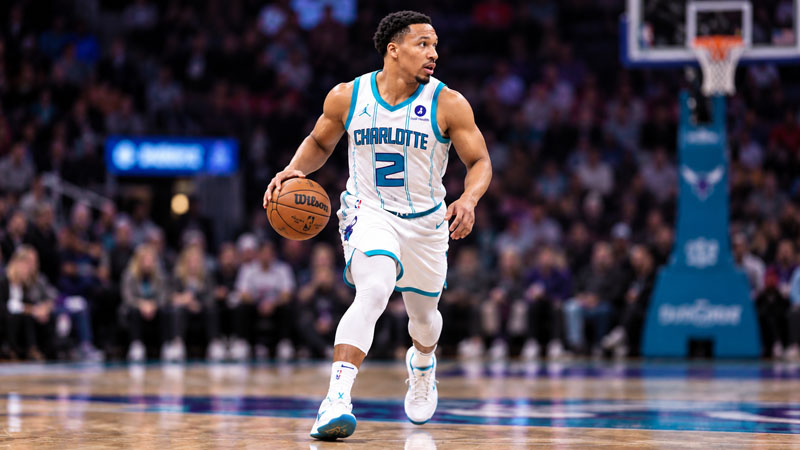
No, Grant Williams is not a small forward; he is primarily a power forward who operates as a modern hybrid big man.
While his 6’7” height matches the standard profile of an elite NBA wing, his immense physical strength, 6’11” wingspan, and 236-pound frame anchor him firmly in the frontcourt.
Statistical trackers confirm that after an experimental rookie season, his minutes at the small forward position plummeted to nearly zero percent.
Today, Williams thrives as a 3-and-D specialist, frequently sliding up to play small-ball center for teams like the Charlotte Hornets rather than playing on the perimeter.
Analyzing the NBA Positional Evolution of Grant Williams
To understand why many fans and analysts initially misclassify Williams, one must look at the shifting landscape of positional archetypes and how his specific career trajectory has moved away from the wing.
The Rookie Season Experiment in Boston
During the 2019–20 season, the Boston Celtics occasionally experimented with Williams at the small forward spot.
This was not necessarily because he was a natural wing, but rather a byproduct of a specific, switch-heavy defensive scheme implemented by then-coach Brad Stevens.
At that stage of his career, the Celtics were testing his versatility to see if his 6’7″ frame could handle the lateral requirements of the perimeter. However, historical data from StatMuse indicates that this was a brief tactical phase rather than a permanent role change.
The Permanent Shift to a Power Forward Identity
Following his rookie year, the coaching staff recognized that his greatest value lay in his ability to battle larger opponents rather than chasing guards.
Official data trackers from Basketball-Reference now estimate his career positional breakdown to be roughly 80% at power forward and 20% at center.
This shift effectively ended any regular-season minutes at small forward, as his skillset and physical density became the cornerstone of his utility as a frontcourt anchor.
By focusing on the four and five spots, Williams has carved out a niche that maximizes his strength over his height.
Why Physical Dimensions Do Not Make Him a Wing
The distinction between a player’s height and their functional position is a critical nuance in professional basketball. While Williams shares the height of many elite wings, his athletic profile is tuned for interior and post-entry defense.
The Limitations of Lateral Foot Speed
A primary reason Williams cannot sustain a role at small forward is a lack of elite foot speed required for the modern wing spot.
In today’s league, small forwards must be able to chase “twitchy” and explosive perimeter stars over multiple screens throughout a game.
While Williams is an elite post defender capable of battling stars in the paint, he often struggles when asked to match the high-velocity lateral movements of primary perimeter creators.
His 236-pound frame is built for absorption and leverage, which is a massive advantage in the post but a hindrance when defending the three-point line against faster guards.
Absence of Perimeter Shot Creation
Modern NBA small forwards are increasingly expected to be “point wings” who can create their own shots off the dribble or run secondary pick-and-rolls. Williams, by contrast, functions almost exclusively as a play-finisher.
His offensive utility comes from knocking down corner three-pointers or setting bone-jarring screens and rolling to the basket.
Because he does not possess the traditional shot-creation skills of a small forward, placing him on the wing would limit a team’s offensive dynamism and floor spacing.
The Strategic Value of the Small-Ball Center Role
In a surprising twist for a player of his height, Williams has actually seen more success moving “up” the positional ladder rather than sliding “down” to the wing.
Tactical Floor Spacing and the Modern Five
Instead of becoming a small forward, Williams is frequently utilized as a small-ball center, or a “five”. The Charlotte Hornets have found significant tactical value in this arrangement, as it allows them to play a five-out offensive style.
When Williams plays center, his three-point shooting ability forces opposing traditional centers to leave the paint, creating massive driving lanes for his teammates.
This “stretch-five” capability is a much more valuable asset in the current league than a 6’7″ player who simply occupies a wing spot without elite creation skills.
Leveraging the 6’11” Wingspan for Interior Defense
Despite being shorter than most centers, Williams’ 6’11” wingspan allows him to contest shots and protect the rim far more effectively than a standard wing. His physical strength is a “force multiplier,” enabling him to hold his ground against seven-footers in the post.
This rare combination of a “tweener” height and “big man” strength allows coaches to keep him on the floor in late-game situations where defensive versatility is paramount.
He provides the interior toughness of a center with the shooting touch of a forward, a blend that defines the “hybrid big” archetype.
Comparison: Small Forward vs. Hybrid Big Man Skills
| Skill / Trait | Traditional Small Forward (SF) | Grant Williams (Hybrid Big) |
|---|---|---|
| Primary Defensive Role | Perimeter containment / chasing wings | Post defense / switching onto bigs |
| Offensive Style | Isolation / Pick-and-roll creation | 3-and-D / Screen setting / Finishing |
| Physical Usage | Lateral agility and verticality | Lower body strength and leverage |
| Floor Position | Corner and wing spacing | High post and small-ball center |
| Wingspan Utility | Passing lane disruption | Rim contest and post leverage |
How Modern NBA Lineups Utilize His Versatility
The classification of “power forward” only tells half the story, as Williams is often used as a Swiss Army knife to solidify various frontcourt configurations depending on the opponent.
Impact on the Charlotte Hornets Rotation
Since joining the Charlotte Hornets, Williams has been a vital part of their rotation by filling multiple frontcourt needs. He is officially classified as a power forward, but his role is highly fluid.
On any given night, he may start at the four but close the game at the five to maximize the team’s perimeter shooting.
This versatility is a key reason why his positional data is so skewed toward the frontcourt; coaches value his ability to stabilize the defense in the paint while providing elite floor spacing on the other end.
The Importance of 3-and-D Frontcourt Depth
The “3-and-D” label is usually reserved for wings, but Williams has redefined it for the frontcourt. In a professional setting, having a player who can shoot nearly 40% from the corner while also being strong enough to box out starting centers is a luxury.
This hybrid identity is why he is rarely, if ever, asked to play the three. His presence allows a team to play “small” without actually sacrificing the physical toughness and rebounding required to win the battle in the trenches.
Frequently Asked Questions About Grant Williams’ Position
Is Grant Williams a small forward or a power forward?
Grant Williams is primarily a power forward. While his 6’7″ height is typical for a small forward, his 236-pound frame and playing style are better suited for the power forward and small-ball center positions.
Data shows he plays approximately 80% of his minutes at the four and 20% at the five.
Why don’t the Hornets play Grant Williams at the three?
The Hornets avoid playing Williams at the three (small forward) because he lacks the lateral quickness to guard elite perimeter wings and does not possess the shot-creation skills required for the role.
Instead, they maximize his value by playing him as a big man who can stretch the floor and defend the post.
What makes Grant Williams a “hybrid big”?
Williams is considered a hybrid big because he combines the size of a wing with the strength and defensive responsibilities of a center.
His 6’11” wingspan and elite lower-body strength allow him to play the center position in “small-ball” lineups, providing a unique tactical advantage through his three-point shooting.
Did Grant Williams ever play small forward?
Yes, during his rookie season (2019–20) with the Boston Celtics, he played limited minutes at small forward. This was largely due to the Celtics’ specific defensive system that emphasized switching.
Since that time, however, his minutes at the wing have effectively dropped to zero.
The Future of the Positionless Frontcourt
The career of Grant Williams serves as a masterclass in how modern basketball has moved beyond simple labels. While the question “is Grant Williams a small forward?” remains common due to his height, the reality is that his impact is felt almost entirely in the frontcourt.
By embracing his identity as a hybrid big man, he has become one of the most reliable 3-and-D role players in the league, offering a blend of strength, shooting, and intelligence that a traditional small forward simply could not provide.
For teams like the Charlotte Hornets, his ability to bridge the gap between a power forward and a center is far more valuable than any contributions he could make on the wing.
As the NBA continues to evolve, the Grant Williams model—the “undersized” big with “oversized” impact—will likely become the gold standard for frontcourt versatility.