
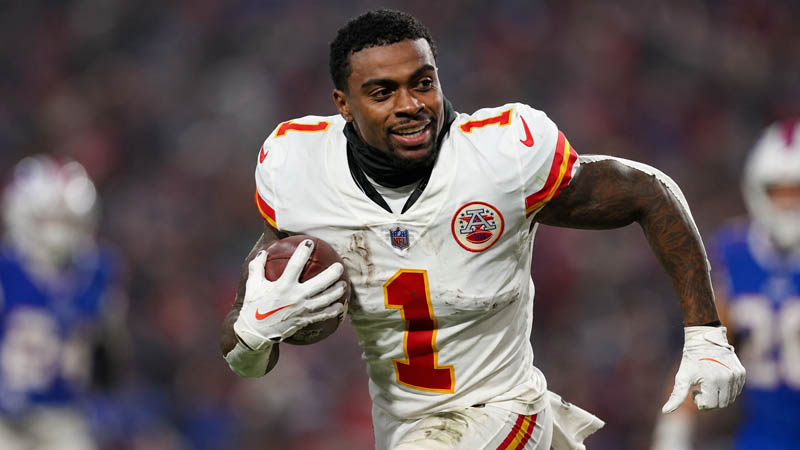
In the modern era of professional football, the value of a player is often measured by their ability to adapt to a high-speed, space-oriented game. Few players personify this transition better than Jerick McKinnon.
Known throughout the league by his moniker, “Jet,” McKinnon has carved out a niche that transcends traditional rushing statistics, becoming a definitive “chess piece” for championship-caliber offenses.
To understand why McKinnon is held in such high regard by coaches and analysts alike, one must look beyond the box score and into the technical nuances of his playstyle, his physical resilience, and his elite football intelligence.
The Athletic Foundation: Power and Explosiveness
Jerick McKinnon’s journey began with a physical profile that defied his smaller stature. Coming out of Georgia Southern, he displayed a rare combination of weight-room strength and explosive speed that immediately drew the attention of professional scouts.
This physical duality allowed him to play much “bigger” than his frame suggested, a trait that would later define his effectiveness in high-stakes situations.
Physical Profile and Performance Traits
- Elite Speed: His ability to hit top-end velocity quickly made him a constant threat on the perimeter and in the open field.
- Lower-Body Strength: His power base allowed him to maintain balance through contact and, more importantly, hold his ground against much larger blitzing linebackers.
- Versatility: He transitioned from a triple-option quarterback in college to a multi-dimensional threat in the professional ranks, demonstrating an innate ability to learn complex offensive systems.
Statistical Overview: Career Productivity
McKinnon’s career is marked by steady contributions across multiple franchises, including the Minnesota Vikings, San Francisco 49ers, and the Kansas City Chiefs. His impact is most visible when combining his ground production with his aerial efficiency.
Jerick McKinnon: Career Statistics at a Glance
| Category | Career Totals |
|---|---|
| Regular-Season Games | 116 |
| Rushing Carries | 660 |
| Rushing Yards | 2,650 |
| Rushing Touchdowns | 14 |
| Average Yards Per Carry | 4.0 |
| Total Receptions | 269 |
| Receiving Yards | 2,048 |
| Receiving Touchdowns | 20 |
| Total Career Touchdowns | 34 |
The “Hidden” Value: Elite Pass Protection
While touchdowns and yards gain the most attention from the general public, professional evaluators point to McKinnon’s pass-blocking as his most elite trait.
In a league where protecting the quarterback is the primary objective, McKinnon became an essential asset on third downs.
Analysts and fans have frequently highlighted his exceptional understanding of space and assignment.
He does not simply “get in the way” of a defender; he processes the defensive front, identifies the most dangerous threat, and uses his leverage to neutralize it.
Why His Blocking Changed the Game
- Assignment Soundness: McKinnon is rarely out of position, ensuring the quarterback has a clean pocket to operate in.
- The Jaguars Block: A frequently cited moment in his career was his dominant blocking performance against the Jacksonville Jaguars, which allowed the offense to stay in rhythm during a high-pressure postseason matchup.
- Earning Playtime: As noted by observers, this specific skill set is what keeps a player on the field during the most critical moments of a game. Coaches trust him to protect the team’s most valuable asset: the quarterback.
- Physicality: Despite being a “change-of-pace” back, his willingness to engage in heavy contact with defensive ends and linebackers set a tone for the entire offensive unit.
Tactical Versatility: The Receiving Threat
McKinnon’s evolution into a premier receiving threat out of the backfield peaked during his tenure in Kansas City. He wasn’t just a safety valve; he was a primary target in high-leverage situations.
- Clutch Performance: He famously converted a 3rd and 31, a feat that demonstrates his ability to find soft spots in defensive coverage and make plays when the odds are heavily stacked against the offense.
- Unstoppable Streaks: Late in the 2022 season, McKinnon underwent a period where he was nearly impossible to defend, scoring receiving touchdowns in six consecutive games.
- Red Zone Efficiency: His 20 career receiving touchdowns underscore his value as a “mismatch” player who can outrun linebackers or outmaneuver defensive backs in tight spaces.
Resilience: Navigating the Challenges of Injury
The narrative of McKinnon’s career is also one of profound grit. After signing a significant contract with the San Francisco 49ers, he faced a series of debilitating injuries that threatened to derail his professional journey.
For several years, he struggled to remain healthy, leading some to question if he would ever return to his explosive self.
However, his successful stint in Kansas City proved that his work ethic and recovery protocols were elite. He transitioned from a highly paid free agent to a veteran leader who was willing to accept a role that maximized his efficiency over raw volume.
The Market Reality for Veteran Backs
- Economic Shifts: McKinnon navigated a “depressed” market for running backs, eventually finding a home where his specific skills were valued more than traditional high-volume rushing.
- Strategic Signing: His decision to sign veteran-minimum deals later in his career allowed him to join a championship contender where his “football IQ” could shine.
The Championship Mentality: Selflessness and Intelligence
Perhaps the most defining moment of Jerick McKinnon’s career occurred in the closing moments of Super Bowl LVII.
With the game tied and the offense within striking distance of the end zone, McKinnon broke free for what appeared to be a certain touchdown.
Instead of scoring, he chose to slide short of the end zone. This tactical decision forced the opposing team to use their remaining timeouts and allowed the offense to run the clock down to nearly zero before kicking a game-winning field goal.
This “team-first” act is the ultimate signal of a player who prioritizes collective success over individual accolades.
Understanding the Impact: Analysis for Different Audiences
To truly appreciate McKinnon, we must look at him through several lenses:
1. The Strategic Lens (Coaching Perspective)
Coaches value McKinnon because he reduces the “tell” of an offense. When he is on the field, the defense cannot know if it is a run play, a pass play, or a screen, because he excels at all three.
2. The Analytical Lens (Data Perspective)
His 4.0 yards per carry average is solid, but his 20 receiving touchdowns—nearly double his rushing total—reveal his true identity as a modern hybrid weapon.
3. The Fan Perspective (The “Unsung Hero”)
Fans often overlook the player who picks up the blitz, but they never forget the player who saves a game with a selfless slide or a 3rd-and-long conversion.
Summary of Key Contributions
- Professional Longevity: 116 games played in a high-contact position.
- Dual-Threat Mastery: Over 2,000 yards in both rushing and receiving categories.
- Championship Pedigree: Two-time Super Bowl Champion with the Kansas City Chiefs.
- Exceptional Intelligence: Known for elite pass protection and situational awareness.
Conclusion: The Legacy of “The Jet”
Jerick McKinnon is far more than a “talented” athlete; he is a specialist whose presence changes the geometry of the football field. By mastering the less-glamorous aspects of the game—such as pass blocking and situational clock management—he transformed himself from an explosive prospect into a vital component of a dynasty.
His career serves as a blueprint for the modern professional athlete: adapt to the needs of the team, master your niche, and always put the win above the stat sheet.
Whether he is obliterating a defender on a blitz pickup or sliding to seal a Super Bowl victory, McKinnon has proven that his value is immeasurable.






