
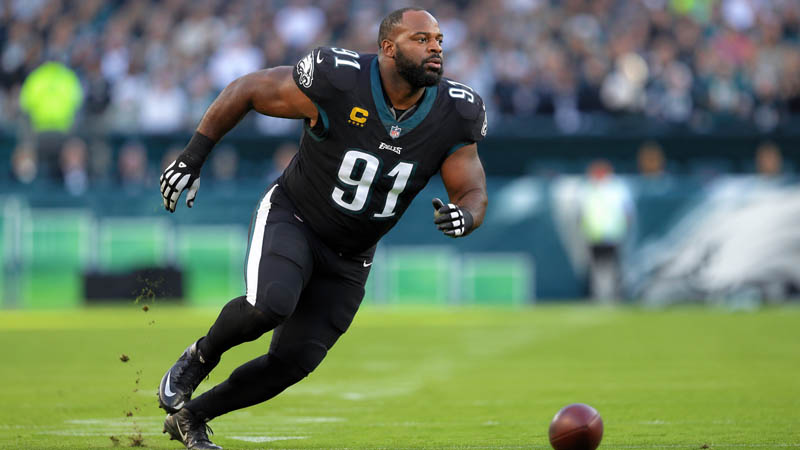
The landscape of the National Football League is often defined by its stars on the field, but the real championships are frequently won or lost in the quiet offices of front-office executives.
In March 2022, the Philadelphia Eagles executed a move that initially sent shockwaves through their fan base and the wider sporting world: the release of franchise icon and perennial Pro Bowl defensive tackle Fletcher Cox.
To the casual observer, it appeared to be the end of an era for one of the most dominant interior linemen in the history of the organization.
However, within forty-eight hours, the narrative shifted from a heartbreaking departure to a tactical masterpiece of roster management.
This analysis explores the intricate financial mechanics, the long-term roster implications, and the strategic philosophy that drove the Eagles to release and subsequently re-sign Fletcher Cox.
The $18 Million Trigger: The Catalyst for Action
The primary driver behind the timing of Cox’s release was a specific contractual deadline. NFL contracts are often structured with “triggers”—dates on which certain salary components or bonuses become fully guaranteed. For Fletcher Cox, that deadline arrived on a Friday afternoon in March 2022.
Had Cox remained on the active roster past that specific deadline, a massive $18 million base salary guarantee would have been triggered.
In the context of a hard salary cap, being locked into an $18 million cash commitment for an aging veteran represents a significant risk for any front office.
By releasing him before this afternoon’s deadline, General Manager Howie Roseman avoided that mandatory guarantee, effectively reclaiming the team’s financial leverage.
This move was not a reflection of Cox’s lack of value to the defensive unit, but rather a response to the “punitive” nature of his existing contract.
Previous restructures, which the team had used to create immediate cap space in prior years, had eventually pushed the “dead money” and salary guarantees to a breaking point.
The Mathematical Logic: Dead Cap and Future Flexibility
To understand why a team would cut its best defensive lineman, one must look at the projected “cap hits” over a multi-year horizon. Before the release, the Eagles were facing a daunting financial trajectory regarding Cox’s contract.
If the Eagles had maintained the status quo and held onto Cox under his original deal through the 2022 season, the future consequences would have been severe.
Projections indicated that cutting him during the 2023 season would have resulted in an $11.2 million cap hit in 2023 and a staggering $33.8 million cap hit in 2024.
By executing a “procedural release” with a post-June 1 designation, the Eagles were able to reset these figures. The restructured reality allowed the team to manage the escalating future hits from previous bonus prorations more effectively.
Under the new strategy, the team was looking at a significantly more manageable $15 million dead cap hit in 2023.
This financial breathing room is what allows a “Fortune 500” level sports operation to remain competitive while others are forced into “fire sales” of their veteran talent.
The “Wink-Wink” Deal and the Open Market Risk
One of the most debated aspects of this maneuver was the risk involved in letting a player of Cox’s caliber hit the open market.
Once the release was official, Cox was legally a free agent, free to negotiate with any of the other thirty-one teams in the league.
Within the Eagles’ community, many wondered if another organization would offer Cox a “stupid deal” that Philadelphia could not match.
There was speculation that the two parties had a “behind closed doors” or “wink-wink” agreement—a mutual understanding that the release was purely procedural and that a new, team-friendly deal was already being finalized.
While such agreements are difficult to prove, the speed of the reunion suggests a high level of trust between the player and the organization.
Just two days after being released, Cox signed a reworked one-year deal to return to the Eagles for the 2022 season.
This new agreement reportedly kept his 2022 compensation at a similar level while dramatically improving the team’s cap health for 2023 and 2024.
Personnel Strategy: Bridging the Gap to the Future
The decision to release and re-sign Cox was also a vital component of the team’s talent development pipeline. In the NFL, “succession planning” is just as important as it is in a corporate boardroom.
The Eagles’ front office recognized that while Cox was still a valuable starter, they needed to begin the transition to a younger, more cost-effective defensive interior.
The 2022 maneuver provided the organization with one more year to develop younger talent, specifically players like Milton Williams, to eventually take over the starting roles.
By keeping Cox on a one-year deal rather than a long-term guaranteed contract, the team ensured they had elite veteran leadership in the short term without blocking the path for the next generation of defenders.
This strategy also reflected a broader shift in how the team allocated its resources. Critics at the time argued that the Eagles had perhaps misallocated too much cap space to the defensive tackle position and lacked “rookie deal” productivity in that room. The Cox restructure was the first step in rebalancing that equation.
The Fan Verdict: Genius vs. Damage Control
The Eagles’ fan base has long been divided on the performance of General Manager Howie Roseman. This specific transaction serves as a perfect microcosm of that debate.
- The “Genius” Perspective: Supporters of the move point to Roseman’s ability to navigate the intricacies of the salary cap, famously referred to as “mastering the edge”. By using the procedural release, he was able to keep a franchise legend in the building while simultaneously saving the team from a $33.8 million cap disaster in 2024.
- The “Damage Control” Perspective: More skeptical observers argue that the only reason the Eagles were in this “bad situation” was because of Roseman’s own previous contract restructures. They suggest that “you don’t get props” for putting out a fire that you started yourself.
Regardless of which side one takes, the results are difficult to argue with. The Eagles were able to sign high-impact free agents, such as Haason Reddick, in that same off-season because their cap situation was managed with such precision.
A less savvy front office might have been paralyzed by the dead money on the Cox contract, but Philadelphia used it as a tool for flexibility.
A Legacy of Strategic Excellence
Fletcher Cox eventually retired as an Eagle, a fitting end for a player of his stature. The 2022 release was never about a lack of respect for his contributions or a decline in his performance that warranted a permanent exit. Instead, it was a necessary piece of financial gymnastics required to maintain a competitive roster in a league designed for parity.
The Eagles proved that they were willing to “ride the edge” of the cap to maximize their competitive window.
By understanding the difference between “cash” and “cap hit,” the organization was able to pay their star what he was worth while protecting the franchise’s future.






