DeVonta Smith never ran an official 40-yard dash at the NFL Scouting Combine or his Alabama Pro Day. Because of a severe dislocated finger suffered in the 2021 College Football Playoff National Championship against Ohio State, he opted out of physical pre-draft testing.
Instead, NFL scouts and draft analysts estimate his true speed to be between 4.45 and 4.50 seconds based on his dominant college film.
This deep dive evaluates his verified high school baseline of 4.49 seconds, internal sophomore team trials in the high-4.4 range, database projections, and functional game-day velocity.
Why Did DeVonta Smith Skip the NFL Combine 40-Yard Dash?
Understanding why a Heisman Trophy winner sat out of the premier pre-draft athletic event requires looking at both physical setbacks and strategic draft positioning at the end of his college career.
The CFP National Championship Finger Injury
During the 2021 College Football Playoff National Championship game against Ohio State, Smith suffered a severe dislocated finger.
This physical injury made it impossible for him to participate in demanding pre-draft workouts, including straight-line speed drills. Rather than risking further damage on a track, he prioritized his recovery and physical rehabilitation ahead of the draft.
A Calculated Business Decision for a Heisman Winner
After securing the prestigious Heisman Trophy and displaying absolute dominance on college football’s biggest stage, further physical testing was unnecessary.
Opting out of the combine drills allowed Smith to protect his draft value and let his body recover fully. He relied on his historically dominant college game tape to prove his value to professional franchises, a strategy that ultimately proved highly successful.
Historical Testing and DeVonta Smith 40 Yard Dash Time Baselines
While his draft cycle lacked a definitive stopwatch metric, earlier periods of his athletic career provide verified baseline numbers that give scouts a clear indication of his physical capabilities.
Verified Recruiting Numbers at Amite High School
As a highly touted recruit coming out of Amite High School in Louisiana, Smith possessed highly competitive baseline speed. He registered a verified high school 40-yard dash time of 4.49 seconds during an official regional recruiting combine.
This early metric established a firm foundation for his athletic profile, proving his natural acceleration long before arriving at the collegiate level.
Internal Sophomore Spring Testing at Alabama
During his sophomore year at the University of Alabama, Smith participated in internal spring athletic testing. NFL scouts watching these developmental workouts reported that he clocked in the high-4.4 range.
This progression showed that his speed had steadily improved within the university’s elite player development program, confirming his ability to separate from high-caliber defenders.
What Is DeVonta Smith’s Projected 40-Yard Dash Time?
Because the NFL requires baseline data for dynamic metrics, major athletic databases and scouts utilize complex models to project what is devonta smith’s 40 yard time on the field.
| Metric Database / Entity | Speed Projection (Seconds) | Methodology & Key Indicators |
|---|---|---|
| Draft Scouts Consensus | 4.45 – 4.50 seconds | Projected based on game tape, acceleration profile, and elite route execution. |
| NFL Draft Buzz | 4.48 seconds | Algorithmic projection translating his high school baseline alongside college film metrics. |
| PlayerProfiler | 4.54 seconds | “Speed Score” projection used to evaluate athletic percentiles within their system. |
| High School Combine | 4.49 seconds | Verified physical track recording as a high school recruit in Louisiana. |
| Alabama Spring Testing | High-4.4 range | Clocked by NFL scouts during internal sophomore spring testing at Alabama. |
These algorithmic projections demonstrate how scouts bridge the data gap when physical testing is absent.
By utilizing historical baselines from high school and matching them with in-game acceleration metrics, database models can simulate track times with remarkable accuracy.
While PlayerProfiler’s model of 4.54 seconds represents a conservative mathematical floor, most NFL scouts rely on the 4.45 to 4.50-second range as the true reflection of his operational field speed.
Functional Pad Velocity vs Pure Track Speed
Understanding athletic performance requires distinguishing between underwear track speed and functional football velocity, a category where the former Crimson Tide star truly stands out among his peers.
The Route Running and Elite Acceleration Edge
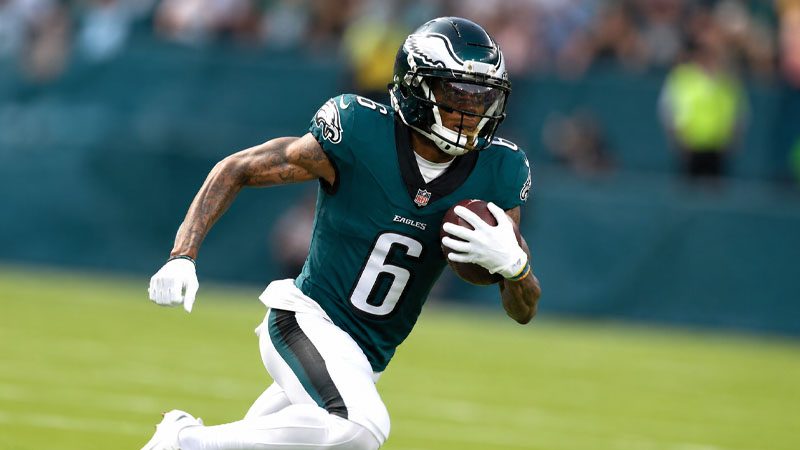
Draft analysts unanimously agreed that Smith’s functional speed on the field was considerably faster than straight-line projections. His elite acceleration and highly precise route-running mechanics allowed him to bypass defensive backs with ease.
By eliminating wasted motion in his breaks, he maintains a higher speed through his routes than athletes with faster track times.
Outrunning SEC Defenses on Game Tape
The ultimate proof of his velocity remains his college film. Smith consistently outran elite defensive backfields in the highly competitive SEC, routinely separating on deep vertical routes.
This game tape demonstrated that his practical playing speed translated into immediate separation against future professional cornerbacks, making stopwatch testing redundant.
The Bold Pre-Draft Challenge to Henry Ruggs
Smith’s personal confidence in his velocity was clear prior to entering the professional ranks. In pre-draft interviews, he confidently stated that he could beat his former Alabama teammate Henry Ruggs III’s blistering time of 4.27 seconds.
While he never got the chance to officially prove this on a track, it highlights the high ceiling of his athletic self-assurance.
Frequently Asked Questions About DeVonta Smith’s Speed
Did DeVonta Smith run at the NFL Scouting Combine?
No, Smith did not run at the 2021 NFL Scouting Combine. He was recovering from a severe dislocated finger sustained during the College Football Playoff National Championship game.
What is DeVonta Smith’s projected 40-yard dash time?
Draft scouts and analysts project his true 40-yard dash speed to be between 4.45 and 4.50 seconds based on his dominant college game film and high school baselines.
What was DeVonta Smith’s speed in high school?
As a high school recruit out of Amite High School in Louisiana, he registered a verified combine time of 4.49 seconds.
How does PlayerProfiler calculate his speed?
PlayerProfiler uses an algorithmic projection known as a “Speed Score” to evaluate his athletic percentiles, which places him at 4.54 seconds.
Could DeVonta Smith actually beat Henry Ruggs’ 40-yard dash time?
While Smith confidently claimed in pre-draft interviews that he could beat his teammate’s blazing 4.27-second mark, he never officially ran on the clock to prove this claim.
Conclusion: Why Pad Velocity Triumphs Over Stopwatches
In the modern NFL, raw stopwatch times are increasingly viewed alongside functional in-game speed metrics.
While the lack of an official physical testing record at the combine leaves a permanent gap in his draft profile, DeVonta Smith’s career has shown that on-field execution is the ultimate evaluator.
From his early days at Amite High School to his Biletnikoff and Heisman-winning campaigns at Alabama, his elite acceleration, fluid route transitions, and outstanding playmaking ability have consistently surpassed any theoretical numbers.
Ultimately, whether his true track speed is closer to his 4.49-second high school baseline or the scouts’ 4.45-second projections, his ability to separate from elite defenders remains unquestioned.
For franchises evaluating long-term performance, functional game speed will always outweigh empty track numbers.