
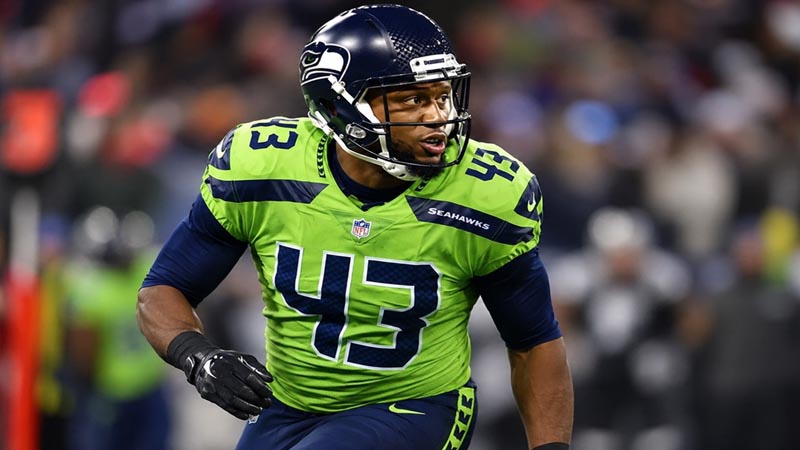
The professional trajectory of a high-caliber defensive end in the National Football League is rarely a linear path. It is a complex narrative of physical endurance, tactical adaptation, and the eventual transition from being a franchise cornerstone to a strategic asset.
Currently, the conversation surrounding Carlos Dunlap centers on a fundamental question of roster status: Is he a starter?
To address this with the precision required for high-level professional analysis, one must look at the current NFL landscape. As of the present moment, Carlos Dunlap is an unattached free agent.
This status confirms that he is not a starter on any active NFL roster. However, his journey through the league—spanning tenures with the Cincinnati Bengals, Seattle Seahawks, and Kansas City Chiefs—offers a masterclass in how elite athletes redefine their utility as their careers progress.
The Evolution of the Defensive Anchor
For the better part of a decade, the term “starter” was synonymous with Carlos Dunlap. During his extensive tenure with the Cincinnati Bengals, he was the primary engine of their defensive front.
In this era of his career, being a starter meant more than just being on the field for the first snap; it meant being a foundational piece of the organizational identity.
He was a player around whom defensive coordinators built their schemes, requiring opposing offensive lines to double-team him or risk immediate pressure on the quarterback.
However, the NFL is an industry defined by efficiency and the management of physical capital. As Dunlap matured, his role began to evolve.
The transition from the Bengals to the Seattle Seahawks and later the Kansas City Chiefs marked a shift in his professional application. He moved from a high-volume snap count to becoming a “key veteran rotational pass-rusher”.
Defining the “Rotational Starter” in Modern Football
In the contemporary NFL, the distinction between a “starter” and a “rotational specialist” is increasingly blurred, particularly on the defensive line.
Top-tier organizations, such as the Chiefs and Seahawks, often utilize a “platoon” system to keep their pass rushers fresh for the fourth quarter.
When Dunlap served as a key veteran rotational pass-rusher, he was often performing the duties of a starter during the most critical moments of the game.
A rotational player of his caliber is brought in on third-and-long situations or during two-minute drills where the primary objective is to disrupt the pocket.
While he might not have been listed first on the depth chart during these later stages, his impact on the win-loss column remained significant.
The Strategic Value of the Unattached Veteran
The fact that Dunlap is currently unattached does not necessarily signal the end of his professional utility. In the ecosystem of professional football, veteran free agents of his pedigree often exist in a state of “strategic availability.”
- Injury Contingency: Contending teams often lose key defensive ends during the grueling mid-season stretch. An unattached veteran who knows multiple systems is the first call a General Manager makes to fill a void in the starting lineup.
- Leadership and Mentorship: Beyond his physical contributions on the field, Dunlap’s experience with three distinct organizations allows him to act as a “coach on the field” for younger players.
- Situational Excellence: For a team with championship aspirations, having a player who has “seen it all” is invaluable. Dunlap’s ability to diagnose offensive line shifts and capitalize on technical flaws is a skill that does not diminish with age.
Analyzing the Free Agency Landscape
Being “unattached” in the later stages of a career is frequently a calculated move by the athlete as much as it is a result of market demand.
A player with Dunlap’s resume may choose to remain a free agent until a specific opportunity arises—one that offers not just a roster spot, but a chance to contribute to a postseason run.
The market for a veteran pass-rusher is highly specialized. Teams looking to rebuild with youth are unlikely to sign a veteran of his stature, as they prioritize developmental snaps for rookies.
Conversely, teams in the “win-now” window value the reliability and specific skill set that Dunlap provides. His history as a starter and a rotational force makes him a versatile tool for any defensive coordinator looking to add depth to their front four.
The Legacy of a Defensive Mainstay
Regardless of his current status, Dunlap’s career reflects the high standards of professional excellence.
To spend over a decade in the NFL, moving between major markets and maintaining a reputation as a productive pass-rusher, is a feat achieved by very few.
His time in Cincinnati established him as a premier talent, his stint in Seattle proved he could adapt to new schemes, and his tenure in Kansas City demonstrated that he could contribute to a championship-level environment.
In each of these chapters, whether he was the designated starter or a rotational specialist, he remained a focal point of the defensive strategy.
Conclusion: Impact Over Title
Is Carlos Dunlap a starter today? Technically, no, as he is currently a free agent. However, defining his value through a binary lens of “starter vs. non-starter” ignores the nuance of professional football.
Throughout his career, Dunlap has demonstrated that his presence on the field—regardless of the snap count—changes the dynamic of the game.
For any organization looking to bolster their defensive line, the availability of an unattached veteran with his history is a significant opportunity.
He remains one of the most respected figures in the league, a testament to the longevity and skill required to thrive at the highest level of American sports.






