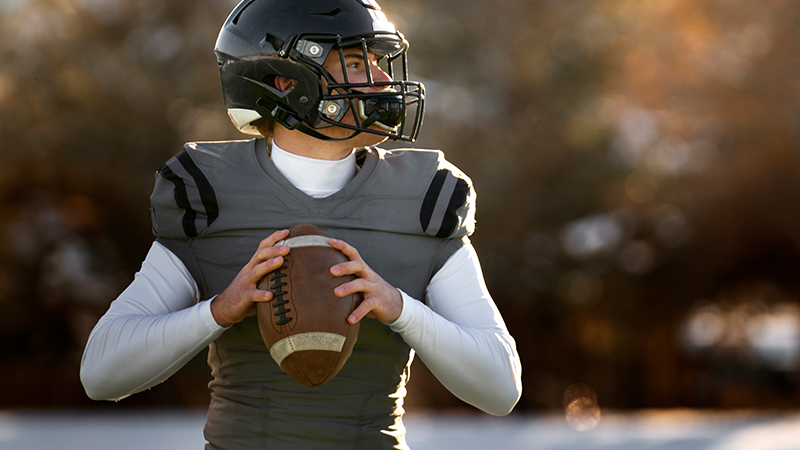
In the multi-billion-dollar, high-stakes environment of the NFL, every micro-adjustment can be the difference between a Super Bowl ring and a missed opportunity.
One of the most ubiquitous, yet frequently misunderstood, sights on the gridiron is a quarterback darting their tongue across their fingertips before a snap.
To the casual observer, it might seem like a strange, perhaps even unhygienic, tic. However, to the professional athlete, this gesture is a calculated move rooted in physics, environmental adaptation, and cognitive psychology.
This deep-dive analysis explores why elite signal-callers—from legends like Joe Montana to modern masters like Patrick Mahomes—rely on this “secret sauce” to maintain control of the game.
The Physics of Friction: Why Moisture is the Quarterback’s Best Friend
At its core, the reason quarterbacks lick their fingers is a matter of tactile sensitivity and friction. A regulation NFL football is a precision instrument, weighing between 14 and 15 ounces and covered in a pebbled leather surface.
While this texture is designed for grip, the leather itself can become remarkably slick, especially when it is brand new, very dry, or exposed to cold temperatures.
1. Enhancing the Coefficient of Friction
When a player’s hands are dry, the friction between the skin and the leather decreases. This lack of “tackiness” makes the ball feel “like glass,” as Aaron Rodgers once described it during a freezing matchup against the Dallas Cowboys. By licking their fingers, quarterbacks introduce a thin, controlled layer of moisture.
This saliva acts as a natural adhesive enhancer. It doesn’t necessarily make the hand “sticky” in the way glue does, but it dampens the skin just enough to increase its pliability.
This allows the ridges of the fingerprints to better fit into the pebbled texture of the football, creating a superior seal and significantly reducing the risk of the ball slipping during the high-velocity motion of a throw.
2. Tactile Feedback and Release
Accuracy in passing relies on the “feel” of the ball as it leaves the hand. Improved moisture levels increase tactile sensitivity, allowing a quarterback to feel the laces and the leather more acutely.
This split-second increase in sensory feedback allows for a cleaner release and better rotational spin, which is essential for “tight spirals”.
Environmental Triggers: Battling the Elements
While the habit is seen in all conditions, certain environments turn finger-licking from a preference into a necessity.
The Impact of Cold and Arid Climates
Cold air is notoriously dry. In sub-freezing temperatures, the natural oils and moisture in a player’s skin evaporate quickly, leaving hands stiff and “smooth”.
Aaron Rodgers provides a perfect case study: during a 22°F game, he was observed licking his fingers before 78% of his dropbacks, a rate far higher than his average in warmer weather. The moisture provides that “half-second edge” needed to secure the ball before the defense closes in.
The Paradox of the Wet Field
It might seem counterintuitive to add moisture to your hands when it’s already raining. However, wet leather is deceptively slick. In rainy conditions, saliva can help create a temporary layer of adhesion that helps the hand “cut through” the surface water on the ball until the hand re-dries.
| Condition | Effect on Grip | Strategic Response |
|---|---|---|
| Cold/Dry Air | Dries skin, reduces friction | Frequent licking to restore moisture |
| Rain/Wet Field | Leather becomes “greasy” and slick | Creates temporary adhesion layer |
| Hot/Arid Climate | Rapid sweat evaporation | Quick moisture boost pre-snap |
| Indoor Dome | Stable, controlled environment | Becomes a ritualistic “mental anchor” |
A Century of Tradition: The Historical Evolution of the Grip
The practice of licking fingers is not a modern fad; it is a legacy passed down through generations of players. Its origins date back to the early 20th century, an era where football was a much grittier affair.
From Dusty Fields to Professional Turf
In the 1940s, players like Sid Luckman competed on uneven, often dusty or muddy fields. Equipment was not standardized, and the balls were made of heavy leather that would either absorb water and become a “leaden weight” or dry out and become impossibly slick. Modern luxuries like synthetic, high-tack gloves or sideline heaters didn’t exist.
Quarterbacks had to rely on instinctive, immediate solutions to maintain control of the game. Licking fingers was the simplest tool in their arsenal.
Over the decades, this behavior became ingrained in the culture of the position, taught by veteran pros to rookies as a fundamental “trick of the trade”.
The Psychology of the “Pre-Snap Anchor”
Beyond the physical benefits of friction, there is a powerful psychological component to this habit. In the high-pressure environment of a two-minute drill, routines provide a sense of control.
Cognitive Triggers and Rituals
As Dr. Alan Resnick, a sports psychologist, notes, “Repetition breeds confidence”. For many quarterbacks, the act of licking their fingers has evolved into a cognitive trigger. It is a “mental anchor” that signals to the brain that it is time to focus, reset, and execute.
This explains why quarterbacks who play in climate-controlled domes—where the humidity is perfectly stable—still lick their fingers.
The physical need for moisture may be absent, but the mental need for the ritual remains. It is a moment of intentionality, much like a musician tuning their instrument or a golfer taking a specific number of practice swings.
The Element of Superstition
Athletes are famously superstitious. If a quarterback licks his fingers and then throws a 50-yard touchdown, a subconscious link is formed.
Legendary QB Brett Favre once admitted that he didn’t even remember when the habit started, but he couldn’t stop because “it just felt wrong not to”. This highlights how these micro-behaviors become a core part of an athlete’s identity and game-day “flow”.
Beyond the Quarterback: A Team-Wide Practice
While the quarterback is the most visible “licker,” the practice extends to other positions where grip is paramount.
- Wide Receivers and Tight Ends: These players often use saliva to “re-activate” the stickiness of their rubberized or silicone-palmed gloves. When gloves get covered in dust or turf pellets, a little moisture can restore their tacky surface.
- Running Backs: For a running back, the ball is their most prized possession. In wet or cold conditions, they may moisten their hands to ensure they can “tuck” the ball securely against their ribs, preventing a game-changing fumble.
Modern Innovations and the “Hygiene” Shift
As we move further into the 21st century, the “gross factor” of licking fingers has come under scrutiny, particularly in the post-pandemic era. While the NFL has not banned the practice, there is a growing trend toward cleaner alternatives.
High-Tech Alternatives
Today’s athletes have access to gear that would have seemed like science fiction to players of the 1950s.
- Advanced Gloves: Modern QB gloves feature “sticky” palms that mimic the friction of moist skin without the need for saliva.
- Sideline Tools: Many teams now use sideline spray bottles, damp towels, or “tack” bags (similar to a pitcher’s rosin bag) to provide moisture or grip-enhancing agents.
- Skin Insulation: In extreme cold, players use petroleum jelly on their skin. While this doesn’t help with grip (it’s actually quite slippery), it acts as an insulator to prevent the skin from losing warmth and moisture to the wind.
FAQs: Everything You Wanted to Know About the QB Finger Lick
1. Is it actually effective, or is it just a placebo?
It is scientifically effective. In dry conditions, moisture increases the coefficient of friction between human skin and leather. While the effect is short-lived, it lasts long enough for the duration of a single play.
2. Why don’t they just wear gloves?
Many do, but gloves can reduce “dexterity”. Many elite quarterbacks prefer the thumb and index finger to be exposed so they can feel the laces and make micro-adjustments during the throwing motion.
3. Is it legal?
Yes. No major league—including the NFL, NCAA, or CFL—has banned the practice. While “deliberate spitting” (like at an opponent or official) is a penalized offense, moistening fingers for gameplay is considered a standard mechanical action.
4. What do they do in the cold besides licking fingers?
Players use a variety of “old school” and “new school” methods:
- Chicken Broth/Soup: Provides warmth, electrolytes, and protein to keep the core temperature up.
- Latex Gloves: Worn under standard gloves to trap body heat.
- Petroleum Jelly: Applied to exposed skin to prevent windburn and heat loss.
Conclusion: The Enduring Legacy of the Grip
The sight of a quarterback licking their fingers is a fascinating intersection of primitive instinct and elite performance. It is a reminder that even in an era of advanced analytics, GPS tracking, and synthetic materials, the game of football still comes down to the most basic human elements: the connection between a player’s hand and the ball.
Whether it’s the physical requirement for friction on a frozen night in Green Bay or a psychological reset in a sun-drenched stadium in Miami, the finger-lick remains a vital part of the quarterback’s toolkit.
It is a small habit that carries a massive impact, bridging the gap between a century of tradition and the split-second decisions that define greatness.