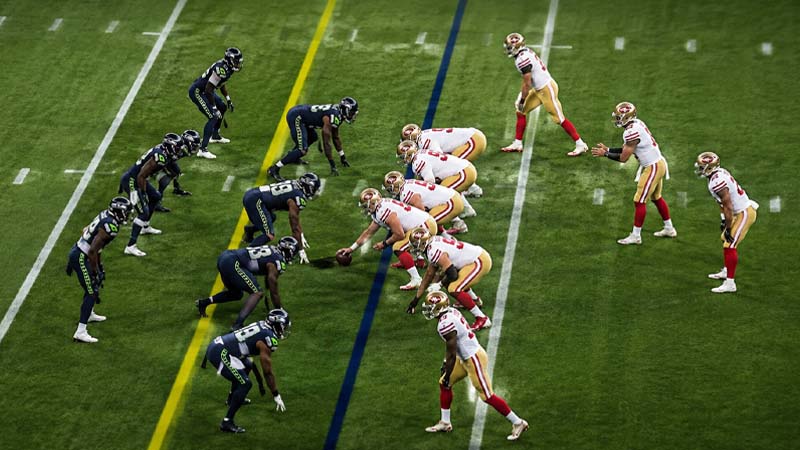
In the high-stakes environment of American football, the term “3rd and 7” represents a critical juncture where strategy, physical execution, and psychological pressure converge.
It is often referred to by coaches and analysts as a “money down,” a moment that can dictate the momentum of an entire game.
Understanding this scenario requires a look at the rules of the game and the strategic layers that professionals navigate on every drive.
The Fundamental Mechanics of 3rd and 7
At its core, American football is a game of territory and attempts. A team is granted a series of four opportunities, known as “downs,” to advance the ball at least 10 yards.
Success in this endeavor earns the team a “first down,” which resets the count and allows them another four tries to continue their progress toward the opponent’s end zone.
When a team faces a 3rd and 7 situation, it signifies they are on their third attempt and must gain exactly 7 or more yards to maintain possession and earn a fresh set of downs.
This specific distance—7 yards—is often classified as “medium-to-long,” placing the offense in a difficult position where the defense has a clear statistical advantage.
The Path to the Third Down
A drive typically begins with a “1st and 10” scenario. The progression to 3rd and 7 usually indicates a drive that has stalled after a promising start or one that has been hampered by efficient defensive play.
The Typical Progression to 3rd and 7:
| Down | Situation | Play Outcome | Resulting Distance |
|---|---|---|---|
| 1st Down | 1st and 10 | 3-yard gain (Run or Pass) | 2nd and 7 |
| 2nd Down | 2nd and 7 | 0-yard gain (Incomplete or Stuffed Run) | 3rd and 7 |
| 3rd Down | 3rd and 7 | Critical Play | TBD |
In this sequence, the offense achieved some success on the first play but failed to capitalize on the second, leaving them with one final realistic chance to move the chains.
The Strategic Landscape: Offense vs. Defense
A 3rd and 7 is a tactical chess match. Because 7 yards is a significant distance, it usually necessitates a passing play, although sophisticated offensive coordinators may use “draw” runs or “screen” passes to catch a fast-pursuing defense off-guard.
Offensive Priorities
The primary objective is simple: reach the 7-yard marker. However, the execution is complex.
- Protection: The offensive line must hold back the pass rush for an extended period, as 7-yard routes take longer to develop than short 2-yard “slants.”
- Route Depth: Receivers must run their routes to a depth of at least 7 yards—a concept known as “reaching the sticks.”
- Quarterback Precision: The quarterback must deliver the ball accurately into windows that the defense will be working to close.
Defensive Priorities
The defense holds the upper hand in a 3rd and 7 scenario. Since they know the offense likely needs a 7-yard gain, they can adjust their “coverage shells” to protect the area near the first-down marker.
- The Pass Rush: Knowing a pass is likely, defensive ends may “pin their ears back” and sprint toward the quarterback to force a sack or a hurried, inaccurate throw.
- Coverage Layers: Defensive backs often play “at the sticks,” meaning they align themselves right at the 7-yard line to tackle any receiver the moment they catch the ball, preventing them from gaining the necessary yardage.
Success and the “Reset”
Achieving a success on 3rd and 7 is one of the most rewarding moments for an offensive unit. If the team manages to advance the ball 7 yards or more through a successful run or completion, the down count immediately resets to “1st and 10”.
This “moves the chains,” allowing the offense to keep their rhythm, tire out the opposing defense, and move closer to a scoring opportunity.
Beyond the yardage, a 3rd-down conversion is a massive psychological boost. It signifies that the offense can execute under pressure, even when the defense knows exactly what is coming.
The Consequences of Failure
If the offense fails to gain the 7 required yards, the situation becomes “4th down”. In professional and high-level collegiate football, 4th down is rarely used for a fifth attempt to gain yardage unless the team is very close to the opponent’s goal line or the game is in its closing minutes.
- The Decision to Punt: Because 7 yards is considered a medium-to-long distance, the risk of failing on 4th down is too high. Failing on 4th down results in a “turnover on downs,” giving the opponent the ball at the exact spot where the play ended.
- Field Position: To avoid giving the opponent a short path to the end zone, teams will almost always use the 4th down to punt the ball away. This kicks the ball deep into the opponent’s territory, forcing them to start their own drive from a much further distance.
The Evolution of the 3rd Down Strategy
While the fundamental rules of 3rd and 7 are static, the way teams approach this distance has evolved with the rise of modern analytics and “West Coast” offensive schemes.
- The “Check-Down” Philosophy: Sometimes, a quarterback will throw to a running back only 3 yards downfield, hoping the player can use their athleticism to run for the remaining 4 yards. This is a high-percentage pass, but it relies heavily on “yards after catch” (YAC).
- Analytics and Go-For-It Rates: Modern data suggests that in certain parts of the field (specifically between the opponent’s 35 and 45-yard lines), teams should be more aggressive. However, 7 yards remains a formidable barrier that usually dictates a conservative punting decision if the 3rd down fails.
Key Components of the 3rd and 7 Experience
To fully grasp the weight of this moment, consider these pillars of the 3rd and 7 scenario:
- The Line to Gain: This is the invisible (and on TV, yellow) line that represents the 7-yard requirement.
- The Crowd Noise: In away games, the home crowd will be at their loudest on 3rd down to disrupt the offense’s communication.
- The Substitution Package: Teams often bring in specialized players—”3rd down backs” who are great at catching or “pass rush specialists”—specifically for this one play.
Analyzing the Pressure: A Professional Perspective
From a management and leadership standpoint, 3rd and 7 is about resource allocation and risk management. An organization invests millions into a quarterback and wide receivers specifically to solve the “3rd and long” problem.
If a team cannot consistently convert these distances, their “Time of Possession” will drop, their defense will become overworked, and their win probability will plummet.
Operational Impact of 3rd Down Efficiency:
- Sustainability: High conversion rates lead to longer drives and more scoring opportunities.
- Defensive Rest: Successful conversions keep the team’s defense on the sideline, allowing them to remain fresh for late-game situations.
- Field Tilt: Consistently failing on 3rd and 7 leads to frequent punting, which eventually loses the “field position battle”.
Summary of the 3rd and 7 Lifecycle
- Origin: The drive begins at 1st and 10.
- Stagnation: Gains on first and second down total only 3 yards, or a 10-yard gain was negated by a 3-yard loss, resulting in the need for 7 more.
- The Play: The offense attempts a high-leverage play to reach the 7-yard marker.
- The Pivot:
- Success: The team reaches the marker, resetting the downs to 1st and 10.
- Failure: The team falls short, leading to 4th down and a likely punt.
Conclusion
3rd and 7 is more than just a number on a scoreboard; it is a definitive test of a team’s composure and execution.
It encapsulates the “bend but don’t break” philosophy of modern defenses and the “precision and timing” requirements of modern offenses.
For the viewer, it is the moment to lean in, as the outcome of this single play often determines the direction of the game.
Whether you are a casual observer or a dedicated student of the game, recognizing the significance of 3rd and 7 allows you to see the underlying strategy of American football.
It is the threshold where drives are kept alive or sent to the sidelines, and where the game’s greatest stars earn their reputations.