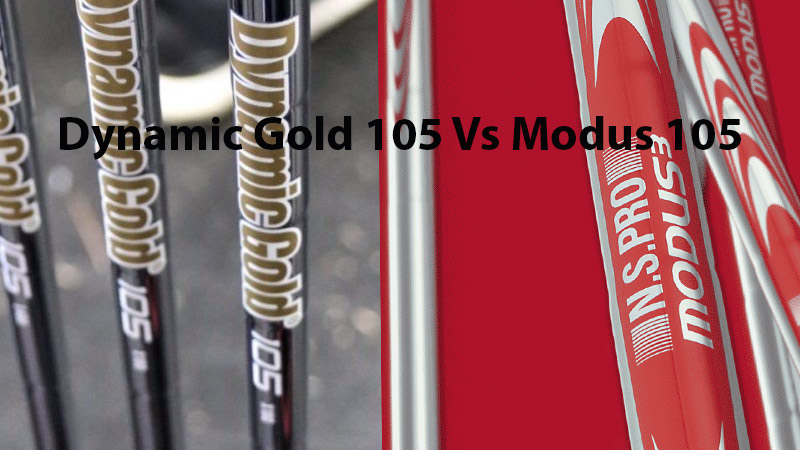
In the contemporary era of golf equipment manufacturing, the “middleweight” steel shaft category—specifically the 105-gram segment—has emerged as the gold standard for players seeking a bridge between heavy Tour-weighted shafts and ultra-light graphite options.
However, a common misconception among amateur and even competitive golfers is that performance is uniform across shafts of the same weight class.
The reality is that manufacturing processes, metallurgical compositions, and profile designs create vast performance gaps that can significantly impact a player’s launch, spin, and dispersion.
As part of our commitment to data-driven equipment analysis, this report provides a comprehensive deep dive into two of the industry’s most prominent contenders: the True Temper Dynamic Gold 105 and the Nippon N.S. Pro Modus3 Tour 105.
By examining rigidity zones, launch characteristics, and real-world testing data, we aim to provide the strategic insight necessary for an optimized fitting.
The Anatomy of Stability: True Temper Dynamic Gold 105
True Temper’s Dynamic Gold (DG) brand has long been synonymous with the “gold standard” of steel shafts on professional tours.
The Dynamic Gold 105 was engineered to provide the legendary stability of the original DG in a package that is roughly 25 grams lighter, making it accessible to a broader range of swing speeds.
Performance Profile and Launch Characteristics
The DG 105 is designed as a mid-launch shaft. One of its most critical performance hallmarks is its resistance to “ballooning”—a phenomenon where high-swing-speed players create too much backspin, causing the ball to climb vertically and lose distance. In rigorous testing, the DG 105 maintained a penetrating trajectory even under aggressive loading.
The shaft features a stiff tip section, which is a vital component for head control. This rigidity ensures that the clubface remains stable through the impact zone, particularly on off-center hits.
This makes the DG 105 an exceptional choice for players who prioritize “workability”—the ability to shape shots left-to-right or right-to-left—and “dispersion,” which refers to the tightness of the shot grouping.
The “Graphite-Steel” Hybrid Feel
Perhaps the most unique aspect of the DG 105 is its tactile feedback. While it is a steel shaft, its feel is often described as being akin to a graphite shaft.
This “smoothness” is attributed to a kick point located just below the midsection. For players with a deliberate swing tempo and a smooth transition from the top of the backswing, this profile offers a seamless loading experience that doesn’t feel overly boardy or harsh.
The Precision of Activity: Nippon N.S. Pro Modus3 Tour 105
Nippon Shaft, a powerhouse in Japanese metallurgy, has captured significant market share with the Modus3 series. The Nippon Modus 105 is often viewed as the “livelier” counterpart to the DG 105, offering a distinct profile that caters to players looking for a more active loading sensation.
High Launch and Soft Landings
In direct contrast to the DG 105, the Nippon Modus 105 produces a slightly higher launch. This is primarily due to a higher kick point compared to its True Temper rival.
The practical benefit of this higher trajectory is “soft landings”—the ability for the ball to descend at a steeper angle and stop quickly on the green.
Furthermore, the Modus 105 is engineered with lower overall spin rates, which, when combined with the higher launch, results in longer carries and increased rollout.
In head-to-head 7-iron testing, the Modus 105 consistently outperformed the DG 105 in distance, gaining an average of 3 yards.
The “Active” Sensation and Consistency
While the DG 105 feels smooth and stable, the Nippon Modus 105 is characterized by a more active feel. This does not equate to a lack of control; rather, there is a “clear kick on release” that feels powerful yet predictable.
Testing indicates that this active profile actually contributes to tighter groupings (dispersion) for many players, suggesting that the shaft’s loading and unloading cycle is exceptionally consistent across various swings.
The Statistical Breakdown
| Metric | Dynamic Gold 105 | Nippon Modus 105 |
|---|---|---|
| Launch Angle | Mid | Mid-High |
| Spin Rate | Moderate/High | Lower |
| Distance (7-Iron) | Base | +3 Yards |
| Dispersion | Steel-like control | Slightly tighter |
| Flex Options | R, S, X | R, S, X |
| Overall Score | 96/100 | 97/100 |
The Spin Factor
The primary reason for the distance disparity between these two shafts is spin. The DG 105 was observed to pick up more sidespin during testing compared to the Nippon.
While sidespin can be a tool for the highly skilled player looking to curve the ball, for the average golfer, it can lead to wider dispersion and lost yardage.
The Nippon’s ability to minimize this spin while maximizing launch angle makes it a “distance gainer” for the mid-to-high handicap demographic.
Strategic Application: From Long Irons to Wedges
A shaft’s performance can vary significantly depending on the clubhead it is paired with. A comprehensive fitting strategy must consider the entire bag.
Long Irons
The DG 105 shines here for players who struggle with a “hook” or “slice,” as it helps maintain a straighter flight path.
However, for those who struggle to get the ball airborne, the Nippon Modus 105 offers a strong trajectory that makes long irons easier to hit.
Wedges
The DG 105’s stiff tip provides excellent control over the wedge head, which is crucial for precision around the greens.
Conversely, the Modus 105’s launch and spin characteristics are highly advantageous when playing from tight lies, allowing for an aggressive strike that still lands softly.
The Driver Gap
It is important to note that both the DG 105 and the Modus 105 are generally considered too light for driver use for the majority of players.
For the tee box, heavier or more specialized graphite shafts are usually required to handle the higher swing speeds and different loading profiles of modern drivers.
User Persona and Fitting Recommendations
Choosing the “superior” shaft is a subjective exercise based on individual swing mechanics. Based on our data, we have developed the following player personas to guide your selection.
Persona A: The “Smooth Tempo” Traditionalist
- Recommended Shaft: Dynamic Gold 105
- Profile: You have a moderate swing speed and a deliberate, smooth transition at the top.
- Why: You value the “deadened” and stable feel of traditional steel but want the weight benefits of a modern shaft. You are likely transitioning from graphite and want a seamless change that doesn’t feel “whippy”.
Persona B: The “Aggressive/High Launch” Seeker
- Recommended Shaft: Nippon Modus 105
- Profile: You are a mid-to-high handicapper looking for “easy distance” (roughly half a club gain).
- Why: You prefer a “lively” feel and need help getting the ball into the air with enough height to stop on the green. You prioritize consistency and tight dispersion over the ability to work the ball.
Enhanced FAQ: Technical Insights for the Competitive Golfer
Q: Can I “overload” these lightweight shafts?
A: Yes. Specifically with the DG 105, players with extremely high swing speeds or very aggressive transitions may find they cannot load the shaft too much without losing feedback or consistency. If you consistently swing at Tour-level speeds, a 120g or 130g shaft may be more appropriate.
Q: Is the 3-yard distance gain with the Nippon consistent across all irons?
A: While testing focused on the 7-iron, the Modus 105 generally provides a distance boost throughout the mid-irons. However, as you move into the 9-iron and wedges, the gap may narrow as control and spin become more important than raw yardage.
Q: Why does the Nippon Modus 105 score higher (97/100) than the DG 105 (96/100)?
A: The Nippon narrowly edges out the DG 105 because it offers a rare combination of higher launch, lower spin, and tighter dispersion. It is a “workhorse” shaft that fits a wider variety of players more effectively.
Conclusion: The Verdict on the 105g Battle
The choice between the Dynamic Gold 105 and the Nippon Modus 105 ultimately comes down to a trade-off between stability and activity.
The Dynamic Gold 105 is a masterpiece of control for the smooth-swinging player who wants a traditional, stable feel with the ease of a lightweight design.
It is the perfect “transitional” shaft for those moving away from graphite who do not want to sacrifice the “steel” profile they trust.
The Nippon Modus 105, however, represents the pinnacle of modern lightweight steel engineering. By providing a livelier feel, higher launch, and tighter dispersion, it offers a tangible performance boost—often resulting in a half-club of extra distance.
For the mid-handicapper looking to optimize their scoring potential, the Nippon Modus 105 is the superior technical choice.
Regardless of the data, we strongly recommend a professional fitting. As manufacturing processes continue to evolve, the “feel” of a shaft remains the most critical factor in a golfer’s confidence at address.