Kevin Durant’s natural position is Small Forward (SF). Despite possessing the 6’11” frame and 7’4″ wingspan of a traditional center, his scoring data and technical mechanics firmly establish him as a perimeter operator.
Throughout his nearly twenty-year career, Durant has accumulated 27,300 points as a small forward, highlighting his comfort on the wing where his guard-like ball-handling and unguardable high release point are most effective.
By operating away from the paint, he avoids the physical fatigue of low-post battles, maximizing his efficiency as the most versatile scoring weapon in professional basketball history.
Analyzing the Positional Evolution of Kevin Durant
Analyzing the career trajectory of Kevin Durant reveals a strategic deployment across the floor, as coaches have historically shifted his alignment to balance his elite offensive output with the physical demands of the professional game.
The Shooting Guard Experiment in Seattle
During his rookie campaign with the Seattle SuperSonics in the 2007–2008 season, head coach P.J. Carlesimo famously started Durant at the “2” guard position. This tactical decision was not based on Durant’s lack of height, but rather a protective measure for his thin frame.
By placing him on the perimeter as a shooting guard, the coaching staff shielded him from the grueling interior physical play of the era.
This early deployment allowed Durant to refine his perimeter mechanics, ensuring that his foundational playstyle was rooted in guard-like agility rather than back-to-the-basket power.
The Small Forward Dominance in Oklahoma City and Oakland
Following his rookie year, Durant moved to his natural home at small forward, where he experienced his most dominant “apex” era.
During his tenure with the Oklahoma City Thunder (2008–2016), he functioned as a pure slashing and pull-up wing while playing alongside traditional interior anchors like Serge Ibaka and Kendrick Perkins.
This trend continued during his time with the Golden State Warriors, where he maintained his primary role as a small forward.
However, he regularly maximized the team’s legendary “Death Lineup” as a hybrid rim protector, demonstrating that his length allowed him to occupy multiple roles without losing his identity as a perimeter scorer.
The Modern Shift to Hybrid Power Forward
As the professional league transitioned toward “positionless” basketball, Durant’s primary alignment began to drift toward the power forward (PF) spot.
Starting with his time at the Brooklyn Nets and continuing through his stints with the Phoenix Suns and the Houston Rockets, he has played extensive minutes at the “4”.
This evolution allows teams to stretch opposing interior defenses, pulling heavy centers away from the rim to create space for driving lanes.
In the 2025–2026 season with the Rockets, tracking models frequently categorize him as a stretch power forward to anchor court spacing, even as he continues to drift natively to the wing.
Why Small Forward is Kevin Durant’s Best Position
While his versatility allows him to bridge multiple roles, specific tactical advantages make the small forward spot his most efficient home on the hardwood for both scoring and longevity.
Leveraging Open Geometric Spacing for Mid-Range Creation
Durant is widely recognized as one of the greatest mid-range and perimeter operators in the history of the sport. Operating from the wing provides him with the necessary geometric spacing to utilize his lethal triple-threat stance and pick-and-roll creation.
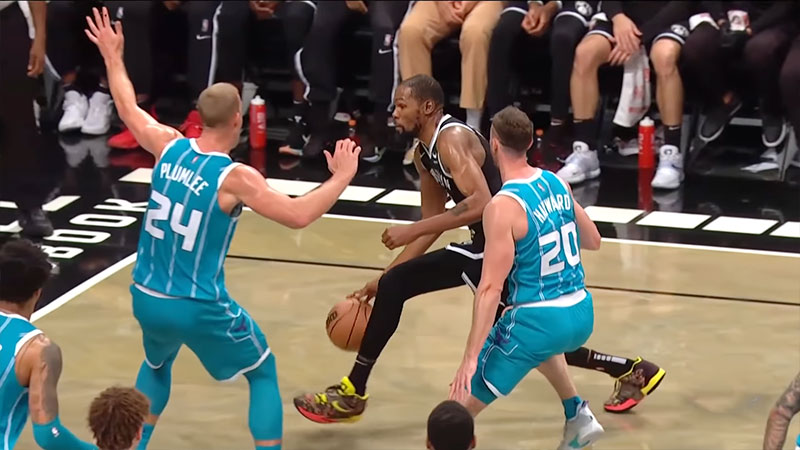
When positioned at the small forward spot, he has the freedom to navigate the perimeter, using his elite ball-handling to create separation for pull-up jumpers.
This spacing is essential for his “guard mindset,” allowing him to use crossovers and finesse to bypass defenders rather than relying on brute force in congested interior areas.
Enhancing Defensive Utility as a Weak-Side Rim Protector
Defensively, the small forward position offers Durant the “sweet spot” for utilizing his 7’4″ wingspan. It allows him to function as a roving help defender and a secondary rim protector.
By playing away from the primary interior assignment, he can use his length to disrupt passing lanes and block shots from the weak side without being tethered to a specific low-post player.
This versatility makes him a defensive nightmare, as he can switch onto multiple positions while still being available to assist in protecting the paint during transition or breakdown scenarios.
Preserving Energy and Minimizing Interior Body Contact
One of the primary reasons small forward remains his natural position is the preservation of his physical longevity.
Durant possesses a lean, thin build that is not designed to absorb the exhausting physical punishment of boxing out traditional centers for over 30 minutes a night. Playing the wing limits the wear and tear associated with constant low-block battles.
By avoiding these high-friction encounters, he can manage his energy more effectively, ensuring that his legendary scoring output remains high throughout the duration of a game and a demanding eighty-two-game season.
Why Is KD Not a Center Despite Having Elite Height?
It is often questioned why a player standing nearly seven feet tall avoids being categorized as a big man, yet the reasoning is rooted in both physical composition and offensive specialization.
Frame Limitations and the High Center of Gravity
Despite his height, Durant has historically resisted being labeled a center or a traditional “big”. Early in his career, he even preferred to be announced at 6’9″ to avoid being pigeonholed into the low post.
His physical frame is built for fluidity rather than mass; he lacks the heavy weight required to anchor the paint against the league’s most powerful interior players.
Additionally, his high center of gravity makes him less effective in back-to-the-basket scenarios where lower-body leverage is the primary requirement for success.
Strategic Avoidance of Low-Post Physical Friction
Placing Durant at center full-time would drastically deplete his offensive efficiency. The energy required to bang with physical interior players for 35 minutes per night would leave him exhausted on the offensive end.
Durant has openly admitted that he does not want to be utilized as a traditional big man because of the “exhausting physical punishment” inherent in the role.
Consequently, he has only played the center position during brief, niche small-ball situational stints where his team prioritized speed and spacing over traditional interior presence.
The Opportunity Cost of Wasting Elite Guard Skills
Sticking Durant in the low post would represent a significant waste of his most elite attributes. He possesses ball-handling skills comparable to an elite guard and a shooting ability that ranks among the all-time greats.
If he were restricted to the paint as a center, the team would lose his ability to run the fast break, operate in isolation on the perimeter, and execute the crossover moves that make him unguardable.
His natural instinct is to face the basket and create, a skill set that is far better utilized from the wing or the “stretch 4” position.
Data Analysis: Kevin Durant Career Position Track Record
The following data points highlight how Durant’s scoring and role have been distributed across different positions throughout his professional journey.
| Position | Total Career Points (Approximate) | Primary Era |
|---|---|---|
| Small Forward (SF) | 27,300 | OKC, Warriors, Early Nets |
| Power Forward (PF) | 3,673 | Late Nets, Suns, Rockets |
| Shooting Guard (SG) | 1,624 | Sonics (Rookie Year), Niche Lineups |
| Center (C) | Negligible | Small-Ball Niche Stints |
What Position Does Kevin Durant Play Currently?
In the current professional landscape, specifically during the 2025–2026 season with the Houston Rockets, Durant’s position is more fluid than ever before.
While he is often categorized as a power forward in modern lineups to optimize floor spacing, his role remains that of a perimeter-oriented scorer.
Head coach Ime Udoka has noted that while Durant is comfortable at every position, the current system allows him to play more in his natural role as the “three” (small forward).
The Rockets utilize him in a variety of ways to exploit mismatches:
- Power Forward (PF): Acting as a stretch “4” to pull defenders out of the paint.
- Small Forward (SF): Drifting to the wing for primary scoring volume and mid-range isolation.
- Shooting Guard (SG): Appearing in jumbo-sized lineups as a literal 7-foot shooter to overwhelm smaller perimeter defenders.
Enhanced FAQ: Kevin Durant Positional Inquiries
What is Kevin Durant’s main position?
Kevin Durant’s main position is Small Forward (SF). While he frequently transitions to power forward depending on team composition and the need for modern spacing, his technical skills are those of a perimeter wing.
What position has Kevin Durant played the most?
Durant has overwhelmingly played Small Forward over his nineteen-year career. This was his dedicated role during his most dominant scoring years in Oklahoma City and his championship runs with the Golden State Warriors.
Can Kevin Durant play Shooting Guard?
Yes, he played shooting guard during his rookie season with the Seattle SuperSonics and continues to be deployed as a “7-foot shooting guard” in specific jumbo lineups with the Houston Rockets to maximize perimeter length.
Why doesn’t Kevin Durant play center full-time?
Durant lacks the heavy mass and physical frame required to box out traditional centers for an entire game. Playing center would also waste his elite perimeter isolation and ball-handling skills, while significantly increasing his risk of physical exhaustion.
Conclusion: The Legacy of a Positional Anomaly
Kevin Durant remains the ultimate positional anomaly in the history of the sport. While his physical measurements suggest he should be an interior force, his “guard mindset” and elite shooting mechanics have made the small forward position his true natural home.
By successfully navigating roles from shooting guard to power forward, he has redefined what it means to be a 7-foot player in the modern era.
Ultimately, whether he is stretching the floor as a “4” or dominating the wing as a “3,” Durant’s ability to remain a perimeter-first giant is what cements his status as an unguardable legend.