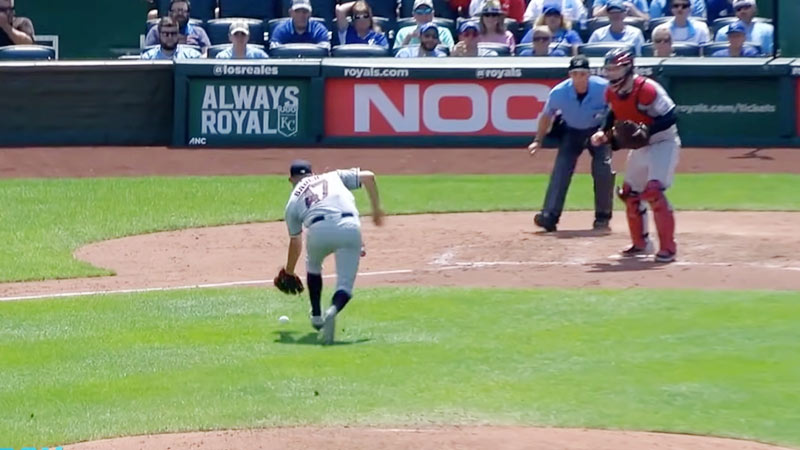
In the fast-paced environment of a baseball game, the basepaths often become a crowded intersection of athletes moving at high speeds.
One of the most common points of confusion for players, coaches, and fans alike is the protocol when a runner and a fielder occupy the same space. Specifically, can a runner stop in front of a fielder?
The short answer is no—not if that fielder is attempting to field a batted ball. Understanding the nuances of this rule is essential for maintaining “Game IQ” and avoiding costly penalties that can shift the momentum of an inning.
The Fielder’s Right of Way
The foundational principle governing these interactions is that the fielder has the right of way to catch or field a ball. In the eyes of the rules, the act of fielding a batted ball is the priority of the play.
Whether a fielder is stationary or in motion, they are protected under the rules to complete the play without hindrance.
If a runner stops, lingers, or deliberately blocks a fielder’s view while that fielder is trying to make a play, the runner is guilty of interference.
The consequences for this are immediate and severe: the runner is called out, and the play becomes a dead ball violation. This means no further runners can advance, and the play is effectively frozen.
The “No Contact” Misconception
A common gap in knowledge among amateur players is the belief that interference requires physical contact. However, according to the sources, physical contact is not necessary for an interference call to be made.
A runner can be called out if they simply hinder the fielder’s ability to make a play. This can happen in several ways that don’t involve a collision:
- Visual Obstruction: If a runner stops or moves in a way that blocks the fielder’s line of sight to the ball, they are interfering.
- Shadowing: Even if the runner doesn’t touch the fielder, by “lingering” in the immediate workspace of the fielder, they may prevent the fielder from having a clear path to the ball or a clean throwing lane.
Note: The specific technicalities of how an umpire judges “intent” or “hindrance” without contact are often based on training and positioning, which is context not explicitly detailed in the provided sources.
When the Fielder is at Fault: Understanding Obstruction
The protection of the fielder is not absolute; it is tied strictly to the act of fielding a batted ball. If the fielder is not in the act of fielding, the dynamic of the “right of way” flips entirely.
If a fielder who is not actively making a play on a ball intentionally blocks a runner’s path, they are guilty of obstruction.
In this scenario, the runner is the protected party, and the fielder is the one penalized for hindering the runner’s progress around the bases.
The Safe Haven: Standing on a Base
There is one notable exception to the interference rule regarding runners who have already reached their destination. A runner is generally not out for interfering if they are standing on a base they legally occupy.
This means that if a fielder must move toward a base to field a ball, and the runner is already standing on that bag, the runner is typically protected from an interference call.
However, this protection is revoked if the umpire deems the interference to be intentional. If a runner on a base makes a deliberate move to knock a ball away or physically shove a fielder, the “base exception” no longer applies, and they can be called out.
Runner vs. Fielder Rights
| Scenario | Ruling | Consequence |
|---|---|---|
| Runner stops/blocks fielder fielding a batted ball | Interference | Runner is out; Dead ball |
| Runner hinders fielder without touching them | Interference | Runner is out |
| Runner is on a legally occupied base | Protected | Generally safe (unless intentional) |
| Fielder blocks runner (not fielding a ball) | Obstruction | Penalty against the defense |