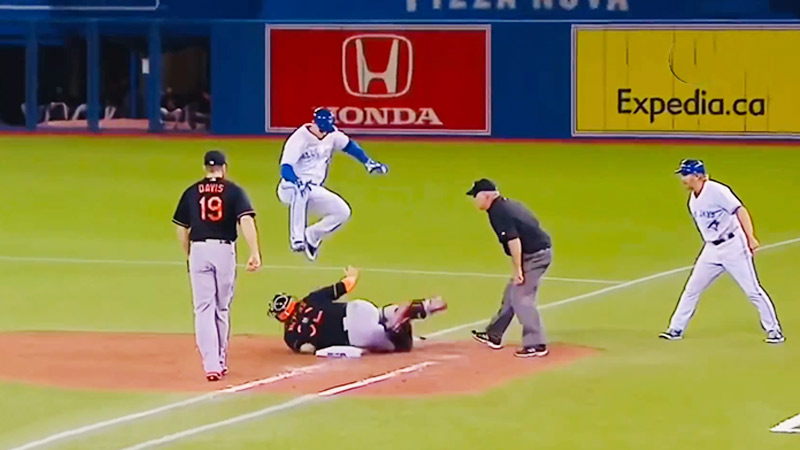
Yes, you can jump over the catcher in MLB. No rule in the Official Baseball Rules bans a runner from hurdling a catcher on a play at home plate, as long as the runner stays in his base path and does not try to run into the catcher.
Even so, it is one of the rarest plays in the major leagues, and when it happens, the clip spreads fast.
The question comes up every time a highlight shows a runner leaping over a crouched catcher, or when a youth coach watches a player try it and wonders whether it should be called out.
The answer depends on which level of baseball you are watching. Major League Baseball allows it. Many high school and amateur rulebooks restrict it.
This guide breaks down what the MLB rules say about jumping over the catcher, how the home plate collision rule changed the play, when a hurdle can still go wrong, and why so few big leaguers ever try it.
The Short Answer: Yes, Hurdling the Catcher Is Legal in MLB
Jumping over the catcher is legal in Major League Baseball. The MLB rulebook has no line that prohibits a runner from hurdling, leaping or jumping over a fielder, and that includes the catcher.
Umpires judge the play the same way they judge any other attempt to score: did the runner stay within the rules of the base path, did he touch the plate, and was he tagged first?
That makes the jump a legal way to avoid a tag. A runner can slide, dive, run around a fielder, or go over the top. Each move is allowed as long as the runner does not interfere with the fielder or break another rule along the way.
The legal question is simple. The practical question is harder. A legal play is not always a smart play, and hurdling a catcher carries more risk than reward in most situations. That is why it remains such a rare sight at the big league level, even though nothing in the rules stops a player from trying it.
What the MLB Rulebook Says About Jumping Over the Catcher
The Official Baseball Rules never mention hurdling by name. Instead, a jump is measured against the general rules that govern how a runner may travel between bases and reach home plate.
The most important one is the three-foot rule. Under Rule 5.09(b)(1), a runner is out if he runs more than three feet away from his baseline to avoid being tagged. The baseline is not a painted line.
It is the straight path from the runner to the base at the moment a fielder tries to tag him. A vertical jump keeps the runner in that path, so a clean hurdle does not break the rule.
Three other basics still apply when a runner goes over the catcher:
- The runner must touch home plate. A runner who leaps over a catcher and lands past the plate without touching it can be called out on an appeal.
- A tag counts in the air. If the catcher touches the runner with the ball, or with the glove holding the ball, before the runner reaches the plate, the runner is out, whether his feet are on the ground or not.
- Contact is judged on intent. A jump that turns into a knee or a cleat driven into the catcher can be ruled interference or a collision violation.
In short, MLB treats the hurdle as one more form of tag avoidance, not as a separate play with its own set of rules.
How the Home Plate Collision Rule Changed the Play
The rule that shapes this play most is Rule 6.01(i), MLB’s home plate collision rule. It was adopted in 2014, a few years after San Francisco Giants catcher Buster Posey suffered a season-ending leg injury in a 2011 collision at the plate.
Before that rule, runners were allowed to lower a shoulder and run through a catcher who was blocking the plate. Hard collisions were part of the game. Pete Rose barreling into Ray Fosse in the 1970 All-Star Game is still one of the most replayed examples.
The collision rule changed the play at home in two ways:
- A runner may not go out of his direct path to the plate to start contact with the catcher or any other player covering home.
- A catcher may not block the runner’s path to the plate unless he has the ball, or is making a legitimate attempt to field a throw. If he does, the umpire can call the runner safe.
These changes make a hurdle less necessary. Catchers now usually set up in front of or beside the plate and leave the runner a lane. A runner with a clear lane has no reason to go over the top. The jump becomes useful mainly when a catcher, ball in hand or reaching for a throw, ends up low and directly in the runner’s path.
Plays at the plate under this rule are also reviewable on replay, so a questionable jump near home can get a second look before the call stands.
When Jumping Over the Catcher Can Still Get You Called Out
A legal hurdle can still end in an out, or worse, a penalty. Umpires watch for five common problems:
- Leaving the baseline. Swerving more than three feet out of the direct path to dodge a tag, then jumping, is an out under the three-foot rule.
- Initiating contact. If the leap is really a way to drive a knee, cleat or forearm into the catcher, umpires can rule a violation of Rule 6.01(i). The runner is out, the ball is dead, and other runners return to the last base they touched.
- Interference. Kicking the glove or knocking the ball loose on purpose can be called interference.
- Missing the plate. Clearing the catcher and landing beyond home without touching it gives the defense an appeal.
- Getting tagged in mid-air. A catcher who reaches up with the glove can tag the runner before his feet come down.
Umpires also judge intent. A runner who clears a catcher cleanly and touches the plate is safe. A runner whose “jump” looks more like a flying shoulder into the catcher is likely to be ruled out, and the league may add a fine or suspension if it views the play as dangerous.
Why MLB Runners Rarely Jump Over the Catcher
Even though it is legal, very few MLB runners ever hurdle a catcher. The reasons are mostly physical and practical.
Time in the air
A slide keeps the runner moving toward the plate and low to the ground. A jump sends him upward, and every split second spent airborne gives the catcher time to apply the tag.
Body position
A catcher receiving a throw at home is often crouched or kneeling, but he can rise in an instant. A runner who commits to a jump cannot change course if the catcher stands up in front of him.
A bigger target
A sliding runner offers a small, moving target, often just a hand or foot reaching for a corner of the plate. A runner in the air exposes his whole body, especially his legs, to the glove.
Injury risk
Catchers wear shin guards, a chest protector and a mask. Clipping that gear mid-leap can send a runner down head first or twist an ankle or knee on landing. For a player a team has invested millions of dollars in, that risk is hard to justify.
Better options
Modern runners are trained in hook slides, swim moves and headfirst slides that reach for the back corner of the plate. These beat a tag more reliably than going over the top.
That is why a hurdle at home is usually an improvised reaction to a catcher lying in the path, not a planned play.
How the Rules Differ in High School, College and Youth Baseball
The answer to “can you jump over the catcher” changes once you leave the major leagues. Amateur rulebooks put more weight on player safety, and many limit or ban hurdling outright.
High school
Most U.S. high school games follow National Federation of State High School Associations (NFHS) rules.
Under those rules, diving over a fielder is illegal, and jumping or hurdling, is legal only when the fielder is lying on the ground. A runner who hurdles a standing or crouching catcher can be called out.
College and youth leagues
College baseball and youth organizations such as Little League publish their own rules on collisions and tag avoidance, and most are stricter than MLB’s. Some require a runner to slide or try to go around a fielder who has the ball and is waiting to make the tag.
If you coach or play below the professional level, check your league’s current rulebook before treating an MLB highlight as a model. A move that is legal on a big league field can mean an out, or even an ejection, in a high school or youth game.
Conclusion
Can you jump over the catcher in MLB? Yes. The major league rulebook does not ban hurdling, and a runner who stays in his base path, avoids contact and touches home plate can legally leap over a catcher to score.
What the rules do ban is going out of the way to crash into the catcher, and that line, drawn by the home plate collision rule, is where most problems begin.
In practice, slides beat tags more often and carry less injury risk, so the hurdle stays rare. Below the pro level, rules are stricter, so check your league’s rulebook.