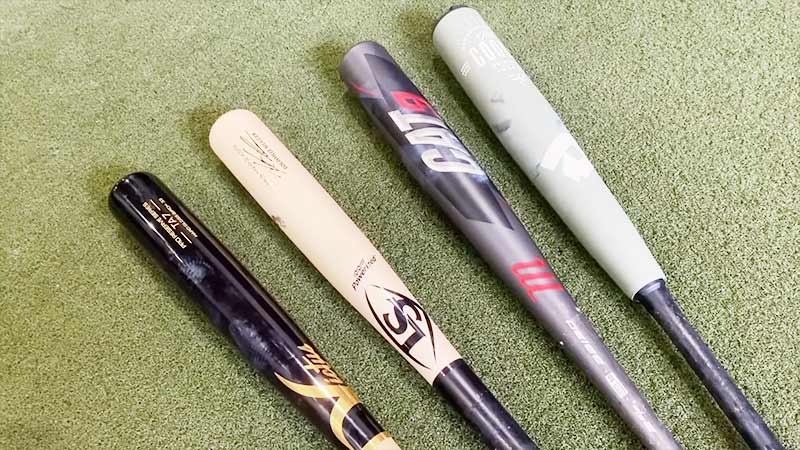
Walk into any batting cage and you’ll hear the same debate: does a wood bat or an aluminum bat hit the ball farther? Players, parents and coaches all have opinions, and many of them are shaped by the ping of metal or the sharp crack of a maple barrel.
The answer matters more than it seems. It affects which bat you buy, how you train and how your numbers hold up when you move to a league with different rules. A bat that adds distance in one league may be illegal in the next.
In this guide, we break down what hits farther, wood or aluminum, and explain the science behind it.
We’ll cover the trampoline effect, sweet spot size, swing speed, bat regulations and the situations where wood still comes out ahead. By the end, you’ll know which bat gives you the best chance to drive the ball.
The Short Answer: Aluminum Usually Hits Farther
In a head-to-head test with the same hitter and the same swing, an aluminum bat will usually send the ball farther than a wood bat. Metal bats produce higher exit velocity, especially on balls that aren’t hit perfectly, and exit velocity is the single biggest factor in how far a baseball travels.
There is an important catch, though. Modern rules have deliberately shrunk the gap. Bats certified for high school and college play must meet the BBCOR standard, which limits how much “pop” a non-wood bat can have.
As a result, today’s regulation aluminum bats perform much closer to wood on a squared-up hit than the hot metal bats of the 1990s and early 2000s did.
So the real answer is this: aluminum hits farther, but by a smaller margin than most people think, and its biggest advantage shows up on mishits rather than on perfect contact.
The Trampoline Effect: Why Hollow Barrels Launch the Ball
The main reason aluminum outhits wood comes down to how each bat behaves at the moment of contact.
Why a Baseball Loses Energy on Impact
A baseball is a surprisingly poor spring. When it collides with a bat, it squashes, and much of the energy that goes into compressing it is lost as heat instead of being returned as speed. The less the ball has to compress, the more energy it keeps.
Solid Wood vs. Hollow Aluminum Barrels
A wood bat is solid. Its barrel barely flexes, so the ball does nearly all of the deforming and loses a large share of its energy.
An aluminum bat has a hollow barrel with thin walls. On impact, those walls flex inward slightly and then spring back, much like a trampoline.
Because the barrel absorbs part of the compression, the ball deforms less and wastes less energy. The barrel then snaps back and pushes the ball off the bat with extra speed.
Measuring the Trampoline Effect
This is known as the trampoline effect, and it is the core reason metal bats generate higher exit speeds. Engineers measure it with a value called the ball-bat coefficient of restitution, which describes how much of the collision’s energy is returned to the ball. The higher that number, the livelier the bat and the farther the ball can travel.
Sweet Spot Size and Mishit Forgiveness
Every bat has a sweet spot, the part of the barrel where contact produces the most ball speed and the least vibration. Where wood and aluminum truly separate is how big that sweet spot is.
Wood bats have a narrow sweet spot, typically just a few inches of the barrel. Hit the ball off the end or near the handle and the bat vibrates, your hands sting, and energy that should have gone into the ball goes into shaking the bat instead. Distance drops off quickly.
Aluminum bats have a noticeably larger sweet spot. Their hollow construction and the way manufacturers tune the barrel walls, spread the high-performance zone across more of the barrel. A ball struck an inch or two away from the ideal spot still comes off with good speed.
For real hitters, this matters more than lab numbers. Very few swings land perfectly. Over a season, the forgiveness of an aluminum barrel turns weak grounders into line drives and warning-track fly balls into extra-base hits. That is why metal bats tend to produce longer drives on average, not just on the best swings.
Swing Speed, Weight and Balance
Distance isn’t only about the bat’s material. It also depends on how fast you can swing it, and here aluminum has a second advantage.
Because aluminum bats are hollow, manufacturers can control exactly where the weight sits. Many models are balanced, with more mass closer to the hands.
This lowers the bat’s swing weight, often called its moment of inertia, so it feels lighter and is easier to accelerate through the hitting zone. More bat speed means more exit velocity.
Aluminum bats can also be made lighter relative to their length. This is described by the drop weight, the difference between a bat’s length in inches and its weight in ounces.
Youth metal bats can have drops of -10 or more, giving young players a long barrel they can still swing quickly. Wood bats usually sit around -3, because the wood has to be dense enough to stay strong.
A heavier wood bat carries more mass into the ball, but most hitters lose more in swing speed than they gain in mass. For the average player, a lighter, easier-to-swing aluminum bat produces faster swings and longer hits.
How Bat Rules Narrowed the Gap
The Era of “Hot” Metal Bats
During the 1990s and early 2000s, aluminum bats became so lively that leagues grew concerned about safety, especially for pitchers and infielders facing hard-hit line drives. Scores climbed, home run totals jumped, and the gap between metal and wood grew wide.
The BBCOR Standard for High School and College
Governing bodies responded with performance standards. In the early 2010s, college and high school baseball adopted the BBCOR standard, which caps the ball-bat coefficient of restitution at 0.50.
That limit was chosen so non-wood bats would perform roughly like a quality wood bat on solid contact. BBCOR bats must also have a drop of no more than -3 and a barrel no wider than 2 5/8 inches.
Youth Bat Standards: USA Baseball and USSSA
Youth baseball followed with its own rules. The USA Baseball bat standard, used by many youth organizations, limits barrel performance so youth bats also play closer to wood. Other youth associations, such as USSSA, set their own standards, which can allow livelier bats.
What the Rules Mean for Distance Today
The result is that a modern BBCOR aluminum bat may hit a perfectly squared ball only slightly farther than a good wood bat. The forgiveness advantage on mishits remains, but the dramatic distance gap of the past is largely gone in regulated play.
Where Wood Bats Still Win
Even though aluminum hits farther, wood bats have real advantages that keep them in the bags of serious hitters.
- Honest feedback. A wood bat punishes poor contact. Training with wood teaches you to square up the ball, and hitters who succeed with wood often see their results improve when they switch back to metal.
- The path to higher levels. Professional baseball, including Major League Baseball, requires wood bats, and many summer collegiate and amateur leagues do too. Getting comfortable with wood early prepares players for that jump.
- Feel and sound. Many hitters love the solid feel and sharp crack of a well-struck wood bat. It is the classic sound of the game.
- Wood bat leagues. Some adult leagues and tournaments are wood-only, so a wood bat is the only legal choice.
The trade-offs are durability and long-term cost. Wood bats can crack or break, especially on inside pitches, while a quality aluminum bat can last for several seasons.
Which Bat Should You Choose?
The best bat is the one that is legal in your league and fits your goals. Start with the rules, then think about how you want to develop as a hitter.
- Check your league’s bat rules first. Look for the required certification stamp, such as BBCOR for high school and college, USA Baseball or USSSA for youth play, or wood-only rules in some adult leagues. Softball uses different standards entirely.
- Choose aluminum for game-day distance. If your league allows it, a certified aluminum bat gives you the best mix of exit velocity, sweet spot size and swing speed.
- Use wood for training. Practicing with a wood bat sharpens your mechanics and contact quality, which pays off no matter what you swing in games.
- Match the bat to your size and strength. A bat that is too long or too heavy slows your swing and costs you distance, whatever it is made of.
Conclusion
So, what hits farther, wood or aluminum? In most cases, aluminum wins. Its hollow barrel creates a trampoline effect, its larger sweet spot forgives imperfect contact, and its lighter, better-balanced design helps hitters swing faster.
However, modern BBCOR and youth bat standards have narrowed the gap, so on a perfectly squared ball a regulation aluminum bat only slightly outdistances wood.
Wood bats still earn their place as training tools and as the standard at the professional level. Choose a league-approved aluminum bat for game-day power, use wood to build a better swing, and you will get the best of both.