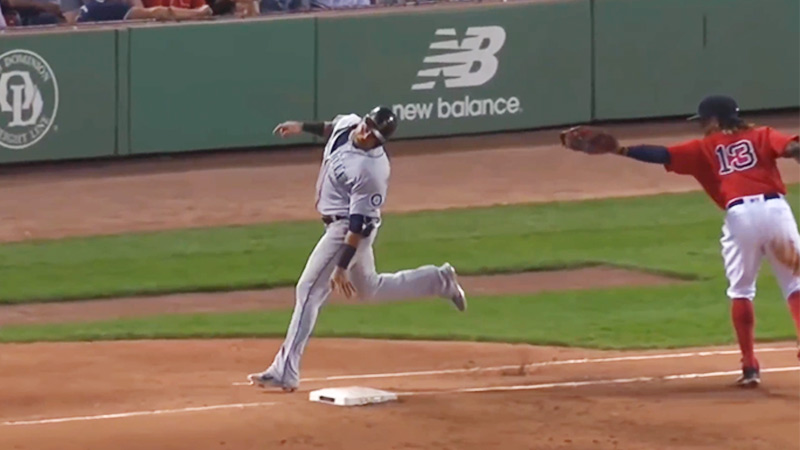
Few moments in baseball feel as safe as a home run trot. The ball is gone, the crowd is on its feet, and the hitter jogs around the bases with nothing left to prove.
Yet that jog carries one strict duty: the runner must touch every base, in order. Miss second base, and a no-doubt blast can shrink into a single, with an out added to the scoreboard.
This guide walks you through exactly what happens when a hitter misses second after a home run. You will learn what the rulebook requires, how the defense claims the out, how the stats and score change, and how players at every level can avoid the mistake.
The short answer
A home run does not count until the hitter legally touches all four bases. If he misses second and the defense makes a proper appeal, the umpire calls him out.
The hitter is then credited with a single, because first base is the last base he touched legally. Runners who were ahead of him and touched every base usually still score.
The out is never automatic. The umpire stays silent unless the fielding team asks for the call, and the hitter can sometimes fix the mistake before it is too late.
What the Official Baseball Rules say
The Official Baseball Rules, used by Major League Baseball and most professional leagues, treat an over-the-fence home run as a dead ball with a condition attached. Every runner may advance home without risk of being put out, but only by touching each base in order.
Four rules decide what happens when a hitter skips second base:
|
Rule |
What it says |
What it means for the hitter |
|---|---|---|
|
5.05(a)(5) |
A fair fly ball over the fence entitles the batter to a home run “when he shall have touched all bases legally.” |
The homer is earned only after the full trip. |
|
5.06(b)(1) |
A runner advancing must touch first, second, third and home, in order. |
Skipping second breaks the required order. |
|
5.09(c)(2) |
A runner who fails to touch each base in order can be called out on appeal. |
The defense must ask for the out. |
|
9.06(c) |
When a batter-runner is out for missing a base, his hit is scored by the last base he reached safely. |
Missing second means a single. |
Rule numbers follow the numbering in use since the rulebook was reorganized in 2015. The key idea is simple: the ball clearing the fence earns the right to score, and the trot completes it.
How the appeal play works, step by step
An appeal is the defense’s formal claim that a runner broke a rule. The umpire may have seen the missed base, but he will not call it until the fielding team asks.
In professional baseball, a home run appeal usually unfolds like this:
- The hitter finishes his trot, and the umpire gives the pitcher a new ball.
- The pitcher takes his position on the rubber, and the umpire puts the ball back in play.
- The pitcher steps off the rubber with his pivot foot, so a throw cannot be called a balk.
- He throws to the second baseman or shortstop, who touches second base while holding the ball.
- The fielder makes it clear to the umpire which runner missed the base. A casual toss around the infield is not an appeal.
- The umpire rules. If he saw the miss, he signals out. If the runner touched the bag, he signals safe and the home run stands.
The deadline is strict. The defense must appeal before the next pitch, or any play or attempted play. If the miss happened on a play that ends a half-inning, the appeal must come before the pitcher and all infielders leave fair territory.
That is why alert teams watch every base touch, even on a home run. Once the next pitch is thrown, the mistake is forgiven for good.
Can the hitter go back and touch second?
Yes, but only within a narrow window. Because a home run ball is dead, the rules close that window the moment the runner touches the next base.
|
Where the hitter is |
Can he return to second? |
|---|---|
|
Between second and third, before touching third |
Yes. He can retrace his steps, touch second, and finish his trot. |
|
On or past third base |
No. During a dead ball, a runner cannot return to a missed base after touching a base beyond it. |
|
Back in the dugout |
No. His only hope is that the defense fails to appeal in time. |
Teammates and base coaches often spot the miss first. A quick shout from the first-base coach can save the run before the hitter rounds third.
The smartest hitters never need that shout. They glance down at each bag, no matter how far the ball traveled.
What happens to the stats and the score
A successful appeal rewrites the box score in several places at once. Here is how a solo home run compares with the same swing after the hitter misses second:
|
Box score item |
Full trot |
Missed second, appeal upheld |
|---|---|---|
|
Hit credited |
Home run |
Single |
|
Total bases |
4 |
1 |
|
Hitter’s run scored |
Yes |
No |
|
Outs added |
0 |
1 |
|
Pitcher’s line |
Home run allowed |
Single allowed |
|
Putout |
None |
Fielder who touched second |
With runners on base, the hitter still earns RBIs for teammates who score on the hit. Those runners usually count, because the hitter was forced only to first, so his out at second is not a force out.
The tricky case is when the appeal makes the third out. Then the run-scoring rule, 5.08(a), applies, and the umpire must judge which runners crossed home before the out. Coaches should know this timing rule, since a single appeal can swing several runs.
Game-ending home runs follow the same logic. The hitter must touch every base for all of his team’s runs to count, even when the stadium is already celebrating.
Famous moments when baserunning erased a big hit
Baseball history shows how fast a baserunning slip can cost a hitter, a team, or even a title. These three moments are still used to teach the rule:
|
Year |
Player |
What happened |
Result |
|---|---|---|---|
|
1999 |
Robin Ventura, Mets |
In Game 5 of the NLCS, his bases-loaded drive cleared the fence in the 15th inning. Teammates mobbed him before he finished his trot. |
Credited with a single, the “grand slam single,” as the Mets won 4-3. |
|
1931 |
Lou Gehrig, Yankees |
Teammate Lyn Lary left the base path, thinking the ball was caught. Gehrig passed him and was called out. |
Credited with a triple. Gehrig finished tied with Babe Ruth at 46 home runs instead of leading alone. |
|
1908 |
Fred Merkle, Giants |
On an apparent game-winning hit, he ran off the field without touching second. |
Forced out at second, the run was wiped away, and the game ended in a tie. |
The Merkle play is the closest cousin to a missed second base on a home run. It proved more than a century ago that skipping second can change a pennant race.
How it works in youth, high school, and college games
The core principle holds at nearly every level: touch every base in order, or risk an out on appeal. What changes from league to league is the procedure.
- Little League: Uses an appeal process modeled on the professional rules, with its own rule numbers. Umpires still wait for the defense to appeal.
- High school (NFHS): The defense may appeal while the ball is dead, often by simply asking the umpire. No throw to second is needed.
- College (NCAA): Follows its own rulebook and appeal procedure, so coaches should review the current edition before each season.
- Adult and recreational leagues: Most follow one of the books above. Check your league’s bylaws to see which one governs your games.
Tips for hitters
- Look down and touch each bag with your foot, even on a towering home run.
- Slow down near second base. It is the easiest base to miss while watching the ball or celebrating.
- If you think you missed a base, go back before you touch the next one.
Tips for coaches and fielders
- Assign base coaches to watch the hitter’s foot at first and second.
- Teach your infielders the appeal steps, so the play is ready when needed.
- Keep an eye on the opposing hitter’s trot. An alert appeal can take away a run that seemed certain.
Tips for fans
Watch the pitcher after a home run. If he steps off the rubber and throws to second instead of facing the next hitter, you are watching an appeal play in real time.
Conclusion
A home run is never official until the hitter touches every base. Miss second, and the defense can appeal, turning a four-base trot into a single and an out.
The fix is simple: look down, touch each bag, and go back before touching third if you slip. Coaches can protect their hitters, and alert fielders can steal a run that seemed certain.