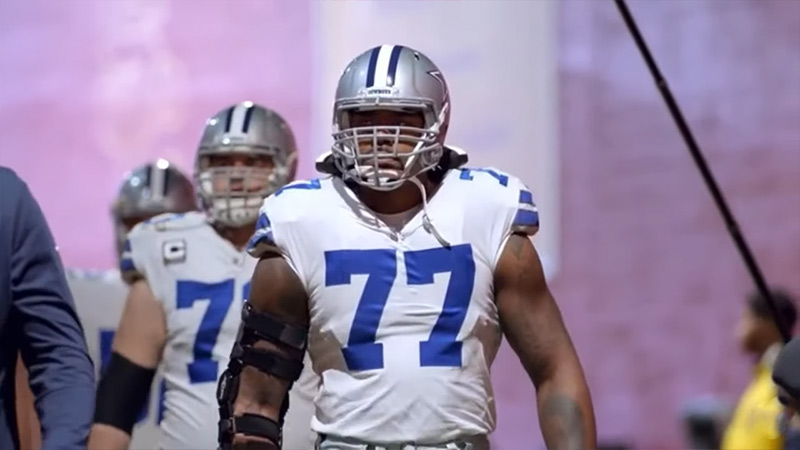
The offensive tackle position in the NFL is often described as a game of inches, but for Tyron Smith, it has been a game of feet and wingspans that defy traditional human proportions.
When scouts and fans ask about the physical dimensions of the former Dallas Cowboys cornerstone and current New York Jets protector, they are not just looking for a number on a spreadsheet; they are looking for the anatomical explanation for over a decade of dominance.
To understand the impact of Tyron Smith, one must look specifically at his reach—a biological toolset that has allowed him to redefine the perimeter of the pocket.
The Biological Blueprint: Breaking Down the Numbers
The foundational measurements of an elite offensive tackle are arm length, hand size, and wingspan.
These three metrics determine the “strike zone”—the area in which a tackle can engage a defensive end before the defender can make contact with the tackle’s chest. In this regard, Tyron Smith is a statistical anomaly.
According to official records, Smith’s arm length is measured between 36 3/8 inches and 36 1/2 inches. To put this in perspective, the average arm length for a starting offensive tackle in the NFL typically hovers around 33 to 34 inches.
Those extra three inches represent a massive strategic advantage. In the high-speed environment of an NFL pass rush, three inches is the difference between a clean block and a strip-sack.
Complementing this extraordinary reach are his hands, which measure 11 inches from the tip of the thumb to the tip of the pinkie.
These are not merely hands; they are massive clamps that allow him to latch onto a defender’s shoulder pads with a grip that is notoriously difficult to break.
When you combine these arms and hands, you arrive at a total wingspan of over 7 feet (84 5/8 inches). This reach is more akin to an NBA center than a traditional football player, providing Smith with a “first-touch” advantage in nearly every engagement on the field.
The 99th Percentile: A Historical Context
In the world of professional scouting, the “99th percentile” is a term reserved for the rarest of athletes. Smith’s measurements at the NFL Combine placed him firmly in this category for offensive tackle prospects.
Why does the 99th percentile matter? It signifies that out of hundreds of elite athletes who enter the draft process every year, Smith possesses physical traits that are superior to almost all of them.
This physical profile is why he was the first offensive lineman drafted by the Dallas Cowboys in the first round in over two decades when he was selected in 2011.
The league recognized that while technique can be coached, a seven-foot wingspan is a gift of nature that cannot be replicated.
The Physics of the Long Arm: Lever Mechanics in Pass Protection
The technical brilliance of Smith’s game is inextricably linked to his arm length. In physics, a longer lever can exert more force or cover more distance with less effort. In football, this translates to the “long-arm” technique.
When a speed rusher attempts to turn the corner, Smith can extend a single arm and create a barrier that the defender must travel around. Because his arms are over 36 inches long, he can keep a defender’s power at a distance, preventing the rusher from getting “into his chest”.
Once a defender loses the ability to get close to a tackle’s frame, they lose their leverage and their ability to use bull-rush moves.
Furthermore, Smith’s 11-inch hands allow him to control the “inner half” of a defender. By placing those massive hands inside the frame of a defensive end, he gains total control of the opponent’s momentum.
This combination of reach and grip strength has made him one of the most difficult tackles to beat in one-on-one situations for over a decade.
The Practical Side of Extreme Anatomy: Equipment Challenges
While having the longest arms in the league is a professional asset, it presents unique logistical challenges. The most famous bit of trivia regarding Smith’s physical stature involves his protective gear.
Standard NFL equipment, even the sizes designed for the largest linemen, often fails to accommodate his frame. Specifically, standard elbow braces do not fit him properly because of the sheer length and girth of his arms.
This has led to a long-standing tradition of custom-made equipment and has become a frequent topic of conversation among teammates who are often stunned by the scale of his requirements.
When a player is so large that the billion-dollar industry of athletic apparel cannot provide an off-the-shelf solution, it underscores just how much of an outlier that player truly is.
Comparison to Contemporary Elite Tackles
To truly appreciate the “Big” in Tyron Smith, we should compare his metrics to other legendary tackles.
- Joe Thomas: Often considered the gold standard of technical tackle play, Thomas had arms measuring roughly 32 1/2 inches. Smith has nearly four inches of reach over a Hall of Famer.
- Trent Williams: Another physical powerhouse of the current era, Williams possesses arms around 34 1/4 inches. Even against the most athletic tackles of his generation, Smith holds a clear length advantage.
This reach allows Smith to play with a “margin for error” that other players do not have. If his footwork is slightly off on a particular snap, he can often compensate by simply reaching out and neutralizing the defender before the mistake becomes a sack.
The Longevity of the Physical Freak
There is a common misconception in professional sports that “physical freaks” rely solely on their athleticism and therefore flame out quickly.
Tyron Smith has proven the opposite. By pairing his 99th-percentile reach with a relentless work ethic and high-level football IQ, he has maintained a career that spans more than 13 seasons.
His move to the New York Jets in 2024 is a testament to the value the league still places on his physical architecture.
Even as he enters the later stages of his career, the fundamental reality remains: you cannot teach a 7-foot wingspan. Coaches know that as long as Smith can get his hands on a defender, the quarterback is safe.
The Legacy of a Prototype
As the NFL continues to evolve, the search for the next Tyron Smith remains the “Holy Grail” for front offices. Scouts are constantly looking for that rare combination of 36-inch arms, massive hands, and the agility to use them. However, as the data shows, Smith is a once-in-a-generation athlete.
His physical architecture—the 36 1/2-inch arms, the 11-inch hands, and the 7-foot wingspan—is not just a collection of impressive numbers.
It is the foundation of a Hall of Fame-caliber career that has set the standard for what a blindside protector should look like. In the history of the league, few players have ever stepped onto the field with a more perfect biological design for the offensive tackle position.
Tyron Smith is more than just a great player; he is a reminder that in the NFL, size and reach are the ultimate currency, and he has been one of the wealthiest men in the league for a long time.