The history of the modern National Football League cannot be fully articulated without a significant chapter dedicated to the man who served as the bridge between a struggling franchise and the greatest dynasty in professional sports.
When the New England Patriots utilized the first overall pick in the 1993 NFL Draft on a towering quarterback from Washington State, they were not merely selecting a player; they were investing in a transformation.
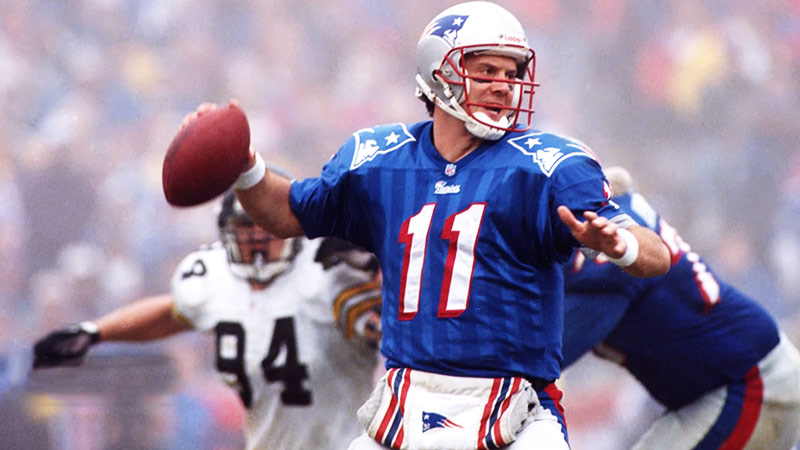
Drew Bledsoe arrived in Foxborough at a time when the team’s relevance was at an all-time low, and through sheer arm talent and physical durability, he anchored the organization’s rise to prominence.
Today, however, a complex debate persists among historians, analysts, and fans: Is Drew Bledsoe a Hall of Famer? While his name is etched into the regional lore of New England and his statistics once sat atop the record books, the doors to Canton remain closed.
To understand the nuances of this candidacy, we must examine the intersection of volume statistics, franchise impact, and the elite standards of the Pro Football Hall of Fame.
The Statistical Powerhouse of the 1990s
To evaluate Bledsoe’s candidacy, one must first appreciate the sheer volume of his production during an era that was significantly less friendly to the passing game than the current NFL landscape.
At the time of his retirement, Bledsoe’s statistical resume was objectively elite. He finished his career with 44,611 total passing yards, a figure that at the time placed him among the most prolific passers to ever play the game.
His contribution to the New England Patriots remains the cornerstone of his legacy, as he threw for over 29,000 yards during his tenure in blue and silver.
When he finally concluded his career, he ranked fifth all-time in completions, a testament to his longevity and the heavy workload he carried as the focal point of his offenses.
At the time of his retirement, he was also ranked 7th in passing yards and 13th in passing touchdowns, rankings that typically signal a strong case for a gold jacket.
Bledsoe was a four-time Pro Bowl selection, a recognition of his status as one of the premier signal-callers in the league during his peak years.
Throughout the 1990s, he was consistently regarded as a top-10 quarterback, possessing a “cannon” for an arm that allowed him to make vertical throws that few others could attempt.
For a generation of fans, Bledsoe was the “first piece” in building a winning culture, serving as the face of the franchise for nearly a decade.
The Foundation of a Dynasty and the 2001 Narrative
Before the era of six championships and a two-decade reign of dominance, the New England Patriots were an organization searching for an identity.
Analysts often argue that Bledsoe was the foundational element that allowed the modern Patriots to exist. He didn’t just play for the team; he revitalized the entire market.
Under his leadership, the team reached two Super Bowls, most notably serving as the primary starter for the squad that reached Super Bowl XXXI.
However, the narrative of his career took its most dramatic turn on September 23, 2001. A devastating hit resulted in a life-threatening injury that famously opened the door for a young Tom Brady.
At the time, Bledsoe had just signed a record-breaking 10-year, $103 million contract, a signal from ownership that he was intended to be a “Patriot for life”.
His most significant “Hall of Fame” moment arguably occurred while he was technically a backup. In the 2001 AFC Championship game against the Pittsburgh Steelers, Brady was sidelined by an injury.
Bledsoe, despite the professional sting of being displaced, stepped onto the field and delivered a poised performance, throwing what would be his final touchdown for the Patriots and securing the win that sent them to Super Bowl XXXVI.
Without this specific contribution, the first championship of the New England dynasty might never have materialized. He ended his career as a Super Bowl XXXVI champion, an essential accolade for any serious Canton candidate.
The “Hall of Very Good” Argument
Despite the yardage and the Pro Bowls, Bledsoe is frequently cited by analysts as the quintessential member of the “Hall of Very Good”.
This designation is not intended to diminish his accomplishments but rather to recognize an elite player compared to the average NFL starter who perhaps lacked the “black ink” of a transcendent legend.
The primary hurdle for Bledsoe’s candidacy is the lack of individual “hardware.” Unlike his contemporaries such as Brett Favre, Steve Young, or Kurt Warner, Bledsoe never won an NFL MVP award.
He also lacks First-Team All-Pro selections, which are often used by voters to distinguish the “best in the game” from those who were merely “very good” for a long duration.
Critics also point to his playing style and efficiency. While he was a prolific passer, he was notably less mobile than many of his peers, a trait that some argue became a liability as the game evolved.
Furthermore, when compared to the 1990s AFC “Mount Rushmore” of quarterbacks—Dan Marino, John Elway, Jim Kelly, and Warren Moon—voters often view Bledsoe as sitting in a tier just below these icons.
Some analysts even categorize him alongside players like Boomer Esiason or Matt Hasselbeck—qualified franchise quarterbacks who were the face of their teams but never truly redefined the position.
A Career of Resilience and Professionalism
One aspect of Bledsoe’s legacy that is universally praised is his professionalism and the dignity with which he handled the transition in New England. After the 2001 season, he continued to play at a high level for the Buffalo Bills and the Dallas Cowboys.
In Buffalo, he immediately made an impact, earning another Pro Bowl nod and demonstrating that his success was not merely a product of the New England system.
He maintained a high level of play until “losing to Father Time,” finishing his career with a resume that many believe would have been a “lock” for the Hall of Fame had he won the Super Bowl he started in 1996.
Some supporters argue that if players like Troy Aikman are in the Hall based on “winning” despite lower statistical volume, Bledsoe’s role as a franchise savior and his prolific yardage should carry similar weight.
Recognition Outside of Canton
While the Pro Football Hall of Fame in Canton has not yet called his name, Bledsoe has been honored by nearly every other institution available to a professional athlete. He is a member of:
- The New England Patriots Hall of Fame: Inducted by the fans who witnessed his impact firsthand.
- The Pac-12 Hall of Honor: Recognizing his dominant collegiate years at Washington State.
- The National Quarterback Hall of Fame: A testament to his status as one of the premier passers in the history of the sport.
These inductions serve as a reminder that a player can have a legendary, impactful career without the ultimate validation of a bronze bust in Canton. He was ranked as the #30 quarterback all-time post-merger, a standing that places him in the top echelon of everyone who has ever played the position.
Conclusion: The Definitive Franchise Anchor
Drew Bledsoe’s career is a masterclass in the importance of context. To judge him purely by his proximity to the Tom Brady era is to miss the man who saved a franchise from relocation and irrelevance.
He was a prolific, tough, and professional quarterback who paved the way for the greatest dynasty in sports history.
Whether he ever receives the “respect he should” from the voters in Canton, his impact is undeniable. He was the right player at the right time—a “qualified franchise quarterback” who operated at a level few could match during the 1990s.
In the final analysis, Drew Bledsoe might not be a Hall of Famer in the eyes of the NFL, but for the fans who watched him revitalize a region, he remains an immortal figure in the game’s history.
His legacy is not defined by a missing gold jacket, but by the unshakeable foundation he built for a franchise that changed the league forever.