The story of Baker Mayfield is one of the most complex character studies in modern professional sports.
To some, he is the ultimate underdog—a two-time walk-on who clawed his way to a Heisman Trophy and a first-overall draft selection.
To others, he represents a specific brand of polarizing arrogance that makes him one of the most scrutinized figures in the league.
The question of why he elicits such strong negative emotions is not answered by a single statistic or a lone controversial moment, but rather by a combination of his fiery demeanor, inconsistent on-field processing, and a series of high-profile locker room fractures.
The Personality Paradox: Self-Assurance or Arrogance?
At the heart of the “Baker Hate” is a hyper-confident personality that critics frequently interpret as cockiness or immaturity.
Mayfield has never been a “company man” in the traditional sense; he plays with an intense, loud confidence that often rubs opposing fans and even fellow players the wrong way.
This demeanor was forged in his “chip on the shoulder” collegiate days, but when brought to the professional stage, it often came across as dismissive rather than merely self-assured.
His history of public feuds has only deepened this divide. Mayfield has never shied away from vocal, sensitive reactions to criticism from media analysts, famously engaging in back-and-forth spats with figures like Colin Cowherd.
For traditionalists, these interactions suggest a lack of the “mental fortitude” required to lead a franchise.
Older moments, such as planting the Oklahoma flag at the center of the Ohio State field or his fiery gestures against Kansas, etched a permanent negative impression in the minds of many long before he ever threw a professional pass.
The Cleveland Divorce: Seeking an “Adult in the Room”
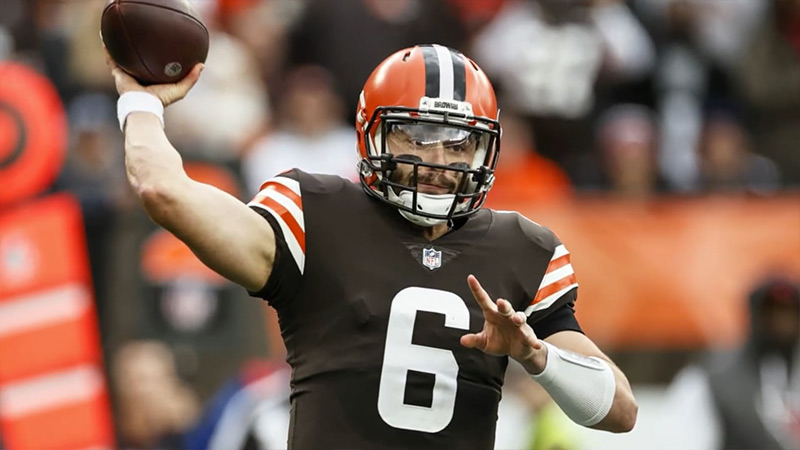
The most significant hit to Mayfield’s reputation came during his tumultuous exit from the Cleveland Browns.
Despite being the quarterback who helped end the franchise’s decades-long playoff drought, the organization’s desire to move on was driven by a perceived lack of “upstanding character qualities” and a desire for an “adult” at the position.
Internal dynamics played a massive role in this shift. The high-profile drama surrounding his tenure with Odell Beckham Jr. led many to blame Mayfield’s leadership style for the star receiver’s lack of production.
Critics pointed to the fact that while Beckham struggled in Cleveland, he immediately thrived upon moving to Los Angeles, which alienated some teammates and led to whispers that Mayfield had lost the respect of the locker room.
Furthermore, when things turned sour, his tendency to “wear his emotions on his sleeve” and express sentiments to the media often fed into melodramatic narratives that damaged the organization’s culture.
Technical Gaps and the “Superhero” Ceiling
While personality is the most common talking point, there is a deep-seated analytical critique of Mayfield’s game that fuels the fire. Even his supporters admit to stretches of erratic play and high turnover numbers.
Since entering the league, Mayfield has struggled with some of the league’s highest interception rates, leading many to label him as a “middle-of-the-road” or “average” starter.
Technical scouting reports highlight several recurring issues:
- Pocket Presence: Analysts have described Mayfield as appearing “spooked” in the pocket, often taking unnecessary sacks because he lacks the patience to trust his offensive line.
- Field Vision: His height has been cited as a physical limitation that makes it difficult for him to see over the line, often leading to swatted passes or missed reads.
- Processing Speed: He has been criticized for being slow to move through progressions, frequently holding onto his first read too long and failing to trust his eyes.
In a loaded conference featuring “superhero” quarterbacks like Patrick Mahomes, Josh Allen, and Lamar Jackson, many front offices—including Cleveland’s—decided that Mayfield’s ceiling simply wasn’t high enough to compete for a championship.
The argument was that he was a “limited” quarterback who could win when the team around him was elite, but he lacked the ability to consistently elevate a roster on his own.
Peer Jealousy and the Commercial King
An often-overlooked factor in why other players may dislike Mayfield is the discrepancy between his on-field success and his off-field fame.
Early in his career, Mayfield received an immense amount of attention from sponsors and high-profile media outlets despite not yet achieving sustained playoff success.
Peers who had put in years of elite work without the same level of marketing spotlight reportedly felt a sense of jealousy toward the “Commercial King”.
When his performance dipped, this resentment came to the surface. Analysts noted that even when he tried to appear humble, it often translated as dismissive to his contemporaries, who wanted to see him “do something in the league” before talking trash.
Grit as a Double-Edged Sword
One of the most polarizing aspects of Mayfield’s career is his willingness to play through significant physical pain. In 2021, he played through a torn labrum, among other lower-body injuries.
While some saw this as the ultimate sign of leadership and grit, others viewed it as a detriment to the team.
Critics argued that if he was too injured to perform competently, he should have stepped aside for a healthy backup rather than contributing to the team’s playoff failure through missed throws and poor reads.
This “warrior” mentality sometimes translated into friction with coaching staffs. Reports surfaced of tension between Mayfield and Kevin Stefanski, particularly regarding how his injuries were managed and his refusal to work with outside QB coaches to improve his mechanics.
The Tampa Bay Redemption: A New Perspective
Recent chapters in Tampa Bay have begun to shift the narrative for some, though the “hate” remains in many circles.
In Tampa, teammates have praised his dedication, noting that he moved to the city full-time and hosted private workouts for younger receivers long before the official program began.
Veterans like Lavonte David have publicly defended his toughness, acknowledging the staggering list of injuries—knee, ankle, and shoulder—that he fought through during his more difficult seasons.
However, even in this new environment, the old “fiery” Baker remains. Recent reports suggest he hasn’t been afraid to fire back at the organization over contract negotiations, proving that while the jersey may change, the unapologetic personality that defines him does not.
The Verdict
Ultimately, people “hate” Baker Mayfield because he is a walking contradiction. He is a leader who can alienate his teammates; he is a gritty competitor who sometimes hurts his team by playing through injury; and he is a talented passer whose technical flaws can be exposed by top-tier defenses.
He refuses to fit into the quiet, humble mold that many expect from a franchise quarterback, opting instead to be a “loveable, charismatic guy” to his fans and a “petty, immature” rival to his detractors.
Whether he is leading a game-winning drive or throwing a costly interception, one thing is certain: Baker Mayfield will never be boring, and the debate over his true value will continue to polarize the football world for years to come.