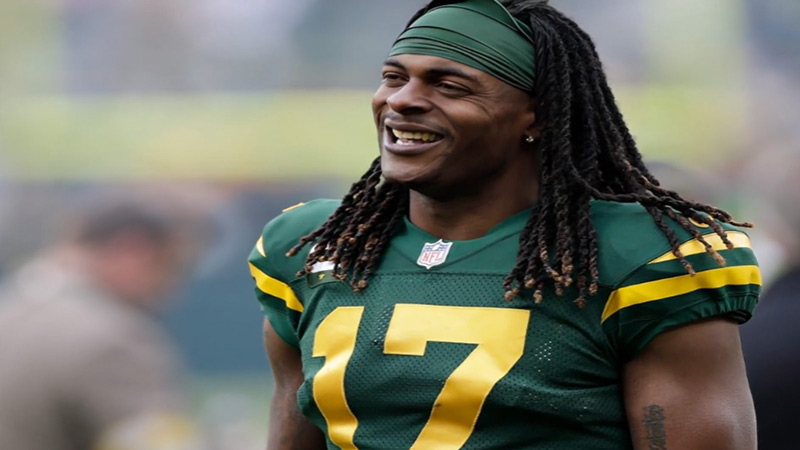
The Pro Football Hall of Fame represents the pinnacle of athletic achievement, a sanctuary reserved for the elite 1% of the 1% who have graced the gridiron.
For modern wide receivers, the path to Canton is increasingly obstructed by a “logjam” of statistical greatness, where even prolific legends find themselves waiting years for enshrinement.
Amidst this era of passing dominance, one name consistently ignites the debate: Davante Adams.
Widely projected as a future inductee, Adams has built a career defined by an elite peak and historical scoring efficiency.
However, as the standards for wide receiver milestones continue to shift, the question remains: has he already done enough, or does his legacy require a few more years of high-volume production to pierce through the crowded ballot?
The Peak of Dominance: A Narrative of Elite Excellence
When evaluating a Hall of Fame candidate, voters often look for a “peak”—a multi-year stretch where the player was undeniably the best at their position.
For Adams, this peak is his strongest argument. For a significant stretch of the late 2010s and early 2020s, analysts and peers alike regarded him as the absolute premier wide receiver in the NFL.
His accolades reflect this dominance. Adams is a six-time Pro Bowler and has earned the prestigious First-Team All-Pro honor three times.
In the context of the Hall of Fame, First-Team All-Pro selections are often more valuable than Pro Bowl nods, as they signify being the best in the entire league for a given season.
His ability to consistently beat double-teams and press coverage became a “masterclass” in route running, often highlighted for his unique release at the line of scrimmage.
This peak is not just a collection of highlights; it is supported by rare historical rarity. Adams currently sits 8th on the all-time receiving touchdowns list.
To put this in perspective, every retired player currently in the top nine of that list is already a Hall of Famer. His high volume of multi-touchdown games places him in the same historical conversation as legends like Jerry Rice and Randy Moss.
Breaking the “System Player” Myth
A common criticism leveled against elite wide receivers is the quality of their quarterback. For years, skeptics argued that Adams’ production was a byproduct of catching passes from a generational talent like Aaron Rodgers in Green Bay. However, his career trajectory after leaving the Packers has effectively dismantled this narrative.
Upon moving to the Raiders and later the Jets, Adams continued to “ball out” regardless of the signal-caller. He has demonstrated elite production while working with a spectrum of quarterbacks, ranging from superstars to mid-tier starters and even a trio of below-average replacements.
For example, in a single half against the Jaguars, Adams recorded nine receptions for 198 yards and two touchdowns, proving his individual talent can transcend team struggles.
This adaptability is a crucial trust signal for Hall of Fame voters. It demonstrates that his success is rooted in technique, IQ, and physical dominance rather than being a “system” beneficiary.
He has led the NFL in receiving touchdowns multiple times while playing for different franchises, a feat that few in history can claim.
The Statistical Gap: Yardage vs. Scoring
While the “eye test” and touchdown totals favor Adams, the analytical comparison against contemporary peers reveals some hurdles.
The Pro Football Hall of Fame Monitor, a formula designed to estimate a player’s chances of induction, currently gives Adams a score of 63.88. This is notably lower than the average Hall of Fame wide receiver score of 101.40.
One of the primary reasons for this disparity is the “yardage logjam.” While Adams has over 12,000 receiving yards and 110 career touchdowns, modern standards for yardage are rising rapidly. Some analysts point to Mike Evans as a point of comparison.
Evans has recorded over 1,000 receiving yards in all ten of his professional seasons, whereas Adams has reached that mark in five out of his first nine seasons.
However, the debate between Evans and Adams often boils down to “consistency versus peak.” While Evans has the edge in consecutive yardage milestones, Adams has significantly higher “peak” recognition through his three First-Team All-Pro selections.
Furthermore, Adams’ scoring rate—ranking 8th all-time in touchdowns—is a heavyweight statistic that often outweighs raw yardage in the eyes of the committee.
Navigating the Modern Wide Receiver Logjam
The path to Canton is currently crowded with retired stars who possess massive career totals but are still waiting for their call.
Players like Steve Smith, Anquan Boldin, Torry Holt, and Reggie Wayne all boast resumes that rival or exceed current active stars in certain categories.
For Adams to bypass this logjam, he may need to reach specific career milestones that provide “statistical security.” Entering the top five in all-time receiving touchdowns or reaching the 14,000-yard mark would make him an undeniable candidate.
He recently became the 17th player in NFL history to reach 1,000 career receptions, a milestone that serves as a significant marker of longevity and sustained excellence.
There is also the “Super Bowl factor.” While not a strict requirement for wide receivers, a championship ring often serves as the final piece of the puzzle. Adams has openly described the Super Bowl as feeling like a “mythical thing” at this point in his career.
Achieving post-season success or a ring with his current team would likely elevate him from a “likely” inductee to a “first-ballot” lock.
Comparative Legacies: The Tim Brown and Julio Jones Benchmarks
To understand where Adams stands, we must look at the archetypes of past and present greats.
Some fans compare his journey to that of Tim Brown, who had to “grind out” nine consecutive 1,000-yard seasons and serve as an elite special teamer before earning his jacket.
Adams, however, relies more on a “decade of dominance” archetype, similar to a peak Julio Jones or Calvin Johnson.
Unlike Julio Jones, who had an incredible six-to-eight-year spell of averaging over 100 yards per game, Adams’ game is built on efficiency in the red zone and surgical precision in route running.
While he may not hit the absurd yard-per-game heights of Jones, his touchdown production is vastly superior, which creates a different but equally compelling path to the Hall.
Expert Conclusion: Is the Resume Complete?
At this juncture, Davante Adams is on a trajectory that almost certainly ends in Canton. With over 110 touchdowns and 12,000 yards, he has already surpassed the production of several existing Hall of Famers.
His three First-Team All-Pro honors are the defining “Expertise and Authoritativeness” signals that the committee values most.
However, the next two to five years will determine the speed of his induction. If Adams can maintain his current pace and add another two or three 1,000-yard seasons to his tally, he will transition from being “in the discussion” to becoming a definitive first-ballot legend.
His ability to “ball out” across different organizations and with various quarterbacks has already established his trustworthiness as an all-time great.