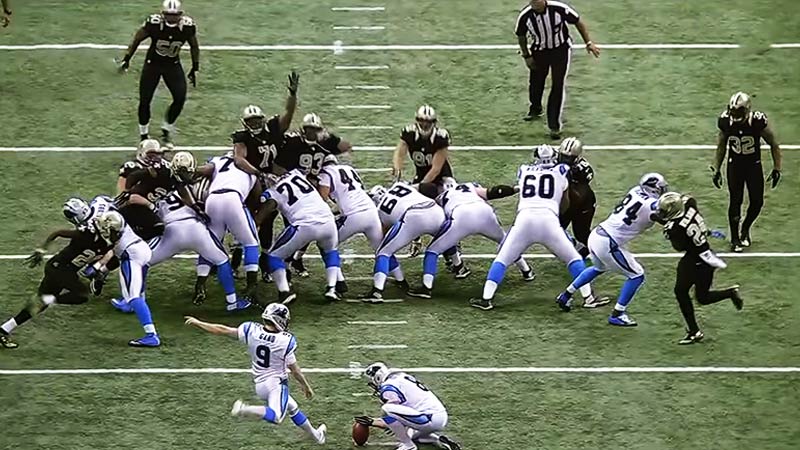
The final seconds of a high-stakes football game often hinge on a single swing of the leg. As the kicker steps forward, the stadium holds its breath.
But when the ball meets the outstretched hand of a surging defender instead of the uprights, the game enters a state of controlled chaos. In that split second, the rulebook becomes the most important document in the building.
Understanding the mechanics of a blocked field goal is essential for players, coaches, and dedicated fans alike.
While the play appears to be a random scramble, it is governed by a precise set of regulations that dictate who can touch the ball, where they can take it, and how many points they can score.
This guide provides a comprehensive analysis of the return rules that transform a failed kick into a game-changing opportunity.
The Live Ball Doctrine: Understanding the Status of the Kick
The primary point of confusion for many spectators is the status of the ball immediately following a block.
Unlike a forward pass that hits the ground, which is immediately ruled dead, a blocked field goal remains active.
Under official regulations, a blocked field goal is classified as a live ball. In many ways, it functions similarly to a loose fumble.
This designation is the foundation of every subsequent action on the field. Because the ball is live, it does not belong to either team until one side establishes clear possession.
This “live ball” status creates a frantic environment. The kicking team—previously in an offensive posture—must suddenly transition into a defensive unit to prevent a return.
Conversely, the defending team must shift from a “block” mentality to an “offensive” one, seeking to secure the ball and advance it toward the opposing end zone.
The Defensive Opportunity: The Mechanics of the “Scoop and Score”
When a defender successfully penetrates the line of scrimmage and deflects a kick, the defense gains a significant tactical advantage.
The rules regarding defensive advancement are straightforward but require immediate recognition from the players on the field.
The Right to Advance
Any member of the defense (the team that blocked the kick) is legally permitted to pick up the ball and run with it toward the opponent’s end zone.
There are no restrictions on which defensive player can recover the ball; a defensive tackle is just as eligible to score as a speedy cornerback.
Scoring Implications
If a defensive player recovers the ball and successfully reaches the opponent’s end zone, the reward is substantial. A return for a touchdown on a standard field goal attempt is worth 6 points.
This can result in a massive “swing” in momentum. A team that was about to concede 3 points through a successful kick can instead gain 6 points of their own, representing a 9-point turnaround in a matter of seconds.
The Return Path
The returner must navigate through the original kicking unit, which is often composed of larger offensive linemen and a specialist kicker who may not be accustomed to tackling in open space.
This often makes blocked field goal returns particularly dangerous, as the “coverage” unit was never intended to be a coverage unit at all.
The Offensive Dilemma: Can the Kicking Team Save the Play?
While the defense has a clear path to scoring, the rules for the kicking team (the offense) are more nuanced and restrictive.
Whether the offense can advance the ball depends entirely on where the recovery occurs in relation to the line of scrimmage.
Recovery Behind the Line of Scrimmage
The offense is permitted to recover and advance the ball, but only if the block happens behind the line of scrimmage or if the ball does not cross that line.
In this scenario, the kicker or any other offensive player can scoop up the ball and attempt to run for a first down or a touchdown.
This rule exists to prevent the offense from “failing forward.” If a kick is blocked and the ball flies twenty yards downfield, the offense cannot simply fall on it and claim a new set of downs or try to run it further. They are only allowed to “save” the play if the ball remains in the backfield.
The Risk of Recovery
If an offensive player recovers the ball beyond the line of scrimmage, the play is generally ruled dead at that spot, and the ball is turned over to the defense. This decides to touch a blocked kick is a high-stakes choice for the kicking team.
If they touch the ball and fail to secure it, they risk a “muff,” which could allow the defense to recover it in even better field position.
The “Try” Exception: Blocked Extra Points
The rules shift significantly during a Point After Touchdown (PAT), commonly referred to as a “try.” Because a try is a specialized scoring attempt that follows a touchdown, the points awarded for a return are scaled differently.
The 2-Point Return
If an extra-point kick is blocked and a defensive player recovers it, they can still return it to the opposite end zone. However, instead of the 6 points awarded during a standard game-play field goal, a returned try is worth 2 points.
This distinction is crucial for late-game strategy. While 2 points may seem minor, they can be the difference between a one-score and a two-score game.
Coaches must ensure their extra-point units remain vigilant even after a touchdown, as a mental lapse during the “routine” kick can result in points for the opposition.
When the Ball Becomes Dead?
To maintain the flow of the game and ensure player safety, officials must identify exactly when the “live ball” status of a blocked kick expires. There are three primary scenarios where the play is ruled dead:
- Out of Bounds: If the ball rolls out of the field of play, it is dead. The spot where it went out of bounds determines the next starting position for the team taking possession.
- Untouched in the End Zone: If the blocked ball enters the opponent’s end zone and hits the ground without being touched by the defense, it becomes dead. This usually results in a touchback or a turnover on downs, depending on the specific league’s rules regarding missed field goals.
- Player Termination: The play ends when a player falls on the ball and makes no attempt to advance, or when the ball carrier is tackled.
Tactical Analysis: How Teams Prepare for the Block?
For professional organizations, the possibility of a blocked kick is not treated as an accident but as a scenario to be rehearsed. Special teams coordinators spend hours drilling the “block response” to ensure that players react instinctively.
The Defensive “Wall”
When a block occurs, the defense is taught to immediately form a “wall” for the returner.
Since the kicking team is often stationary or moving toward the line of scrimmage at the start of the play, they are poorly positioned to stop a return heading in the opposite direction.
The defense seeks to exploit this lack of momentum by creating lanes for the player who secures the ball.
The Kicker’s Responsibility
Modern kickers are increasingly trained in basic tackling techniques. While they are the smallest players on the field, they are often the “last man back” during a return. Their ability to force a returner out of bounds can save 6 points and keep their team in the game.
Conclusion: The High Stakes of Special Teams
The blocked field goal return is a reminder that football is a game of constant transitions. A play that begins as a calculated, technical execution can instantly devolve into a test of raw athleticism and situational awareness.
By understanding that a blocked kick is a live ball, knowing that the defense can score 6 points on a return, and recognizing the 2-point value of an extra-point return, teams can better navigate these rare but pivotal moments.
In the world of high-performance athletics, the margin between victory and defeat is often found in the mastery of these specific, complex regulations.