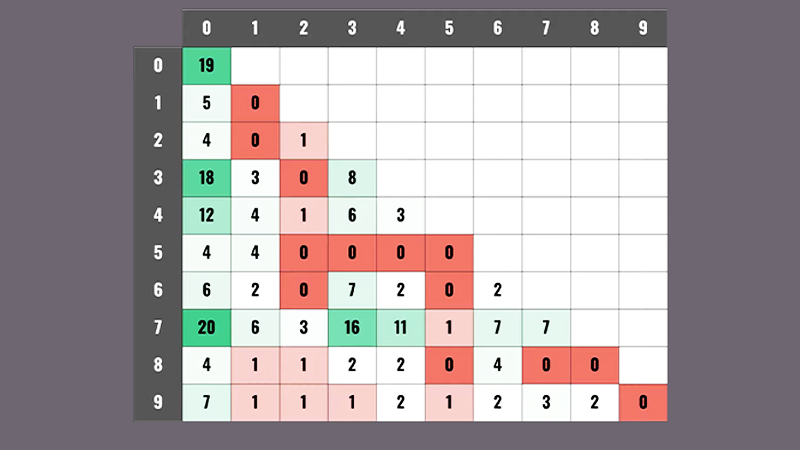
Super Bowl Sunday represents the pinnacle of American sporting culture, blending high-stakes competition with a unique social tradition: the football squares pool.
For many, it is an entry point into the game, a way to have “skin in the game” without needing to decipher complex defensive schemes or offensive packages.
However, while the assignment of numbers is often a matter of random chance, the outcome is anything but.
In any standard 10×10 grid, players are at the mercy of the digits assigned to them once the board is full.
While most participants view this as a game of “dumb luck,” historical data and scoring patterns reveal a significant disparity between the most lucrative squares and the statistical “dead zones”.
Understanding which numbers are disadvantageous—and why—is the first step in moving from a casual participant to an informed observer of the game’s numerical flow.
The Foundation: Why Football Scoring Isn’t Random
To understand why certain numbers are “bad,” one must first examine the fundamental architecture of NFL scoring.
Unlike basketball or baseball, where scores increment by ones or twos, football scoring is dominated by two primary values: the seven-point touchdown (including the extra point) and the three-point field goal.
These increments create predictable mathematical paths. Scores like 14, 17, 20, 24, and 27 are frequent because they are the natural result of standard offensive drives.
Consequently, the last digits of these scores—0, 4, and 7—become the “gold mines” of the grid.
Conversely, digits that fall outside these common scoring paths require “funky” or rare events to manifest, such as safeties, missed extra points, or unconventional two-point conversion attempts.
The “Worst” Numbers: Identifying the Statistical Disadvantages
When the numbers are drawn, there are four specific digits that seasoned pool veterans dread seeing on their axis: 2, 5, 8, and 9.
These are widely considered the worst numbers to hold because they represent the lowest historical win percentages in professional football squares.
The Isolation of 2 and 5
Numbers 2 and 5 are frequently cited as the absolute least desirable digits. The path to a score ending in 2 is notoriously difficult.
A team might reach 2 points via a safety—an event that occurs in only a small fraction of games—or by reaching 12, 22, or 32 points.
Reaching 12 points usually requires an unusual combination like four field goals or two touchdowns with missed extra points.
Similarly, the number 5 is a mathematical outlier. To end a quarter with a 5, a team typically needs 5 points (a field goal and a safety), 15 points (five field goals or two touchdowns with a failed two-point conversion), or 25 points. Because these paths rely on rare scoring quirks rather than standard touchdowns and field goals, squares featuring a 5 have significantly fewer opportunities to win.
The Disadvantage of 8 and 9
While 8 and 9 are slightly more common than 2 or 5, they remain major statistical disadvantages. An 8 often requires a score of 18 or 28.
While 28 is a common score (four touchdowns), 18 is much harder to reach, often requiring six field goals or two touchdowns and two field goals—a sequence that is less frequent than the paths leading to 0, 3, or 7.
The number 9 is similarly elusive. It often relies on a team reaching 9 points (three field goals) or 19 points (two touchdowns, a missed extra point, and two field goals).
These “clunky” combinations mean that if your square relies on an 8 or a 9, you are essentially betting on a non-traditional game flow.
The “Dead Zone” Combinations: When Bad Numbers Collide
While having a single bad number on your square is unfortunate, landing a combination of two bad numbers is statistically devastating. Historical data identifies the five worst square combinations as:
- 2/2
- 5/5
- 2/5 (or 5/2)
- 8/8
These pairings are considered “dead zones” because they require both teams to land on highly improbable ending digits simultaneously. For a 2/2 square to win, for instance, the game might need to be 12-2 or 22-12 at the end of a quarter.
The probability of both teams being stuck on these “unlikely” numbers at the exact moment a quarter ends is remarkably low. If you land one of these combinations, your chances of a payout are mathematically slim.
The Nuance of 1 and 6: Not Bad, But Not Great
Beyond the “Worst Four,” there are numbers like 1 and 6 that occupy a middle ground. They aren’t as disastrous as a 2 or a 5, but they aren’t considered “good” numbers either.
- The 1 Factor: The number 1 primarily relies on a team reaching 21 points (three touchdowns). While 21 is a very common score in football, it rarely shows up in the first or second quarters. Therefore, if you have a 1, your square may be worthless for the first half of the game, only gaining value if the game follows a traditional high-scoring trajectory in the later stages.
- The 6 Factor: The number 6 is a “clunky” digit. It is possible early in the game—for example, if a team kicks two quick field goals—but the scoring paths after 6 are often difficult to navigate. It often requires specific, less-frequent scoring sequences to hit consistently across all four quarters.
The 0/0 Trap: Payout Structure Matters
One of the most important insights for any squares participant is the difference between quarterly payouts and the final score jackpot.
Statistically, 0/0 is the king of the grid if your pool pays out at the end of every quarter. This is because many games begin at 0-0 and stay there for a portion of the first quarter, and many quarters end with scores like 10-0 or 10-10.
However, if the “big money” in your pool is reserved for the final score, 0/0 actually loses its luster. Data from FanDuel suggests that the final score combinations of 0/7 or 7/0 are the most likely to hit, with approximately a 7% chance.
In contrast, a final score ending in 0/0 ranks only 15th, with a mere 2% chance of occurring. This is because NFL games rarely end in ties like 20-20, meaning a 0/0 final score usually requires a score like 30-10 or 30-20, which is statistically less common than a score ending in 7.
Embracing the Chaos: The “Ugly” Win
If you find yourself stuck with 2/5 or 8/8, do not lose all hope. The beauty of the NFL is its inherent unpredictability. While the math favors 0 and 7, “weird stuff” happens in almost every game.
A perfect example occurred in Super Bowl LVIII between the Kansas City Chiefs and the San Francisco 49ers. A blocked extra point—a relatively rare special teams play—kept the 49ers’ lead at 16-13 in the fourth quarter.
That single missed point altered the ending digits for both teams, ultimately contributing to a 25-22 finish. For someone holding a 5/2 square, that blocked kick was the difference between a loss and a lucrative payout.
Summary Checklist for Your Square Pool
To maximize your engagement and understanding of your win probability, keep these data points in mind:
- The Elite Tier: 0, 3, 4, and 7 are the most consistent winners across all quarters.
- The Historical Best: 0/0 is the most likely square to win any quarter, but 0/7 and 7/0 are superior for the final score.
- The Avoid List: 2, 5, 8, and 9 require “chaos” to win.
- The Integrity Check: Always ensure your pool assigns numbers after the squares are purchased to ensure a fair distribution of these statistical probabilities.
While you cannot control the numbers you receive, understanding the science behind the square allows you to manage your expectations and identify exactly when you need to start rooting for a safety or a missed field goal to turn your “bad” numbers into a winning ticket.