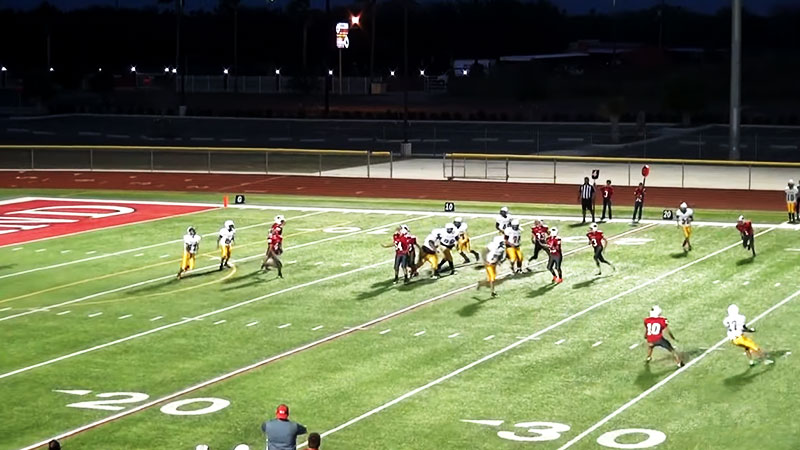
In the fast-paced, high-stakes environment of professional football, the nuances of the rulebook often dictate the outcome of a game more than the physical prowess of the athletes on the field.
Among the most frequent points of confusion for fans and analysts alike is the complex set of regulations governing special teams, specifically regarding the “scrimmage kick.”
A question that frequently emerges during chaotic special teams plays is whether a kicker or punter can legally catch their own ball after it leaves their foot.
The answer is a nuanced “yes,” but the legality of the play is entirely dependent on the ball’s location relative to the line of scrimmage and whether an opponent has interfered with its trajectory.
Understanding these distinctions is essential for anyone looking to master the strategic depth of the game.
The Line of Scrimmage: The Invisible Boundary of Legality
To understand the mechanics of a self-caught punt, one must first recognize the line of scrimmage as the ultimate legal threshold. The rules of the game shift dramatically depending on whether a ball is “behind” or “beyond” this line.
Behind the Line: The Live Ball Scenario
When a kicker strikes a punt, the ball is traditionally expected to travel far downfield to flip the field position.
However, in instances where a punt is blocked or perhaps severely affected by weather conditions, the ball may remain behind the original line of scrimmage.
In this specific scenario, if the kicker catches their own punt behind the line of scrimmage, the ball remains live. Because it has not crossed the neutral zone, the kicker essentially retains the status of an offensive player.
In this rare moment, the kicker can legally run with the ball or even attempt a forward pass, provided they have not already crossed the line of scrimmage themselves.
However, there is a strategic catch: catching the ball behind the line does not automatically grant a new set of downs. The kicking team has relinquished their standard offensive possession by choosing to kick.
Therefore, if the kicker catches the ball behind the line, they must still advance the ball to the original first-down marker to maintain possession of the drive. If they fail to reach that marker, the ball is turned over on downs at the spot where they are tackled.
Beyond the Line: The “Illegal Touching” Violation
The rules change the moment the ball crosses the line of scrimmage. Once a punt travels beyond the neutral zone, it is considered a “scrimmage kick” in flight.
If a member of the kicking team—including the punter himself—catches the ball out of the air before it has been touched by the receiving team, it is ruled as illegal touching.
Under these circumstances, the play is effectively whistled dead. The kicking team is not allowed to advance the ball, and possession is awarded to the receiving team at the spot of the catch.
This rule exists to prevent kicking teams from using the punt as a “self-pass” to gain yardage, which would bypass the standard defensive structures of the game.
The Art of “Downing” the Ball: Strategic Logistics
While catching a punt out of the air beyond the line of scrimmage is a foul, “retrieving” or “downing” a punt is one of the most common and vital components of special teams strategy.
Capitalizing on Field Position
The primary objective of a punting unit, aside from maximizing distance, is to pin the opposing offense as deep in their own territory as possible.
If the receiving team chooses not to fair catch or return the ball—often to avoid the risk of a fumble deep in their own zone—the ball will bounce and roll.
At this point, members of the kicking team will attempt to “down” the ball. This occurs when a kicking team player touches the ball after it has hit the ground, effectively ending the play.
The receiving team then takes over possession at the exact spot where the ball was first touched by the kicking team.
This is a frequent occurrence and represents a successful outcome for the punter, who has maximized the “net” yardage of the kick.
The Momentum Rule and the Endzone
A critical logistical nuance involves the proximity of the endzone. If a member of the kicking team attempts to down a ball near the goal line, their physical momentum must be accounted for by the officiating crew. If a player touches the ball but their momentum carries them into the endzone, the play is ruled a touchback.
This results in the receiving team getting the ball at the 20-yard line (or 25-yard line, depending on the specific league’s touchback rules), which often negates the excellent field position the punter was trying to achieve.
Specialist players, known as “gunners,” are specifically trained to stop their momentum before the goal line or to “bat” the ball back into the field of play to a teammate before they step into the endzone.
The “Muff” Exception: When the Ball Becomes Live
The rigid rules regarding the kicking team’s inability to recover their own punt are instantly nullified if a member of the receiving team touches the ball first. This is colloquially known as a “muff.”
If the returner or any member of the receiving team touches the ball—whether it hits their helmet, shoulder, toe, or ankle—the ball becomes live for anyone to recover.
In this chaotic scenario, if the kicker or any of their teammates recovers the ball, they gain full possession of the football, and the offense returns to the field at the spot of recovery.
It is important to note that a “muff” is distinct from a “fumble” in some technical aspects, but for the purpose of recovery, the result is the same: the kicking team is no longer restricted by the illegal touching rule because the receiving team has technically “interfaced” with the possession of the ball.
Punts vs. Field Goals: Key Legal Distinctions
While punts and field goals are both classified as scrimmage kicks, the implications of catching or recovering the ball differ slightly in practice and regulation.
The Failed Field Goal
In general, the rules for recovering a scrimmage kick apply to both punts and field goals. However, if a field goal attempt is short and falls into the endzone, it is typically ruled a dead ball or a touchback.
Unlike a punt, where the kicking team wants to down the ball near the goal line, a missed field goal that is not touched by the defense usually results in the defending team taking possession at the spot of the kick (or the 20-yard line, whichever is further from the goal).
The Blocked Extra Point
A unique exception to the “dead ball” nature of missed kicks occurs during an extra point attempt. If an extra point is blocked and the kicking team manages to recover the ball, they can actually attempt to run it into the endzone for a two-point conversion.
This is a rare but legal maneuver that highlights the “live ball” status of a blocked kick behind the line of scrimmage.
Enhanced FAQ: Navigating Edge Cases
1. Can a kicker catch their own kickoff and keep it?
A kickoff is different from a scrimmage kick (punt/field goal). Once a kickoff travels ten yards, it is a live ball that can be recovered by either team.
If the kicker manages to kick the ball ten yards and catch it themselves before it goes out of bounds or is touched by the opponent, their team maintains possession. This is the fundamental principle of the onside kick.
2. Is it a touchdown if a teammate catches a short field goal in the endzone?
No. On a field goal attempt, the kicking team can only gain possession if the defending team touches the ball first. If a kicking team player catches a short field goal in the endzone without the defense touching it, it is simply a dead ball and a touchback.
3. What happens if a punt is blocked and the punter catches it in the air?
If the catch happens behind the line of scrimmage, the punter can run or pass the ball. If the catch happens beyond the line of scrimmage (which is unlikely on a block, but possible on a tip), it is illegal touching.
4. Why is the “10-yard rule” only for kickoffs and not punts?
A kickoff is a “free kick,” whereas a punt is a “scrimmage kick.” Scrimmage kicks are designed to give the ball to the opponent, which is why the kicking team is generally forbidden from being the first to touch the ball beyond the line of scrimmage unless the receiving team muffs it.
Conclusion: Strategy and Rule Mastery
In the professional landscape, the margin between victory and defeat is often found in the mastery of these obscure regulations.
While the sight of a kicker catching their own punt is a rarity, the rules governing that possibility provide the framework for the strategic “cat-and-mouse” game played on every fourth down.
The line of scrimmage serves as the definitive boundary for legality. Behind it, the ball remains a live extension of the offense; beyond it, the ball becomes a specialized tool for field position, governed by the strictures of illegal touching and the hope for a muffed return.
For the modern athlete and the dedicated fan, understanding these logistics is the key to appreciating the full complexity of the sport.
Special teams may only account for a small percentage of total snaps, but as we have seen, a single touch—legal or otherwise—can change the entire trajectory of a season.