If you tune into any professional football game, the broadcast audio presents a highly specific pre-snap soundtrack.
Amidst the roar of tens of thousands of fans, a clear, rhythmic string of words cuts through the stadium: “Set! Blue 80! Blue 80! Ready, Go!”.
To the casual observer, these words sound like random shouting, perhaps a traditional eccentricity passed down through generations of athletes. However, in the high-stakes environment of professional football, nothing is left to chance.
Every syllable spoken by a quarterback at the line of scrimmage is a calculated, strategic, and acoustically optimized tool.
The phrase “Blue 80”—and its closely related linguistic cousins—serves as the backbone of modern offensive communication.
By analyzing the physical properties of sound, the chess-like strategic maneuvers of play-calling, and the practical demands of professional playbooks, we can uncover the fascinating mechanics behind the quarterback’s cadence.
1. Defining the Snap Cadence: The Offense’s Metronome
To understand why quarterbacks repeat these specific phrases, one must first understand the concept of a snap cadence.
A cadence is the structured progression of words, numbers, and tones spoken by the quarterback immediately before the ball is snapped.
Establishing Rhythm and Synchronized Timing
The primary purpose of a cadence is to establish a shared, predictable auditory rhythm for the entire offensive unit. In professional football, success is measured in fractions of a second.
Offensive linemen, tight ends, and wide receivers must burst forward into their blocks or routes at the exact tenth-of-a-second the ball is snapped.
Because the offensive players know the play and the timing sequence, they can anticipate the snap.
This synchronized anticipation gives the offense a physical head start over their defensive opponents, who must wait to react purely to the physical movement of the ball or the offensive line.
The Standard Cadence Structure
A typical “base cadence” used across many levels of football follows a standardized rhythm:
“Set. Blue 80. Blue 80. Ready. Go!”
If the quarterback instructs the team in the huddle that the play will begin “on one,” every player knows the center will snap the ball the instant the word “go” is spoken.
By repeating “Blue 80” at a consistent tempo, the quarterback establishes a steady metronome. The offensive players use this tempo to count down the seconds in their minds, perfectly timing their explosive first steps.
2. The Acoustic Physics of the Gridiron
Why do quarterbacks specifically choose words like “Blue” and “Eight” over other vocabulary? The answer lies in the physics of sound and human hearing under extreme conditions.
Battling the Wall of Stadium Noise
An NFL stadium is one of the most acoustically hostile environments in professional sports. Crowd noise often exceeds 100 decibels, generating a dense, high-pitched acoustic wall.
For a quarterback, communicating with teammates who are spaced up to 15 yards away—all while wearing heavily padded helmets—is an extraordinary physical challenge.
Linguistic and acoustic research reveals that crowd noise typically occupies higher frequency spectrums. To cut through this high-pitched din, a quarterback must speak in a lower register.
- Low-Pitch Projection: The words “Blue” and “Eight” are naturally spoken with a lower vocal pitch and deeper resonance. Low-frequency sounds travel better through physical barriers—like plastic helmet shells and ear padding—without being absorbed or scattered as easily as high-frequency sounds.
- Sharp Consonants and Hard Vowels: “Blue 80” utilizes hard consonant boundaries and sharp, distinct vowel sounds. These phonetic elements prevent the words from slurring together, ensuring that even a distant wide receiver can distinguish the start of each syllable.
“Hut” vs. “Hike”: A Phonetic Choice
The same acoustic principles explain why football players historically transitioned away from the word “hike” in favor of the modern “hut”.
| Word | Pitch Category | Vocal Resonance | On-Field Effectiveness |
|---|---|---|---|
| Hike | High Tone | Spreads out, easily masked by high-pitched crowd screaming | Poor projection in loud stadiums |
| Hut | Low Tone | Sharp, explosive, distinct drop in pitch | Highly effective at cutting through noise |
“Hut” acts as a sharp, low-frequency exclamation that is immediately recognizable to the offensive line, serving as the perfect final trigger.
3. Tactical Strategy: How “Blue 80” Directs the Play
Beyond physical acoustics, “Blue 80” is a dynamic tool for pre-snap tactical adjustments.
                [ Huddle: Play Called ]
                           │
                           ▼
              [ Line of Scrimmage Set ]
                           │
            ┌──────────────┴──────────────┐
            ▼                             ▼
    [ Keep Play ]                 [ Change Play ]
    (Base Cadence)                  (Audible)
"Set. Blue 80. Blue 80."     "Set. Blue 80. Blue 80.
        Ready. Go!         Jet Fire. Ready Go!"
The Base Cadence vs. The Audible
For many teams, “Blue 80” represents the base cadence. When the quarterback approaches the line of scrimmage and utters “Blue 80,” it signals to the offense that the play called in the huddle remains active and unchanged.
However, if the quarterback identifies an unfavorable defensive alignment, they can use “Blue 80” as an “alert” or a transition signal to call an audible (a live play change). In this scenario, the cadence serves as the dividing line between the old play and the new instructions:
“Set. Blue 80. Blue 80. Jet Fire. Ready Go!”
Here, the repetition of “Blue 80” commands the offensive unit’s focus, and the subsequent phrase—“Jet Fire”—acts as the new instruction, instantly overwriting the huddle play call.
Advanced Color and Number Systems
At highly advanced levels of the game, coaches design complex playbooks where different colors and numbers represent specific tactical categories. This system allows quarterbacks to adjust plays seamlessly without tipping off the defense.
- Categorized Play-Action: A team might design a system where “Black” indicates a pass play, while “Green” indicates a run play.
- The Number System: The numbers following the color specify the exact blocking scheme, route combination, or target gap.
- An utterance of “Black 74” tells the entire team to execute pass play number 74.
- A shift to “Green 74” immediately changes the call to run play number 74.
- Live vs. Dummy Indicators: To prevent defenses from decoding these signals, offensive coordinators constantly rotate “live” and “dummy” indicators. In a given week, “Blue” might be the “live” color, meaning the offensive line must adjust their blocking to target a specific blitzing defender or identify the middle linebacker (“Mike”). The following week, “Red” might become the live color, and “Blue” reverts to a meaningless dummy call.
4. Famous Variations: The Voices of the NFL
While “Blue 80” is a highly recognizable baseline, elite quarterbacks often customize their cadences to suit their physical voices, team identities, and offensive systems.
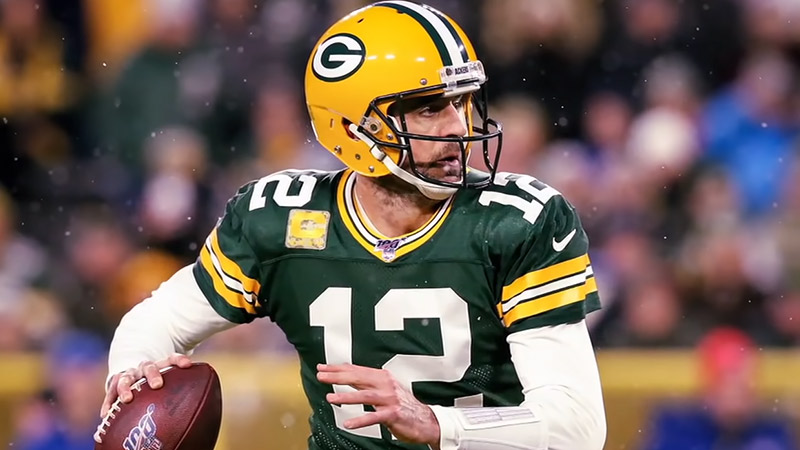
Aaron Rodgers: “Green 18”
One of the most recognizable voices in modern football history belongs to Aaron Rodgers, whose signature pre-snap shout is “Green 18”.
Interestingly, this call represents a direct evolution of franchise history. When Rodgers backed up Hall of Fame quarterback Brett Favre, he listened to Favre use “Green 80” as his primary cadence.
When Rodgers took over, he adapted the color but adjusted the numerical suffix, creating an iconic vocal brand that has kept defenses on their toes for nearly two decades.
Tom Brady and Cam Newton: “White 80”
Seven-time champion Tom Brady and former MVP Cam Newton frequently utilized “White 80” as their preferred pre-snap foundation. Brady also developed highly specialized cadence offshoots to manipulate defensive lines:
- “Alpha Go!”: Used during fast-paced, no-huddle situations to snap the ball immediately and catch defenders off guard.
- “Alpha, we go!”: Utilized as a fake count to test the defense’s reaction without actually snapping the ball.
Other Notable Cadences
- Eli Manning: Famous for his sharp, distinct drawl of “Blue 18… Blue 18, set hut!”.
- Jameis Winston: Frequently relies on the classic, standard “Blue 80” to dictate the rhythm of his offense.
- Andy Dalton: Utilizes “Green 18”, mimicking the rhythm popular in West Coast-style offenses.
- Ben Roethlisberger: Utilized “Blue 80” variations for over a decade to manage the offensive line.
- Marcus Mariota: Known to frequently call out “Delta Set” before initiating his snap count.
5. Playbook Portability: The Standardized Language Advantage
An overlooked benefit of standardized cadences like “Blue 80” is what coaches call playbook portability.
In the modern professional league, roster movements occur rapidly. Teams frequently sign backup quarterbacks, offensive linemen, or wide receivers mid-season due to injuries.
If a newly signed quarterback has to learn a unique, highly complex vocal language in four days, the offense risks total collapse due to pre-snap penalties.
By utilizing universally understood baselines like “Blue 80,” a backup quarterback can step onto the field with a new franchise and immediately execute the basic playbook.
Because the physical cadence and timing are familiar, the player can focus their mental energy on mastering the highly complex playbook diagrams, blocking schemes, and route adjustments.
The Tactical Symphony
The next time you watch a game, listen closely as the offense approaches the line of scrimmage. What sounds like a simple, repetitive shout is actually a sophisticated strategic system.
From the acoustic choice of low-frequency syllables to the strategic implementation of play-altering audibles, “Blue 80” represents the perfect intersection of physical science and gridiron chess. It is the quiet metronome that guides the chaotic, explosive game of professional football.