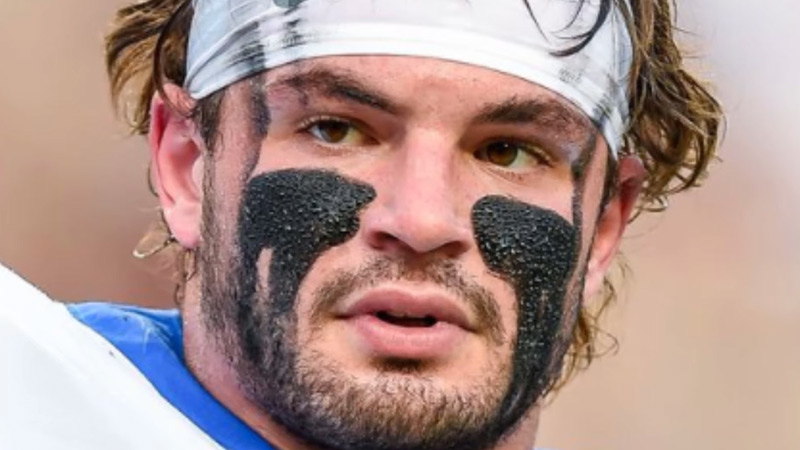
When elite athletes step onto the gridiron under blinding stadium lights or the blazing afternoon sun, one visual signature immediately captures the attention of millions of fans: the dark, horizontal stripes drawn across their cheekbones.
It is a striking aesthetic—a modern iteration of ancestral preparation—that prompts a fundamental question spanning physics and psychology: Why do football players put black on their cheeks?
While many viewers witness this ritual without questioning its function, the reality is a compelling mix of optical engineering and competitive edge.
1. The Historical Genesis of Eye Black
To understand eye black, one must trace its lineage back over a century to early American sports.
Although heavily associated with football today, the practice found its first major champion in baseball legend Babe Ruth during the early 1920s, who used black strips to combat the unforgiving glare of the sun.
In those early days, athletes used makeshift solutions. The earliest recorded mixtures consisted of simple, easily attainable ingredients: burnt cork ashes and shoe polish.
As sports grew more commercialized, the technology evolved. Modern grease formulations replaced shoe polish with skin-safe components, developing into a structured blend of beeswax, paraffin, and carbon soot.
More recently, adhesive eye black stickers emerged as a major alternative. These pre-cut fabric strips with adhesive backings gained rapid popularity because they are easy to apply and leave virtually no sticky residue. Despite their convenience, a division remains among purists regarding which format offers superior performance.
2. The Biophysics of Glare and Light Absorption
Behind the aesthetic lies a basic principle of optical physics. When we look at a white object, we see a surface that reflects all visible light wavelengths into our eyes. Conversely, black is the visual sensation experienced when an object absorbs light rather than reflecting it.
This optical rule explains why athletes apply dark pigments to their faces. When an athlete sprints across the field, their eyes are subjected to high-intensity light rays from natural sunlight or massive stadium floodlights.
The human cheekbone is a prominent surface that catches this light. If left bare, the natural skin tone reflects these harsh rays upward, bouncing them directly into the eyes. This glare can severely impede a player’s depth perception, making it difficult to track a ball.
By placing a highly absorptive black material directly over the cheekbones, players prevent this secondary light reflection.
The grease or fabric absorbs stray light rays, helping players maintain a clear focus, improve contrast when looking upward, and track objects moving through the sky with maximum precision.
3. The Empirical Debate: Hard Science vs. Athletic Perception
While the theory behind glare reduction is straightforward, the scientific community remains divided on its quantifiable benefits.
Optical experts continue to debate whether the physical change in glare is truly significant enough to alter athletic performance, with some researchers hypothesizing that biological variations like eye color play a role in how light is processed.
This scientific skepticism was explored on a 2008 episode of MythBusters. The showrunners conducted rigorous testing and revealed a nuanced truth: while the literal reduction of glare on the cheekbones was minimal, the dark stripes provided a measurable benefit in helping eyes distinguish between light and dark contrast.
Specifically, the markings helped test subjects track a dark object, such as a ball, flying through a bright sky.
In locker rooms, an ongoing debate persists regarding traditional grease versus modern stickers. Many professional players insist traditional grease is noticeably more effective at reducing glare, though very few formal, peer-reviewed clinical studies exist to conclusively back up this claim.
4. The Psychology of “War Paint” and Sports Rituals
In high-stakes sports, the mental game is just as critical as physical preparation. This explains why eye black usage has expanded far beyond its original practical purpose.
Even when physical glare reduction benefits are minimal, athletes continue to draw these markings for a powerful psychological advantage.
For many, applying eye black serves as a competitive anchor, helping them transition into a focused, aggressive mindset.
It has evolved into personal “war paint,” used to project a tough, uncompromising image designed to intimidate opponents. Some players even associate the ritual with historical traditions, such as tricks originally utilized by Native Americans.
The deeply ingrained nature of this habit is most evident in environments where glare is absent. Players regularly wear eye black during games played inside completely enclosed domes or deep into the night under standard lighting conditions.
Furthermore, offensive and defensive linemen—whose primary responsibilities involve blocking and tackling with no requirement to look upward—frequently wear the markings.
For these athletes, the practice is entirely traditional and mental. Many competitors confess that playing without eye black makes them feel mentally exposed or vulnerable, which can actively degrade their performance.
5. Advanced Equipment Evolution and Safety Dynamics
To fully appreciate how eye black fits into modern football, one must look at how player equipment has evolved. A century ago, football was played under drastically different safety standards without padding.
As the game grew faster and increasingly violent, injuries skyrocketed, prompting historical figures like President Teddy Roosevelt to demand safety reforms.
The introduction of mandatory padding and helmets successfully mitigated fatal risks, transforming the sport into a structured contact game. Within this heavily padded uniform, the face remains one of the few areas exposed to direct observation.
While helmets and visors provide physical protection against high-speed impacts, they do not completely shield the eyes from shifting stadium lights.
Unlike baseball caps, which feature a prominent brim that naturally shades the face, football helmets lack this protective brim, leaving the upper face vulnerable to overhead light reflection.
Consequently, eye black acts as a personalized micro-adjustment, bridging the gap between massive physical armor and precision optical performance.
Comprehensive Eye Care and Safety Insights
Maintaining visual clarity on the field is paramount to preventing injuries. When glare obstructs a player’s field of vision, it delays reaction time, making them vulnerable to unexpected, high-velocity collisions.
While eye black is a valuable tool for contrast enhancement, modern sports vision clinics emphasize that it should be part of a comprehensive approach to ocular safety.
Athletes should regularly consult with eye care specialists to ensure their natural vision and depth perception are fully optimized.
For players experiencing persistent visual strain under stadium lighting, advanced clinical evaluations—such as tracking visual contrast sensitivity—can help identify if specific light-filtering visors are necessary alongside anti-glare applications.
Conclusion
The iconic black marks worn under the eyes of football players represent a perfect fusion of physical science and athletic psychology.
What began as a simple experiment using burnt cork and shoe polish by Babe Ruth in the 1920s has grown into an enduring global symbol of competitive intensity.
Whether used to sharpen visual contrast on a deep pass or as a mental shield in the trenches, eye black remains an essential element of the sport’s rich heritage.