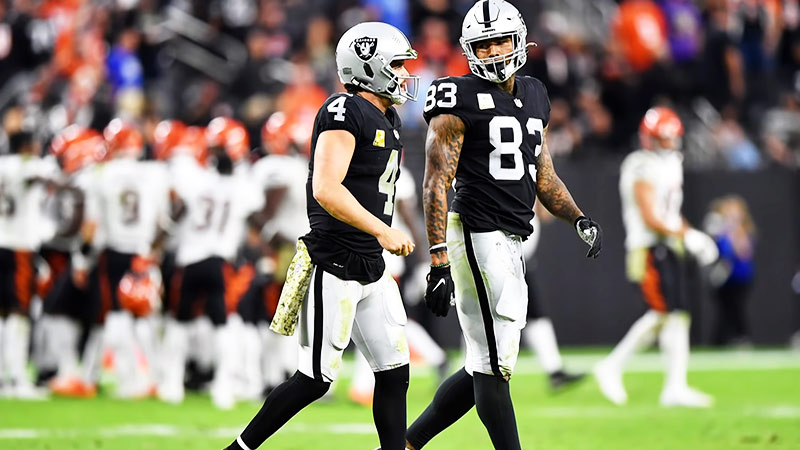
Few modern quarterbacks have experienced the sheer volume of structural disruption that defined Derek Carr’s professional football career.
When discussing quarterback longevity, analysts often focus heavily on head coaching changes. However, the true heartbeat of a quarterback’s development, statistics, and tactical identity lies in the office of the offensive coordinator.
Throughout his 11-year journey in professional football, Derek Carr worked with exactly five official offensive coordinators.
While his well-documented navigation of organizational instability saw him play under seven different head coaches, the turnover rate at the offensive coordinator position tells an even deeper story about tactical adaptation, scheme changes, and the pursuit of sustained offensive rhythm.
This comprehensive analysis explores every coordinator Carr worked with, the systems they ran, and how this unique carousel shaped his career trajectory.
The Blueprint: Derek Carr’s Offensive Coordinators at a Glance
Before diving into the chronological breakdown, it helps to look at the complete landscape of play-callers who shaped Carr’s career from his rookie debut in Oakland to his final season in New Orleans.
1. Greg Olson (Oakland Raiders: 2014, 2018–2021)
The Rookie Awakening and the Reunion
Greg Olson holds a unique distinction in Carr’s career: he was the very first professional offensive coordinator Carr ever played under, and he was also the coordinator during Carr’s final years in Oakland.
When Carr was selected in the second round of the 2014 NFL Draft, the Raiders handed the offensive reins to Olson.
Stepping onto the field as a rookie starter is rarely pretty, and Olson’s task was to shepherd a young quarterback through a rebuilding roster.
The offense relied heavily on short, rhythm-based throws to protect the rookie, laying a foundational toughness that would characterize Carr’s career.
After stints elsewhere, Olson returned to the Raiders in 2018 under newly appointed head coach Jon Gruden.
This second four-year stretch (2018–2021) represented the longest period of continuous scheme familiarity Carr experienced in his professional life.
Under Gruden and Olson, the offense leaned into a West Coast derivative featuring complex pre-snap motions, deep play-action passing, and a heavy emphasis on timing routes.
Despite constant roster turnover and off-field organizational distractions, the Olson-led offenses consistently ranked in the upper half of the league in passing yards, proving that stability—even in a complex system—yields statistical productivity.
2. Bill Musgrave (Oakland Raiders: 2015–2016)
The Peak of the Black and Silver
If Olson built the foundation, Bill Musgrave constructed the penthouse. Hired ahead of the 2015 season, Musgrave unlocked a new tier of production for Carr, pairing him with ascending young talents like wide receiver Amari Cooper and tight end Clive Walford.
The culmination of this partnership arrived during the unforgettable 2016 campaign. Musgrave designed an aggressive, balanced attack that maximized Carr’s quick release and deep-ball accuracy.
Carr emerged as a legitimate Most Valuable Player candidate, orchestrating numerous fourth-quarter comebacks and leading the franchise to a 12-4 record.
Tragically, a late-season leg injury derailed what looked like a deep postseason run. Despite the team’s offensive success—ranking sixth in total offense that year—the front office made the surprising decision not to renew Musgrave’s contract following the season, prematurely halting one of the most promising partnerships of Carr’s career.
3. Todd Downing (Oakland Raiders: 2017)
The Transition Season
Following Musgrave’s departure, the organization chose internal continuity over external hiring, promoting quarterbacks coach Todd Downing to offensive coordinator for the 2017 season.
Downing had built a strong relationship with Carr during their time working closely together in the quarterback room, which was the primary catalyst for the promotion.
The objective was to build upon the explosive success of 2016 while adding fresh wrinkles to the passing game.
However, the 2017 offense suffered a noticeable regression. The unit struggled with consistency, third-down efficiency, and finding a cohesive rhythm.
While individual statistics remained respectable, the offense lacked the dynamic fluidity of the previous year. Following a disappointing 6-10 finish, sweeping coaching changes were made, leading to Downing’s departure after just one season in the coordinator chair.
4. Mick Lombardi (Las Vegas Raiders: 2022)
The Final Chapter in Las Vegas
When Josh McDaniels took over as head coach of the newly minted Las Vegas Raiders in 2022, he brought Mick Lombardi with him from the New England Patriots coaching tree to install a Patriot-style offensive system.
For Carr, this meant learning an entirely new playbook for the first time in five years. The system required mastering deep option routes, precise timing, and intricate pre-snap communication. The transition period came with growing pains as Carr and the offensive skill players adjusted to the rigorous mental demands of the scheme.
Despite pairing Carr with superstar wide receiver Davante Adams, the offense experienced wild fluctuations in performance. Games of brilliant offensive output were marred by stagnant halves, leading to close losses.
Following a turbulent 6-11 campaign, the franchise decided to move in a different direction at the quarterback position, bringing an end to Carr’s nine-year tenure in the organization.
5. Pete Carmichael Jr. (New Orleans Saints: 2023)
Heading to the Bayou
As a free agent in the spring of 2023, Carr signed with the New Orleans Saints, seeking stability and a fresh start in the National Football Conference.
There, he stepped into an offense run by longtime coordinator Pete Carmichael Jr., who had spent nearly two decades under the Sean Payton coaching umbrella.
Carmichael’s system offered a blend of traditional West Coast concepts and option-heavy route combinations.
For Carr, learning a playbook steeped in decades of institutional knowledge required patience during the opening months of the season.
While the offense started slowly, it found its footing late in the year, stringing together impressive performances down the stretch.
Carmichael provided a steady, veteran presence in the coaches’ booth, helping Carr navigate the mental hurdle of changing franchises for the first time in his career.
6. Klint Kubiak (New Orleans Saints: 2024)
The Final Professional Campaign
For the 2024 season, the New Orleans Saints overhauled their offensive coaching staff, bringing in Klint Kubiak to inject modern, Kyle Shanahan-derived offensive principles into the scheme.
Kubiak’s offense emphasized wide-zone rushing attacks, heavy play-action passing, motion at the snap, and clear-read progressions designed to make throws easier for the quarterback.
The system instantly revitalized the passing game, allowing Carr to distribute the ball efficiently to playmakers in space.
However, football is a war of attrition. During his tenth appearance of the 2024 season, Carr suffered a severe shoulder injury that ultimately sidelined him for the remainder of the year.
This injury served as a turning point, prompting Carr to officially announce his retirement from professional football in May 2025, bringing a close to his legendary playing days.
Post-Professional Transition: From Player to Mentor
True students of the game rarely stay away from the gridiron for long. Following his retirement announcement, Carr wasted no time pivoting to the next phase of his football life.
In May 2025, he accepted a role with UCLA Football as a volunteer special adviser. In this capacity, Carr works directly alongside head coach Bob Chesney and the Bruins’ offensive staff.
His day-to-day responsibilities include assisting with advanced game-planning strategy, breaking down opponent tendencies, and—most importantly—mentoring young quarterbacks as they navigate the complexities of college football.
Having absorbed systems from five different official coordinators and seven head coaches across eleven professional seasons, Carr possesses a masterclass-level understanding of quarterback mechanics, defensive structures, and offensive design. That wealth of experience is now being passed down to the next generation of signal-callers in Los Angeles.
Key Takeaways: What the Coordinator Carousel Teaches Us
Analyzing Carr’s relationship with his offensive coordinators highlights several vital truths about modern football:
Scheme Mastery Takes Time
Changing coordinators every two to three seasons forces a quarterback to constantly relearn terminology, footwork, and progressions, stunting the compounding growth that comes with long-term system stability.
The Sweet Spot
The most productive statistical years of Carr’s career (such as 2016 under Bill Musgrave and the later Gruden-Olson years) occurred when he enjoyed multi-year continuity within the same offensive architecture.
Adaptability as a Superpower
Surviving five different play-callers requires immense mental agility. Carr’s ability to absorb radically different offensive philosophies—from power-spread concepts to West Coast timing routes and modern wide-zone play-action—proved his status as a high-IQ football mind.
Enhanced FAQ
How many head coaches did Derek Carr play for?
During his 11-year career, Carr played under seven different head coaches (counting interim coaches), making organizational instability a defining theme of his playing days.
Who was Derek Carr’s most successful offensive coordinator?
Statistically and operationally, Bill Musgrave in 2016 stands out as Carr’s most explosive coordinator pairing, resulting in an MVP-caliber season and a 12-4 record before injury struck.
What is Derek Carr doing now?
Following his retirement from professional football in May 2025, Carr joined the UCLA Bruins coaching staff as a volunteer special adviser, focusing on game-planning and quarterback mentorship.
Conclusion
Derek Carr’s career cannot be told without acknowledging the revolving door of play-callers who walked into his meeting rooms.
From Greg Olson’s rookie guidance to Klint Kubiak’s modern scheme, navigating five official offensive coordinators required resilience, constant learning, and professional maturity.
Now, as he shares those hard-earned lessons from the coaching booth at UCLA, that turbulent carousel has come full circle—transforming a battle-tested quarterback into an invaluable mentor for the future.