When you sit down on an autumn afternoon to watch a professional football game, one of the most distinctive sounds of the broadcast is the loud, rhythmic barking of the quarterback right before the ball is snapped.
With modern high-definition television microphones capturing every grunt and quiet stadium moment, leaving the field audio exposed, these pre-snap calls are heard with crystal clarity in living rooms across the world.
You might hear a superstar shout a rapid sequence like “White 80! White 80! Set! Hut!” or a sudden, frantic adjustment that sends offensive linemen shifting into new stances.
To the casual observer, this vocal display sounds like a chaotic, random collection of colors, numbers, and strange words yelled at maximum volume.
To the trained ear, however, it is a highly coordinated, incredibly sophisticated pre-snap language. This vocal sequence is known as the cadence, and it serves as the operational central nervous system for the entire offense at the line of scrimmage.
What is a Quarterback Cadence?
At its core, a quarterback’s cadence is a structured, rhythmic sequence of colors, numbers, and trigger words. Far from being a random assortment of words, every single syllable spoken by the quarterback under center has a specific functional purpose.
The primary goal of the cadence is to coordinate the offensive unit, ensuring that all eleven players on the field act in perfect unison at the exact millisecond the play begins.
Because the offensive players know the exact rhythm and structure of the cadence, they can jump into action the instant the ball is snapped.
Conversely, the defensive players, who are forced to react purely visually to the movement of the ball, are placed at a natural split-second disadvantage.
The cadence is not static. Throughout a single game, a quarterback will constantly vary their verbal sequence to serve several critical roles:
- Timing the Snap: Informing the center and the rest of the offense when the ball will be put into play.
- Executing Audibles: Instantly changing the play call or the offensive formation on the fly based on how the defense aligns.
- Adjusting Protections: Directing the offensive line to account for blitzing defenders and shifting pass-rush schemes.
- Using Deception: Deploying dummy counts and fake signals to bait aggressive defenders into jumping offside, securing a free five-yard penalty.
The Anatomy of a Basic Cadence
To understand how these complex plays are run, one must first understand the fundamental building blocks of a standard pre-snap sequence.
While every coaching staff designs its own unique playbook, almost all professional cadences follow a predictable structural syntax.
1. The Preliminary Communication
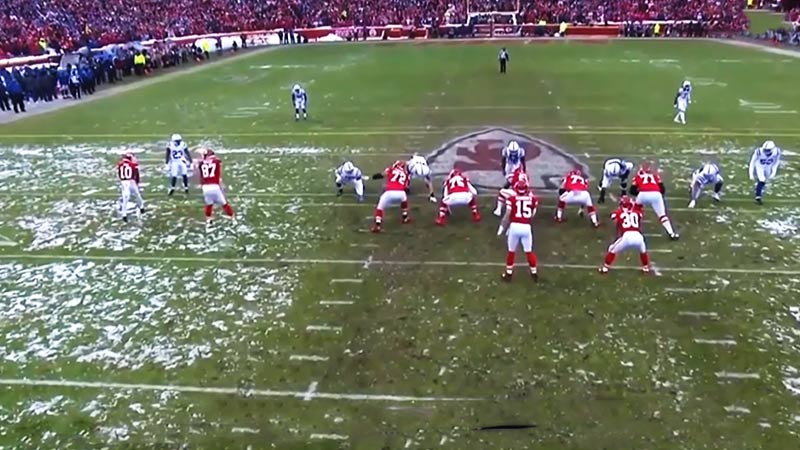
Before the formal, rhythmic cadence begins, quarterbacks will often engage in direct, non-rhythmic communication. When they first break the huddle and step up to the line of scrimmage, they must analyze the defensive front.
During this initial phase, the quarterback may point out specific defensive players, identify the “Mike” (the middle linebacker), or shout instructions directly to their offensive linemen. This “free-talking” communication ensures that the blocking foundation is secure before any snaps are attempted.
2. The Color-Number Pairings
Once the initial alignments are verified, the quarterback drops into their physical stance and begins the rhythmic portion of the cadence, which almost always features a color paired with a number (such as “White 80” or “Blue 42”).
These color-number combinations are repeated to establish a consistent vocal rhythm. These pairings can communicate a variety of immediate instructions, including snap timing, receiver route alterations, or blocking adjustments.
3. The Trigger Word
The final element of any cadence is the sharp, loud trigger word. This is the vocal cue that tells the center to snap the ball.
Common trigger words include “Hut!”, “Go!”, or even a sharp, guttural grunt. The exact trigger word used is strictly coordinated during practice so that the entire offense moves as one.
Decoding the Color and Number Codes
For decades, fans have wondered what specific colors and numbers actually mean.
While teams frequently change their code words from week to week to prevent opponents from cracking their system, there are several historic, traditional meanings behind some of the game’s most famous pre-snap calls.
The Universal Anthem: “White 80”
If you have watched superstars like Aaron Rodgers or Tom Brady orchestrate an offense, you have undoubtedly heard them yell “White 80” repeatedly. If you always assumed they were yelling “180,” you are completely mistaken.
“White 80” is the most popular pre-snap phrase in professional football. In the simplest terms, “White 80” serves as a universal signal that means “let’s go”. When a quarterback barks “White 80,” it tells the offensive line’s center that the quarterback is fully set and ready for the snap.
Additionally, it serves as a critical alignment cue for wide receivers, helping them understand exactly where they should position themselves along the line of scrimmage so that the upcoming play can be executed with high accuracy.
The Long-Ball Alert: “Blue 80”
When a quarterback changes their standard color call to “Blue 80,” it often carries a highly specific tactical meaning.
In many professional systems, shouting “Blue 80” is a coded warning to the entire offensive unit that the quarterback is about to attempt a deep pass down the field.
This vocal cue tells the wide receivers to prepare for a long, vertical route and brace themselves to compete for a deep throw.
Because of the high risk and high reward of a deep passing play, you will frequently hear quarterbacks deploy “Blue 80” during critical, high-pressure moments, such as a late-game winning drive or during high-stakes overtime periods.
Mapping the Defensive Coverage: “Blue 31” and “Blue 32”
Sometimes, a quarterback’s color and number calls are used to communicate real-time intelligence about the defensive secondary’s alignment. If a quarterback is calling out phrases like “Blue 31” or “Blue 32,” they are often telling their receivers and offensive line exactly what kind of pass coverage they have diagnosed.
- “Blue 31” is a common code indicating that the defense is lining up in Cover-1 (a man-to-man defense with a single deep safety).
- “Blue 32” is a code indicating that the defense is lining up in Cover-2 (a zone defense with two deep safeties splitting the field).
By yelling these coverage reads during the cadence, the quarterback ensures that receivers know exactly how to adjust their routes to exploit the holes in the specific coverage scheme.
Peyton Manning’s “Omaha”
Perhaps the most famous cadence word in modern football history is “Omaha”. Popularized by Hall of Fame quarterback Peyton Manning during his historic runs with the Indianapolis Colts and the Denver Broncos, “Omaha” became a household term during the 2012 season.
Manning eventually revealed the simple, urgent truth behind the famous code: “Omaha” meant that the play clock was running out. When Manning stood at the line of scrimmage and barked “Omaha,” he was telling his teammates:
“Hey, there are just two or three seconds left on the play clock, and I need the ball snapped right now!”. It was an immediate signal to skip the rest of the cadence and snap the ball instantly to avoid a costly delay-of-game penalty.
The Mechanics of the Snap Count
A crucial function of the cadence is establishing the snap count. The snap count determines the exact moment the center must pass the ball back to the quarterback.
Offenses vary their snap counts continuously throughout a game to prevent defensive pass-rushers from timing their jump perfectly.
| Snap Count Type | Verbal Structure Example | Snap Moment | Strategic Advantage |
|---|---|---|---|
| “On One” | “Down! Set-Hit!” | On the first “Hit” | Standard rhythm; quick execution. |
| “On Two” | “Down! Set-Hit! Hit!” | On the second “Hit” | Slows down the defensive pass rush. |
| “On Sound” / “On Go” | “Go!” | Instantly on the first bark | Catches a napping defense completely unprepared. |
| “On Color” | “Down! Color!” | Instantly upon hearing the color | High-speed snap; bypasses the long cadence. |
By shifting between going “on one,” “on two,” or even “on three,” quarterbacks keep defensive linemen off balance.
If a defense gets overly aggressive and expects a snap “on one,” the quarterback can deliberately call a play “on two”. When the eager defender rushes forward on the first “hit” and crosses the line of scrimmage, they are flagged for an offside penalty, giving the offense a free five yards.
Real-Time Strategy: Audibles, Protection Adjustments, and the “Kill” Call
An elite quarterback does not simply walk up to the line and run whatever play was called in the huddle. They must act as an on-field general, diagnosing the defensive alignment and making rapid adjustments in a matter of seconds.
Calling an Audible
If a quarterback breaks the huddle and realizes that the defense has lined up in a perfect counter to the called play, they must change the play entirely. This is known as calling an audible.
To do this, the quarterback will yell a completely new coded phrase or a specific set of words to instruct the offense to switch to a different play.
One common method used across the league is the “Alert” method. If the quarterback wants to signal a play change at the line of scrimmage, they will physically point to their helmet or head and shout the word “Alert!”.
This visual and verbal cue tells the entire offense to throw out the huddle play and prepare for the backup play designed for that specific defensive look.
The “Kill” Call: The Ultimate Panic Button
Sometimes, a quarterback doesn’t need to invent a brand-new play at the line; they simply need to cancel the current one. In many systems, teams will walk out of the huddle with two plays called: a primary play and a built-in secondary backup.
If the quarterback sees that the defense is set up to stop the primary play, they will loudly yell “Kill, kill!” (or use similar trigger words like “can” or “check”).
Shouting “Kill” immediately instructs the entire offensive unit to cancel the original play and instantly pivot to the pre-arranged backup option. This simple, high-speed adjustment prevents the offense from running directly into a defensive trap.
Adjusting Pass Protection
The quarterback’s pre-snap language is also vital for the survival of the offensive line. Before starting the snap cadence, quarterbacks must ensure that their blockers are aligned to stop the incoming rushers.
If a quarterback identifies a blitzing linebacker or an unprotected gap, they will “free-talk” to their offensive line to adjust the blocking scheme.
For example, they might call out a specific pass-blocking package by shouting something like, “Hey, 200 Jet, 200 Jet!” before dropping back into their rhythmic cadence.
This tells the offensive tackle and guards exactly how to slide their protection to keep the quarterback safe in the pocket.
The Deceptive Game: Dummy Calls and Silent Counts
Not everything a quarterback says at the line of scrimmage is a genuine instruction. In fact, a massive percentage of what is barked out is purely meaningless filler known as dummy calls.
Because defenses are constantly trying to study game tape to crack the offensive code, quarterbacks will deliberately pepper their cadences with random words, numbers, and colors that have absolutely no meaning to the offense.
The offensive players are trained to ignore these dummy calls completely, while the defensive players are left guessing whether a specific color indicates an incoming deep pass, an adjusted run, or absolutely nothing at all.
The Silent Count
What happens when the game is played in a highly hostile, incredibly loud stadium where the offensive players cannot hear the quarterback’s voice? Under these extreme conditions, a verbal cadence becomes useless.
To combat crowd noise, teams will switch to a silent count. Instead of relying on a vocal rhythm, the quarterback will use physical triggers to coordinate the snap.
A common technique involves the quarterback clapping their hands sharply. This visual and physical cue acts as the silent trigger, telling the center to snap the ball immediately.
The Cognitive Load: Why Pre-Snap Mastery Separates the Elite
Operating a professional offense at the line of scrimmage is one of the most mentally demanding tasks in all of sports.
In a span of just 15 to 20 seconds, a quarterback must walk to the line, identify the defense’s front, locate the middle linebacker, adjust the offensive line’s blocking scheme, analyze the safety depth to diagnose the coverage, decide whether to keep or change the play, execute any necessary audibles, and then deliver a perfectly timed, rhythmic cadence to snap the ball.
For veteran superstars, this process is second nature. They process these complex streams of information fluidly, making the pre-snap phase look effortless. However, when a team is forced to play a rookie quarterback with limited playing time, the sheer speed and complexity of this cognitive load become painfully obvious.
Without years of experience, a young quarterback can easily become overwhelmed by the defensive look, leading to broken cadences, late snaps, missed blocking assignments, and pre-snap penalties that can cause the offense to fall apart in a matter of minutes.
Conclusion: Active Listening Next Sunday
The next time you watch a football game, try to look past the physical action of the play and focus closely on the final fifteen seconds of the play clock.
Pay attention to the quarterback’s hand gestures, their sudden shifts in vocal pitch, the repetition of key color-number pairings, and the sudden use of panic words like “Kill” or “Alert”.
By understanding the secret language of the line of scrimmage, you can pull back the curtain on the game’s ultimate chess match, appreciating the incredible mental athletics that occur before the ball is ever snapped.