In the high-stakes environment of professional football, player availability and physical durability are two of the most critical metrics evaluated by front offices, sports analysts, and fans alike. Every physical setback, minor muscle twitch, or practice absence is subjected to intense public scrutiny.
However, understanding an elite athlete’s true physical status requires moving past immediate headlines and examining their comprehensive clinical history.
Jaylen Waddle represents a fascinating study in sports medicine, athletic resilience, and physiological recovery.
To evaluate his long-term physical durability, one must analyze the defining moments of his medical history: his major collegiate ankle reconstruction, his surgically clean transition to the professional ranks, and his recent soft-tissue management during late-summer practices.
This comprehensive clinical profile examines the exact nature of Waddle’s historical surgical intervention, his recovery benchmarks, and the physiological context behind his current physical management.
1. The Right Ankle Surgery of 2020: A Biomechanical Analysis
To understand Waddle’s current physical baseline, we must return to his collegiate career at the University of Alabama.
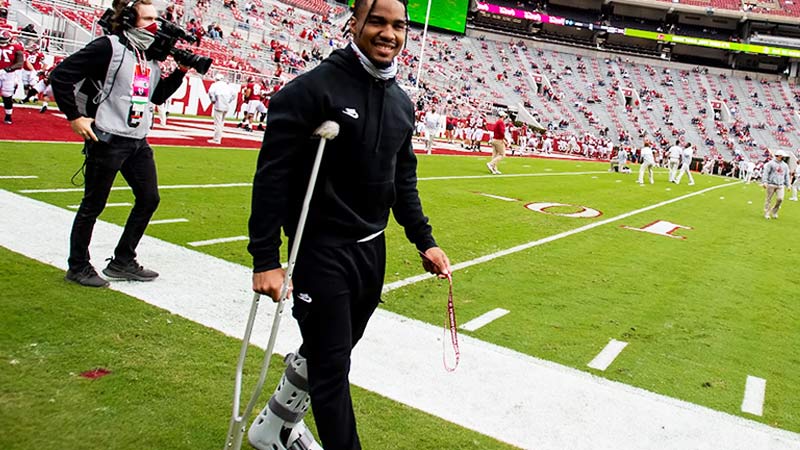
In October 2020, during his junior season, Waddle suffered a severe right lower-extremity injury during a game against Tennessee. The clinical diagnosis revealed a combined injury: a right ankle fracture and a high-ankle sprain.
Understanding the Pathology: Fracture and High-Ankle Sprain
A combined ankle fracture and high-ankle sprain is a complex orthopedic event. Unlike a standard lateral ankle sprain, which involves the anterior talofibular ligament (ATFL) on the outside of the ankle, a high-ankle sprain damages the syndesmotic ligaments.
The syndesmosis is a critical fibrous joint that holds the tibia (shinbone) and fibula (outer lower leg bone) together, maintaining the structural stability of the ankle mortise.
When a high-ankle sprain is accompanied by a fracture—even a small one—the mechanical stability of the ankle is severely compromised.
In Waddle’s case, the injury required immediate surgical intervention to ensure proper bone alignment and joint stabilization.
The Surgical Intervention
In October 2020, Waddle underwent successful surgery on his right ankle to repair the small fracture and stabilize the high-ankle joint. The primary goals of this type of surgical procedure in an elite speed athlete are:
- Anatomical Alignment: Securing any fractured bone fragments (often in the distal fibula) to ensure the joint surfaces line up perfectly.
- Syndesmotic Stabilization: Restoring the tight connection between the tibia and fibula. This is traditionally achieved using metallic syndesmotic screws or a flexible “tightrope” fixation system, which stabilizes the joint while allowing for natural micro-motion during running and cutting.
- Preservation of Range of Motion: Minimizing the formation of scar tissue so the ankle can eventually regain the deep dorsiflexion required for explosive acceleration.
The Historic Recovery Timeline
From a clinical standpoint, the most remarkable aspect of Waddle’s 2020 surgery was not the procedure itself, but his rapid rehabilitation.
Just months after undergoing major right ankle surgery, Waddle returned to the field to play in the National Championship game for Alabama.
An ordinary recovery timeline for a surgically repaired ankle fracture with syndesmotic instability in elite athletes typically spans four to six months.
Returning to play in under three months requires a precise alignment of several factors:
- Optimal Surgical Execution: The stabilization must be structurally flawless to withstand early loading.
- Advanced Physiological Healing Capacity: High cellular turnover and exceptional tissue healing rates.
- Aggressive, State-of-the-Art Rehabilitation: Utilizing progressive loading protocols, blood flow restriction (BFR) therapy to preserve muscle mass without overloading the joint, and extensive proprioceptive retraining.
Waddle’s ability to compete at the highest collegiate level so soon after a major ankle reconstruction established a baseline indicator of his elite recovery capacity and physical resilience.
2. The Professional Era: Structural Integrity and Long-Term Durability
When evaluating an athlete’s physical profile, sports medicine professionals look for patterns of chronic instability or recurrent surgical needs.
A key indicator of Waddle’s overall physical durability is his medical record since transitioning to the professional level.
Zero Post-Draft Surgeries
Since entering the professional ranks, Waddle has not required any reported surgeries.
This is an incredibly significant data point for a player whose game relies so heavily on explosive change-of-direction, sudden deceleration, and vertical speed.
The professional environment imposes immense physical stress on a wide receiver’s lower extremities. The sheer volume of route-running, contact, and high-velocity deceleration places continuous strain on the ankles, knees, and soft tissues. A surgically clean professional record indicates several positive physiological realities:
- Successful Long-Term Adaptation: The right ankle joint repaired in 2020 has successfully adapted to professional-grade stress, showing no signs of chronic instability or hardware complications that would necessitate follow-up arthroscopic cleanups.
- Effective Neuromuscular Control: An athlete’s ability to avoid major joint injuries often stems from superior proprioception—the body’s ability to sense its position in space and stabilize joints dynamically during high-speed movements.
- Excellent Preventative Conditioning: Maintaining structural health over multiple professional seasons requires a dedicated, year-round strength and conditioning regimen focused on joint mobility, kinetic chain alignment, and eccentric muscle strength.
While minor, non-surgical soft-tissue issues are common for speed-reliant athletes, the absence of any major surgical interventions since 2020 reinforces the narrative that Waddle possesses a durable and highly resilient physical framework.
3. Demystifying the August 2026 Training Camp Setback
In August 2026, public attention focused on Waddle’s physical status once again due to a practice absence during training camp.
To provide an accurate clinical perspective, we must examine the specific nature of this setback and differentiate it from his past major orthopedic event.
The Diagnosis: Minor Muscle Tightness and Hamstring Strain
During August 2026 practices, Waddle dealt with minor muscle tightness and a hamstring-related strain.
+---------------------------------------------------------------------------------+
|                         CLINICAL DIFFERENTIATION                                |
+---------------------------------------------------------------------------------+
| FEATURE               | 2020 ANKLE SURGERY           | AUGUST 2026 CAMP STATUS  |
+-----------------------+------------------------------+--------------------------+
| Tissue Type Involved  | Bone and Ligaments           | Skeletal Muscle          |
| Injury Classification | Structural / Joint Instability| Soft-Tissue Tightness    |
| Surgical Requirement  | Required Surgical Repair     | No Surgery Required      |
| Management Protocol   | Cast, Non-Weight Bearing     | Active Rest, Physical    |
|                       | and Extensive Rehab          | Therapy, Guided Loading  |
+-----------------------+------------------------------+--------------------------+
A hamstring strain involves micro-tearing of the muscle fibers or the tendon of the biceps femoris, semitendinosus, or semimembranosus muscles. In speed-dominant athletes, hamstring tightness is a common consequence of high-velocity running during the transition from off-season training to the intense, repetitive workloads of summer training camp.
The Medical Consensus: No Surgery Required
Crucially, head coach Sean Payton confirmed that Waddle’s August 2026 muscle tightness did not require surgery and that he would be fine.
This distinction is vital for understanding the athlete’s current physical trajectory. A soft-tissue strain of this nature is managed conservatively. The medical protocol for a minor hamstring strain focuses on:
- Immediate Inflammation Control: Utilizing active rest, compression, and targeted modalities to promote blood flow without aggravating the tissue.
- Mobility Restoration: Gently restoring full range of motion to the hip and knee joints to prevent compensatory patterns.
- Progressive Eccentric Loading: Reconditioning the hamstring muscle to handle the high eccentric forces experienced during deceleration and sprinting.
- Controlled Re-Entry to Practice: Gradually transitioning the athlete from individual drills to full-speed, competitive team periods.
By managing the issue conservatively, the coaching and medical staff ensure that minor muscle tightness does not escalate into a more severe, chronic muscle tear.
This cautious approach during the late-summer practice window is standard best practice for protecting highly valuable, speed-dependent assets.
4. The Physiology of Athletic Resilience and Tissue Management
The difference between an athlete who experiences chronic, career-altering physical setbacks and one who maintains a long, high-performing career often comes down to individual physiological resilience and the quality of their medical management.
Tissue Quality and Healing Capacity
Waddle’s rapid return to play following his 2020 ankle reconstruction suggests excellent baseline tissue quality and microvascular health.
The body’s capacity to repair bone, ligament, and muscle tissue relies on efficient blood circulation, optimal nutrient delivery, and high-quality collagen synthesis.
When an athlete exhibits strong healing capacity, their tissues recover more robustly from both major structural repairs and the daily micro-trauma experienced during intense practices.
Waddle’s clean professional medical history suggests that his body has adapted exceptionally well to the physical demands of professional football.
The Role of Preventative Sports Science
Modern professional franchises employ highly sophisticated sports science departments to monitor player workloads and prevent soft-tissue injuries.
Using GPS tracking, force plate analysis, and biometric monitoring, medical staff can detect subtle biomechanical shifts that indicate muscle fatigue or asymmetry.
When an athlete like Waddle experiences minor hamstring tightness in training camp, these tracking systems often flag changes in acceleration profiles or leg-to-leg asymmetry before a major tear occurs.
Intervening early with a period of modified practice allows the muscle to heal, preserving the athlete’s long-term physical availability.
Analytical Conclusion: The Long-Term Performance Outlook
An objective analysis of Jaylen Waddle’s physical profile reveals a highly resilient athlete with a strong history of physiological recovery.
While his October 2020 collegiate ankle surgery was a major orthopedic event, his rapid return to play in the National Championship game demonstrated an exceptional capacity for healing and physical rehabilitation.
The most telling indicator of his physical durability is his subsequent professional career. Operating in an environment of extreme physical demand, Waddle has maintained a surgically clean record, requiring no reported procedures since entering the professional ranks.
His August 2026 training camp absence for minor hamstring tightness and muscle strain is a routine management decision rather than a structural concern.
As confirmed by head coach Sean Payton, the issue does not require surgery, representing a standard, cautious approach to soft-tissue health in a key speed athlete.
For analysts and observers evaluating Waddle’s long-term availability, his clinical history indicates a structurally sound athlete whose historical recovery metrics and lack of professional surgical interventions support a highly positive physical outlook.