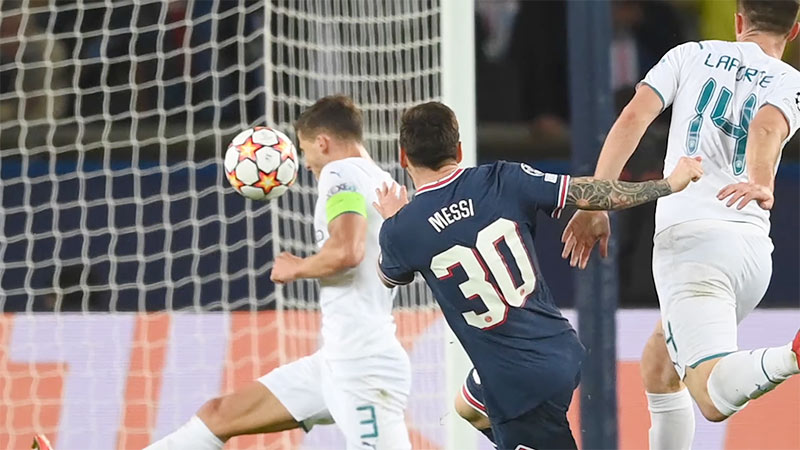
In the modern landscape of elite athletics, few events have carried the seismic weight of Lionel Messi’s 2021 departure from FC Barcelona to join Paris Saint-Germain (PSG).
For a global brand, and this was not merely a transfer; it was a merger of the world’s most recognizable individual brand with the rising power of French football.
To evaluate this period accurately, one must look past the subjective narratives and emotional debris of his departure from Spain.
This comprehensive analysis explores the statistical record of Lionel Messi during his tenure from 2021 to 2023, offering a definitive look at his performance metrics, his evolution into a primary playmaker, and his role in securing domestic dominance.
The Macro View: Quantifying a Two-Year Legacy
When assessing a player of Messi’s caliber, the primary KPIs (Key Performance Indicators) are traditionally goals and assists.
However, at the ages of 34 and 35, during his stay in Paris, Messi’s role underwent a tactical shift. He was no longer the primary volume-shooter of his early twenties; he became the architect of the offense.
Between 2021 and 2023, Messi made 75 total appearances for Paris Saint-Germain across all competitive platforms. In those 75 matches, he managed a staggering 67 total goal involvements.
This efficiency—nearly one goal involvement per match—remains elite by any global standard, even before considering the gravity he pulled on the pitch, which created space for teammates like Kylian Mbappé and Neymar Jr.
The raw breakdown of these figures is as follows:
- Total Goals: 32
- Total Assists: 34 to 35
- Total Appearances: 75
When looking at a 67-goal involvement record in 75 games, the data skews heavily toward a narrative of high-level sustained productivity.
The Arc of Adaptation: Decoding the Season-by-Season Trajectory
One of the most critical gaps in the general public discourse surrounding Messi’s time in Paris is the failure to distinguish between his first and second seasons.
Like any elite executive moving to a new firm, there is an “onboarding” period. For Messi, this adaptation was visible in the scoring trends of Ligue 1.
Season One (2021-22): The Transition Phase
During his debut season, Messi faced the challenges of a new league, a new city, and the physical demands of the French top flight. He recorded 6 Ligue 1 goals during this campaign.
While critics pointed to this as a decline, the underlying metrics suggested he was focusing more on facilitating the attack while adjusting to a more physical style of play than the technical “tiki-taka” of La Liga.
Season Two (2022-23): The Resurgence
By his second year, the adaptation was complete. Messi’s domestic output nearly tripled, as he netted 16 Ligue 1 goals.
This jump from 6 to 16 goals highlights a significant increase in comfort and tactical synergy with the PSG front line. When we look at his total league contribution across both seasons, he finished with 22 Ligue 1 goals.
This year-over-year growth is a vital data point for understanding the “user journey” of a world-class athlete in a foreign environment.
It proves that despite being in the twilight of his European career, his ability to optimize his performance based on environmental familiarity remained intact.
The Playmaker’s Renaissance: Redefining Impact
While the media often focuses on goals, Messi’s 34 to 35 assists are perhaps the most impressive aspect of his Parisian tenure.
This volume of playmaking highlights a shift in his “product offering.” In Paris, Messi functioned as the primary engine room, feeding a high-octane attack.
With 67 total goal involvements, the distribution was almost perfectly split between scoring and assisting. This balance is rare in modern football and speaks to his versatility.
In many ways, Messi’s time at PSG can be viewed as the ultimate “Efficiency Play”—he maximized his output while minimizing unnecessary physical exertion, ensuring he remained a constant threat over his 75 appearances.
In addition to his domestic league tally, Messi remained a potent force on the European stage, contributing 10 goals in the Champions League and other cup competitions.
This ensured that PSG remained a competitive entity in the most-watched sporting tournament in the world, maintaining the club’s brand prestige and commercial value.
Silverware and Supremacy: The Tangible Results
Critics often overlook the fact that Messi’s arrival coincided with a return to consistent domestic dominance for the club.
During his two-year stint, Messi secured:
- Two Ligue 1 Titles: Reaffirming PSG’s status as the premier club in France.
- One French Super Cup: Adding to the club’s historical trophy haul.
While the Champions League remained elusive, the acquisition of three major trophies in two seasons is a statistically successful tenure by any objective metric.
Frequently Asked Questions (FAQ)
How many total goals did Lionel Messi score for PSG?
Lionel Messi scored a total of 32 goals in all competitions during his time at Paris Saint-Germain.
How many assists did Messi record at PSG?
He recorded between 34 and 35 assists, contributing to a total of 67 goal involvements.
Did Messi win any trophies with Paris Saint-Germain?
Yes, he won two Ligue 1 titles and one French Super Cup.
What was Messi’s goal record in Ligue 1?
He scored 22 goals in Ligue 1: 6 in his first season (2021-22) and 16 in his second season (2022-23).
How many games did Messi play for PSG?
He made 75 appearances across all competitions between 2021 and 2023.
Conclusion: A Legacy of Professionalism and Productivity
In conclusion, the data surrounding Lionel Messi’s tenure at Paris Saint-Germain reveals a player who, even in his mid-thirties, remained at the pinnacle of global football.
With 67 goal involvements in just 75 games, he provided a level of offensive production that few players in the history of the sport could match.
His move to Paris was characterized by an initial adaptation period followed by a dominant second season, resulting in three major trophies and a bolstered statistical record that includes 22 league goals and a massive haul of assists.
For PSG, the Messi era was a period of high-level visibility and domestic success, proving that the synergy between a legendary individual and a powerhouse club can indeed yield elite-level results.