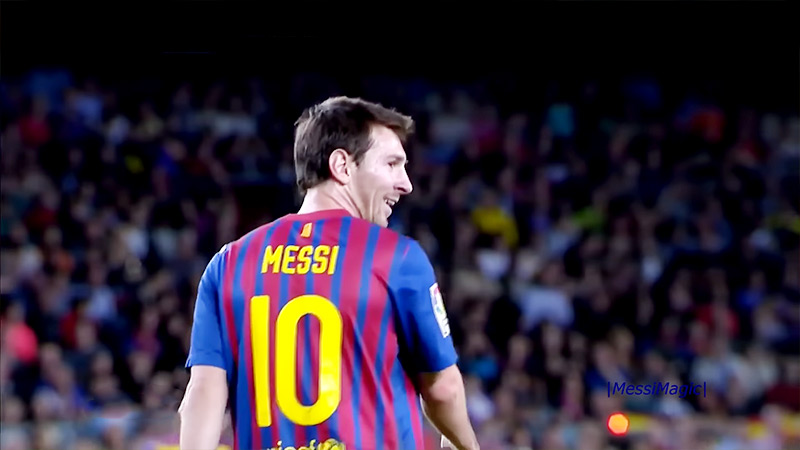
In the history of association football, few names evoke as much awe as Lionel Messi. Often described as a “magician” or an “alien,” Messi has spent over two decades redefining the parameters of what is possible on a pitch.
While many elite athletes rely on overwhelming physical power or blistering straight-line speed, Messi’s dominance is built on a unique intersection of biomechanical advantages, technical precision, and a predictive cognitive intelligence that allows him to operate several steps ahead of his peers.
Widely regarded as the standard of a “complete player,” he is a historic outlier who functions as the world’s best scorer, playmaker, and dribbler simultaneously.
This post explores the specific “blueprints” of his genius, from the physics of his low center of gravity to the neuroscience behind his vision.
The Biomechanical Blueprint: The Power of a Low Center of Gravity
Standing at 5’7″ (1.70m), Messi is shorter than the average modern professional footballer, a trait that earned him the nickname La Pulga Atómica (“The Atomic Flea”). However, this height is precisely what grants him a distinct biomechanical edge.
Rotational Inertia and Agility
Because his center of mass is only roughly 0.9m from the ground, Messi possesses a lower center of gravity than taller defenders.
This physical reality minimizes his rotational inertia, allowing him to change direction up to 0.2–0.3 seconds faster than his opponents. In a sport where games are decided in milliseconds, this agility makes him nearly impossible to tackle in tight spaces.
Balance and Strength
Despite his small stature, Messi possesses significant upper-body strength and short, powerful legs. This combination allows him to withstand physical challenges from much larger defenders without losing his balance or resorting to diving—a trait for which he has been frequently noted.
Short Ground Contact
Messi’s feet touch the ground for only 0.12–0.15 seconds per step, whereas the average professional requires 0.18–0.20 seconds. This facilitates explosive re-acceleration, allowing him to leave defenders “stuck” in the mud as he bursts away.
Technical Mastery: The “Ball Magnet” Effect
One of the most common descriptions of Messi’s play is that the ball appears “glued” to his foot. This isn’t just hyperbole; it is the result of refined mechanics.
The Laces Drag
Messi primarily uses the outside and laces of his left foot to “drag” the ball while sprinting. He keeps the ball so close that the distance between his foot and the ball is often shorter than the distance between the ball and an opponent’s foot, making dispossession an almost impossible task.
Moving Faster with the Ball
Former manager Pep Guardiola once famously observed that Messi is the only player who runs faster with the ball than he does without it.
This paradox exists because his control is so precise that he never has to break his natural running gait to “catch up” to a heavy touch.
The Stop-and-Go
Messi is a master of the “stop-and-go” technique. By coming to a complete halt with the ball, he forces defenders to commit to a movement or shift their weight.
The moment the defender reacts, Messi exploits their resulting weakness by accelerating into the newly created space.
The Mental Architect: Vision and Predictive Intelligence
While his feet are legendary, Messi’s most potent weapon may be his brain. Neuroscience suggests his brain functions on anticipatory control, allowing him to process visual information faster than other players.
Superhuman Vision
Messi possesses a rare ability to “see” the entire field, identifying passing lanes and open spaces that are invisible to others. He has been described as a magician who can conjure opportunities out of nothing.
Strategic Walking and Scanning
Observers often note that Messi spends the opening minutes of a match walking rather than running. This is a deliberate “scanning phase” where he ignores the ball to mentally map the opposition’s defensive structure, identifying specific tactical weaknesses to exploit later in the game.
“La Pausa”
Messi is a master of slowing down the game—a concept known in Argentine football as La Pausa. By inviting pressure and waiting for the perfect moment, he forces defenders out of position before delivering a lethal pass or strike.
Tactical Versatility: A Dual-Threat Legacy
In modern football, players are usually specialists: a “number 9” scores, while a “number 10” creates. Messi redefined this by excelling in both roles simultaneously throughout his career.
- False Nine to Playmaker: Under managers like Pep Guardiola, Messi pioneered the “false nine” role, dropping deep into midfield to draw defenders away and create space for others. As he aged, he transitioned into a deeper playmaker, using his vision to dictate the tempo of the entire match.
- Unrivaled Decision-Making: What sets Messi apart is his near-perfect decision-making. He consistently chooses the right action—whether to pass, dribble, or shoot—often acting as the primary engine for his team’s entire offensive output.
- Statistical Dominance: His records are a testament to this duality. He holds the record for the most goals in a calendar year (91 in 2012) and is the all-time leader in assists for both international football and major leagues like La Liga.
Psychological Resilience: Turning Disadvantage into Asset
Messi’s journey was nearly derailed before it began. Diagnosed with a Growth Hormone Deficiency (GHD) at age 10, his family struggled to afford the $1,000-per-injection treatment.
- Adapting the Game: This medical hurdle forced a young Messi to adapt his playstyle to a smaller stature. Instead of relying on physical dominance, he learned to evade contact entirely, turning his small frame into his greatest asset: unrivaled agility and close-quarters maneuverability.
- Character and Humility: Unlike many of his glamorous peers, Messi has often been noted for his humility, introverted nature, and refusal to participate in gamesmanship like diving. His goal is always singular: to stay on his feet and continue the attack.
Conclusion: The Standard of a Complete Player
Lionel Messi is not merely a product of talent, but a combination of refined biomechanics, elite technical skill, and a “predictive” football IQ.
From his record eight Ballon d’Ors to his status as the most decorated player in history with 46-48 team trophies, the data supports what the eyes perceive: he is a historic outlier.
By blending the roles of the ultimate finisher and the ultimate creator, Messi has set a benchmark that may never be surpassed.
He remains the definitive “True Superhero” of the sport, proving that even in an era of giants, skill and intelligence remain the most precious commodities in football.