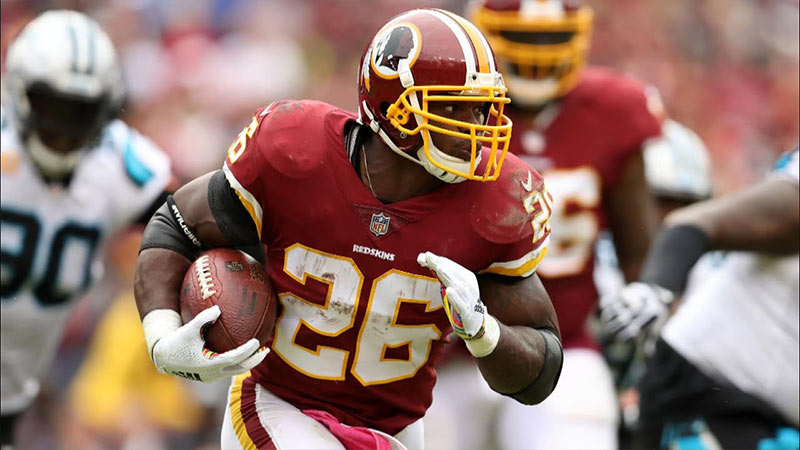
The physical demands of professional football are nowhere more apparent than in the backfield.
For an NFL running back, the average career duration is approximately 3.4 years, a statistic that reflects the immense toll of constant high-velocity collisions and the repetitive stress of carrying the ball.
Amidst this landscape of high turnover and early retirements, a select group of athletes has managed to defy biological and professional odds.
When examining which NFL running back has had the longest career, one name stands as the definitive statistical outlier: Frank Gore.
The Phenomenon of Frank Gore: A 16-Season Marathon
Frank Gore holds the undisputed record for the longest career by a running back in the history of the National Football League.
Spanning from 2005 through 2020, Gore’s 16-season tenure is a feat of professional endurance that many analysts previously considered impossible for his position.
While many elite backs lose their effectiveness or suffer career-ending injuries by their late 20s, Gore remained a viable offensive contributor well into his late 30s.
His durability is best illustrated by his 241 regular-season games, which is the record for games played by an NFL running back.
This level of availability allowed him to climb the historical rankings, eventually retiring with 16,000 rushing yards, positioning him third on the NFL’s all-time rushing list.
Gore’s journey began as a third-round selection, the 65th overall pick in the 2005 NFL Draft by the San Francisco 49ers.
Over the next decade and a half, he would demonstrate an uncanny ability to adapt to different offensive systems and coaching philosophies across five different franchises: the San Francisco 49ers, Indianapolis Colts, Miami Dolphins, Buffalo Bills, and New York Jets.
His five Pro Bowl selections serve as a testament to the fact that his longevity was supported by elite-level performance.
Defining Sustained Success: The Elite Longevity Tiers
To understand the magnitude of Gore’s 16 seasons, it is necessary to compare him against the historical “Gold Standard” of running back durability. Historically, success in the backfield has been measured by the 1,000-yard rushing benchmark.
While Gore was present for the longest duration, other legends maintained a higher level of statistical dominance over their respective tenures.
The Tier of Decades: 10+ Years of Dominance
Only a handful of players have managed to remain “dominant,” rather than just “present,” for a decade or more.
- Emmitt Smith: Often cited as the ultimate answer to sustained success, Smith played for 15 seasons. He holds the record for 11 consecutive seasons with over 1,000 rushing yards. During 12 years, he averaged 1,270.8 yards per season, proving that he could maintain a workhorse load for over a decade.
- Walter Payton: Known as “Sweetness,” Payton played 13 seasons and averaged 1,287 rushing yards per season over his entire career. He had 10 seasons where his combined rushing and receiving yards averaged 1,871 yards per year, often playing behind offensive lines that were considered subpar compared to his peers. He was still receiving MVP votes in his 12th professional season.
- Curtis Martin: Martin is frequently highlighted for his consistency, recording 10 straight 1,000-yard seasons to begin his career. Remarkably, he achieved this level of production despite later admitting he did not particularly enjoy the sport he played.
- Barry Sanders: Sanders represents the “peak talent” argument. Although he only played 10 seasons, he never recorded a season with fewer than 1,115 rushing yards. In the one season he fell to that “low” mark, he had missed five games due to injury; otherwise, he never rushed for less than 1,300 yards in a year. He retired while still at the top of his game, having rushed for 1,491 yards in his final season.
The Tier of Consistency: 7 to 9 Seasons of Success
Beyond the legends of the 10-year club, there is a secondary tier of players who doubled the average career length of an NFL running back. Approximately 21 running backs in history have achieved seven or more 1,000-yard seasons.
- Frank Gore: While he played the longest, he recorded nine seasons of 1,000+ yards.
- LaDainian Tomlinson: Tomlinson was a model of efficiency and scoring. Over nine years in San Diego, he averaged 1,306 yards and 17 total touchdowns per season.
- Adrian Peterson: Known for his physical running style, Peterson played for 15 seasons and recorded eight seasons with over 1,000 yards.
- Steven Jackson: Often overlooked due to the teams he played for, Jackson recorded eight consecutive 1,000-yard seasons.
The Evolution of the Running Back Role
The discussion of longevity is shifting as modern NFL offenses move away from the traditional “bell-cow” back. In the current era, “sustained success” may no longer be defined solely by rushing yards, but by total yards from scrimmage and versatility in the passing game.
Players like Alvin Kamara represent this shift; Kamara has maintained high-level production and over 13 touchdowns per season without ever hitting the traditional 1,000-yard rushing mark, instead relying on nearly 1,500 yards from scrimmage annually.
This suggests that future records for longevity may be held by versatile “hybrid” backs who take fewer high-impact hits between the tackles than the workhorses of previous generations.
Comparative Analysis: Longevity vs. Peak Performance
When evaluating the longest career, there is a distinct difference between “Volume” and “Dominance”.
| Player | Seasons Played | 1,000-Yard Seasons | Career Defining Trait |
|---|---|---|---|
| Frank Gore | 16 | 9 | All-time games played record (241) |
| Emmitt Smith | 15 | 11 | Most consecutive 1k seasons |
| Adrian Peterson | 15 | 8 | Explosive power and longevity |
| Walter Payton | 13 | 10 | High yardage-from-scrimmage average |
| Barry Sanders | 10 | 10 | Never rushed for less than 1,100 yards |
| Curtis Martin | 11 | 10 | 10 straight 1k seasons to start career |
Conclusion: The Legacy of Endurance
The career of Frank Gore remains a singular achievement in professional sports. By playing 16 seasons and 241 games at the most punishing position in football, Gore redefined the expectations for athlete longevity.
While legends like Emmitt Smith and Barry Sanders may have had higher peaks of annual dominance, Gore’s ability to remain productive across three different decades is a testament to his professional discipline and physical resilience.
As the NFL continues to evolve into a more pass-heavy, specialized league, the record of 16 seasons as a primary ball carrier may stand for a very long time.