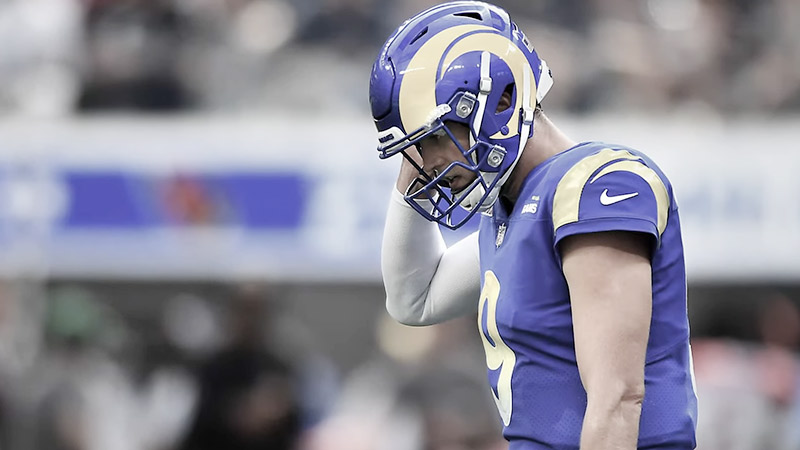
The modern quarterback position is often evaluated through a narrow lens: rings, win-loss records, or pure statistical volume.
Rarely does a single player encapsulate the entire spectrum of these debates quite like Matthew Stafford.
Over a career spanning more than fifteen seasons, Stafford has established himself as one of the most prolific and clutch passers in professional football history. Yet, his legacy remains a subject of intense analysis among analysts and fans alike.
A fascinating contrast defines Stafford’s career. At the team level, he has navigated the highest peaks and the deepest trenches, resulting in a career starting record of 120-118-1.
However, when you peel back the team records to examine his individual statistical accomplishments, you find a player who has rewritten the history books.
Stafford holds three primary NFL records: two all-time career passing speed milestones and an iconic single-season clutch record.
This deep dive examines the exact records Matthew Stafford holds, puts his career statistics into historical context, and explores how his magnificent, league-leading 2025 resurgence has solidified his trajectory toward the Pro Football Hall of Fame.
Redefining Passing Pace: The All-Time Speed Milestones
For a long time, the standard for how quickly a quarterback could accumulate passing yards was held by iconic, timing-based pocket passers like Drew Brees.
When Stafford entered the league, his elite arm talent and high-volume passing offenses changed the math entirely. He did not just accumulate yards; he did so at an unprecedented rate, leaving several legendary figures in his wake.
Stafford holds two primary NFL speed-to-distance records that remain intact to this day:
- Fastest Player to Reach 40,000 Career Passing Yards: Stafford achieved this monumental milestone in just 147 games. By doing so, he cemented his place as the quickest quarterback to cross this threshold, showcasing a rare combination of early-career availability, high-volume throwing, and consistent production.
- Fastest Player to Reach 50,000 Career Passing Yards: He followed up his 40K record by reaching 50,000 yards in only 182 games. This achievement surpassed the previous benchmark held by Drew Brees and other legendary signal-callers, proving that Stafford’s elite pace was not a short-term hot streak but a decade-long reality.
While other contemporary players have challenged his early paces—most notably Patrick Mahomes, who eventually overtook Stafford’s mark for the fastest to reach 35,000 passing yards—the 40,000-yard and 50,000-yard games-played speed markers still stand firm as Stafford’s major historic benchmarks.
Other milestones, such as reaching 30,000 or 60,000 yards, also place him near the absolute top tier of historical lists, but these two specific marks are his official, record-holding crowns.
The table below outlines Stafford’s historic speed records and how they sit within his overall career progression:
| Milestone Record | Games Played to Achieve | Historic Significance |
|---|---|---|
| Fastest to 40,000 Passing Yards | 147 Games | All-time NFL Record |
| Fastest to 50,000 Passing Yards | 182 Games | Surpassed Drew Brees’ previous mark |
| Most 4th-Quarter Comebacks (Season) | 8 (2016 Season) | All-time NFL Record |
The 2016 Clutch Masterpiece: Unmatched Late-Game Dominance
If arm talent and passing yards represent Stafford’s physical gifts, his late-game performance represents his competitive spirit.
Throughout his career, Stafford has been synonymous with late-game heroics, but his ability to deliver under pressure reached its absolute peak during a legendary campaign in Detroit.
During the 2016 NFL season, Stafford set an all-time league record that highlights his unmatched clutch performance:
- Most 4th-Quarter Comeback Wins in a Single Season: Stafford orchestrated 8 fourth-quarter comebacks in a single season.
In 2016, the Detroit Lions repeatedly found themselves trailing in the final minutes of games. Time and again, Stafford marched his offense down the field, showing icy composure and executing game-winning drives.
This single-season record of 8 comebacks is more than just a statistical quirk; it is a testament to his ability to elevate his team when the defense knew exactly what was coming. It remains one of the most remarkable individual carrying jobs by a quarterback in modern league history.
This clutch performance is not an outlier. Stafford’s entire career has been punctuated by game-winning drives.
Whether fitting the ball into tight windows in Detroit or orchestrating playoff drives in Los Angeles, his late-game execution has defined his football identity.
Analyzing the Complete Career Volume: Durability in the Trenches
To fully appreciate the records Stafford has broken, we must look at the foundation of his career. Across 239 career games, Stafford has put up historic volume statistics that place him among the top passers of all time.
Let’s break down his complete career metrics:
- Total Passing Yards: 64,516 yards. This volume places him in an elite class of quarterbacks who have crossed the 60,000-yard barrier.
- Total Passing Touchdowns: 423 touchdowns. This places him among the most prolific scoring passers in history.
- Pass Completions & Attempts: Stafford has completed 5,562 of his 8,763 attempts, yielding a career completion percentage of 63.5%.
- Passer Rating & Efficiency: He maintains a career passer rating of 92.4, averaging 7.4 yards per pass attempt and throwing for an average of 269.9 yards per game.
However, playing at this elite level for so long has come with a massive physical cost. Stafford has played many seasons on rosters with struggling offensive lines and minimal rushing support.
Consequently, he has been sacked 525 times for a total loss of 3,515 yards. Despite taking this immense physical punishment, his durability and willingness to play through injury have allowed him to maintain his elite output year after year.
This resilience is a critical element of his journey, adding deeper weight to his milestone accomplishments.
| Statistic Category | Career Value | NFL Historical Context |
|---|---|---|
| Games Played | 239 Games | High-level longevity over 15+ seasons |
| Pass Completions | 5,562 | Top-tier volume |
| Pass Attempts | 8,763 | High-volume offensive reliance |
| Passing Yards | 64,516 | Ranks among the top passing yards leaders |
| Passing Touchdowns | 423 | Elite touchdown producer |
| Career Passer Rating | 92.4 | Strong career-long efficiency |
| Sacks Taken | 525 | Highlights high physical toll and toughness |
| Sack Yards Lost | 3,515 | Total yards lost due to defensive pressure |
The 2025 Renaissance: Elite Late-Career Dominance
While Stafford’s early-career milestones in Detroit built his reputation, his late-career work with the Los Angeles Rams has cemented his greatness.
A prime example of this is his sensational 2025 season. Rather than slowing down with age, Stafford put together an MVP-caliber campaign that led the league in multiple categories.
In 2025, Stafford dominated the league with these accomplishments:
- Passing Yards Leader: Stafford led the entire NFL with 4,707 passing yards in 2025. He outpaced league-wide stars like Jared Goff (4,564 yards) and Dak Prescott (4,552 yards) to claim the passing title.
- Passing Touchdowns Leader: He topped the league with 46 passing touchdowns. This mark placed him well ahead of his peers, with Jared Goff finishing a distant second with 34 touchdowns.
- Elite Passing Efficiency: Stafford registered a spectacular 109.2 quarterback rating in 2025. This mark was second in the NFL, trailing only Drake Maye’s 113.5 rating, and ahead of Goff’s 105.5.
This individual dominance translated directly to team success. Stafford guided the Los Angeles Rams to a stellar 12-5 record.
Under his leadership, the Rams’ offense became the most potent unit in the league, ranking first in the NFL with 30.5 points per game and first with 394.6 total yards per game. The passing attack alone averaged 276.9 yards per game, ranking second in the league.
Stafford’s 2025 renaissance showed that his early-career records were not merely a product of playing in pass-heavy, trailing situations in Detroit.
Instead, they were the baseline of an elite quarterback who, when paired with a top-tier scheme and supporting talent, can orchestrate one of the most efficient and explosive offenses in football history.
Evaluating the Canton Verdict: Stafford’s Place in Football History
When evaluating Stafford’s candidacy for the Pro Football Hall of Fame, analysts often point to his career win-loss record of 120-118-1 as a point of contention.
However, this argument fails to account for the context of his career. Football is a team game, and Stafford spent twelve seasons carrying a franchise that historically struggled to build balanced rosters.
When you look at his individual achievements, his case for Canton is undeniable:
- Elite Peak Dominance: His 2025 campaign showed that he remains capable of being the best quarterback in football, leading the league in yards and touchdowns while guiding a team to 12 wins.
- Unmatched Speed-to-Milestone Pace: Being the fastest ever to reach 40,000 and 50,000 yards proves his sustained, high-level excellence over long stretches.
- Clutch Defining Moments: His single-season comeback record of 8 wins in 2016 showcases a unique clutch ability that very few quarterbacks have ever matched.
- Enormous Career Volume: Standing with over 64,000 passing yards and 423 touchdowns places him in a historic statistical tier where nearly every eligible member is in the Hall of Fame.
Conclusion: A Legacy Carved in Stone
Matthew Stafford’s career is a masterclass in perseverance, arm talent, and elite production under pressure.
While critics may point to a near-even career win-loss record, the individual numbers and historic records tell a far more accurate story of his greatness.
From setting speed records that outpaced Drew Brees to executing eight comebacks in a single year, Stafford has left an indelible mark on NFL history.
His spectacular 2025 season proves that his story is still being written, and his ultimate destination in Canton, Ohio, is well-deserved.