In professional football, raw athletic capability is often measured by milliseconds on a track or inches on a vertical jump. Yet, the true engine of football dominance lies in the lower body.
The capacity to generate explosive power, maintain a low center of gravity, and drive through elite defenders requires world-class lower-body strength.
To evaluate this physical foundation, coaches and athletes look to one definitive benchmark: the back squat.
While the general public is captivated by bench press repetitions at the annual Scouting Combine, the squat is the ultimate indicator of functional power on the field.
However, tracking down these numbers is notoriously difficult. Official league-wide gym testing data is not uniformly published by the NFL or its franchises.
Instead, the public must rely on documented training videos, high school powerlifting records, and verified collegiate metrics to determine who truly rules the weight room.
Below is an analytical exploration of the heaviest documented squat records among notable professional football players, detailing the sports science behind these staggering feats of human performance.
The Undisputed King of the Gridiron: Andrew Billings
When examining the absolute peak of lower-body strength in professional football, defensive tackle Andrew Billings holds the undisputed record for the heaviest documented squat among notable players, having registered an incredible 805 pounds (365 kg).
Breaking a Legendary State Record
What makes Billings’ achievement even more remarkable is that this gargantuan lift was established before he ever set foot on a professional football field. He set this mark during his legendary high school powerlifting career in Texas.
In doing so, Billings broke a long-standing Texas state record previously held by Olympic weightlifter and professional strongman Mark Henry.
For context, Texas high school powerlifting is widely considered one of the most competitive amateur strength circuits in the world.
To eclipse a record held by Mark Henry—a man formally dubbed “The World’s Strongest Man”—required an athletic anomaly.
Billings’ 805-pound squat is not merely an impressive football lift; it is an elite powerlifting milestone that commands respect in any competitive strength circle globally.
The On-Field Translation of 805 Pounds
As a defensive tackle, Billings’ role is defined by the battle for leverage in the trenches. An 805-pound squat indicates an extraordinary ability to produce ground force.
In football, the player who stays lowest and generates the most upward force wins the encounter.
By mastering the squat at this elite level, Billings developed a natural resistance to double-teams, allowing him to anchor the defensive line and collapse the pocket from the interior.
The Trench Beasts: Interior Defensive Linemen
The interior of the defensive line is home to some of the most punishing physical collisions in sport.
Players must withstand blocks from 300-pound offensive guards while simultaneously exploding forward to disrupt the play. It is no surprise, then, that this position group produces some of the most staggering squat numbers.
Michael Pierce and the Power of the “Unbelted” Max
Directly behind Billings in the interior line strength rankings is defensive tackle Michael Pierce, who has demonstrated a massive 725-pound squat.
To the untrained eye, 725 pounds is an astronomical number. However, strength conditioning specialists look at the specific manner in which Pierce completed this lift: it was performed as an unbelted max.
In heavy lifting, a weightlifting belt is typically worn to increase intra-abdominal pressure, stabilizing the lower back and allowing the lifter to handle heavier loads.
Performing a 725-pound squat without a belt requires an extraordinary, almost incomprehensible level of core and back stability.
For Pierce, this translates directly to the field. When battling offensive linemen, his core remains completely rigid, allowing him to transfer force directly from his feet, through his hips, and into the opposing player without any energy leaks.
Skill Position Power: The Running Back Elite
While massive squat numbers are expected from defensive tackles weighing north of 300 pounds, the true marvel of modern athletic conditioning is found in the running back position. Today’s elite ball-carriers combine track-level speed with powerlifting-level strength.
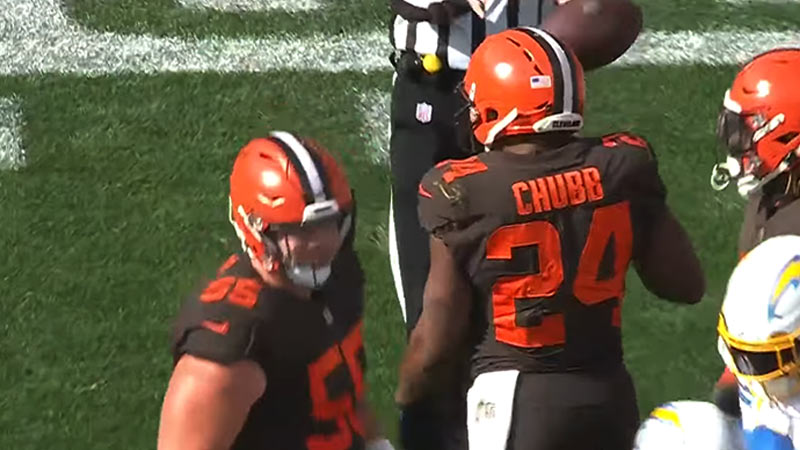
Nick Chubb’s Relentless Lower-Body Drive
Star running back Nick Chubb frequently showcases a massive squat range of 675 pounds to 725 pounds.
Chubb, who weighs significantly less than the interior linemen mentioned above, approaches a strength-to-bodyweight ratio that rival elite lightweight powerlifters.
Saquon Barkley’s 700-Pound Foundation
Matching this elite tier of lower-body development is Saquon Barkley, who features a documented 700-pound squat.
   [Squat Force Generation]
           |
           v
   [Kinetic Energy Transfer] ---> [Hip/Knee/Ankle Extension] ---> [Tackle-Breaking Power]
This level of strength explains why both Chubb and Barkley are widely regarded as the most difficult running backs to bring down on first contact. A 700-pound squat provides several physical advantages on the field:
- Impenetrable Contact Balance: The ability to absorb a hit to the lower extremities and maintain an upright path.
- Violent Leg Drive: The capacity to continue moving forward even when multiple defenders are attempting to halt progress.
- Explosive Horizontal Cut: To make a sharp cut at high speed, an athlete must plant their foot and absorb multiple times their body weight in force. A massive squat capacity ensures the ligaments and muscles can withstand these extreme lateral forces.
Redefining Quarterback Strength: Jalen Hurts
Historically, quarterbacks were viewed as pocket-bound distributors who avoided heavy contact and focused primarily on upper-body mechanics and rotational power.
The modern game, however, demands highly athletic, dual-threat quarterbacks who can act as additional runners.
Jalen Hurts has completely redefined the physical expectations for the position, with documented squat numbers exceeding 600+ pounds.
The Powerlifting Pedigree
Hurts’ exceptional strength is no accident; he is renowned for his competitive powerlifting background, which began during his formative training years. Rather than abandoning these movements upon entering college and professional programs, Hurts integrated heavy lower-body compound movements into his routine.
Tactical Advantages of a 600-Pound Squatting Quarterback
In modern offensive systems, having a quarterback who can squat over 600 pounds provides a massive tactical advantage:
- Short-Yardage Dominance: On critical third-down conversions or goal-line situations, Hurts can leverage his massive lower-body drive to push forward, making short-yardage sneaks highly reliable.
- Durable Running Capability: The structural integrity developed through 600+ pound squats helps protect the joints and spine from the repetitive, high-velocity impacts quarterbacks face outside the pocket.
- Extended Playmaking: A strong lower half allows a quarterback to shrug off arm tackles in the pocket, keep their eyes downfield, and complete throws under immense physical pressure.
Comparing the Elite Squatters of the Gridiron
Because the league does not publish official weight room data, compiling these verified figures is the best way to understand the physical hierarchy of professional football players. The table below outlines the documented squat records of these elite athletes:
| Player | Position | Documented Squat Weight | Notable Distinction |
|---|---|---|---|
| Andrew Billings | Defensive Tackle | 805 lbs (365 kg) | Broke the Texas state record previously held by Mark Henry. |
| Michael Pierce | Defensive Tackle | 725 lbs | Achieved as an unbelted max, showcasing elite core stability. |
| Nick Chubb | Running Back | 675 lbs to 725 lbs | Consistently demonstrates elite, high-volume lower-body power. |
| Saquon Barkley | Running Back | 700 lbs | Provides the physical foundation for legendary tackle-breaking ability. |
| Jalen Hurts | Quarterback | 600+ lbs | Leverages a competitive powerlifting background to dominate short-yardage situations. |
The Sports Science of the Squat in Professional Football
To fully appreciate these numbers, it is helpful to look at the biomechanics of the squat and why it remains the gold standard for athletic development in football.
1. The Principle of Ground Reaction Force
In sports, movement is initiated by applying force to the ground. According to Newton’s third law of motion, the ground pushes back with equal and opposite force. When an athlete squats, they train their nervous system and muscles to push violently against the earth.
Whether a defensive tackle is exploding off the snap or a running back is launching into a sprint, their acceleration is entirely dependent on the amount of force they can drive into the turf.
2. Triple Extension Coordination
The squat trains “triple extension”—the simultaneous extension of the hips, knees, and ankles. This coordinated movement is the exact sequence used when jumping, sprinting, or tackling an opponent.
By overloading this pattern with hundreds of pounds, athletes teach their muscle groups to fire in perfect, explosive harmony.
3. Injury Prevention and Joint Integrity
The physical toll of an NFL season is immense. Heavy squatting builds structural density not only in the muscles (such as the quadriceps, hamstrings, and gluteals) but also in the bones, tendons, and ligaments surrounding the knees and hips.
This enhanced structural integrity acts as a protective suit of armor, reducing the likelihood of soft-tissue injuries during high-velocity changes of direction.
Summary
The pursuit of elite strength in professional football is a constant, year-round endeavor. While many players possess exceptional physical gifts, the select group of athletes highlighted here has pushed the boundaries of human performance.
From Andrew Billings’ historic 805-pound record to Jalen Hurts’ quarterback-redefining 600+ pound lifts, these numbers show that the path to dominating the gridiron is paved with iron.