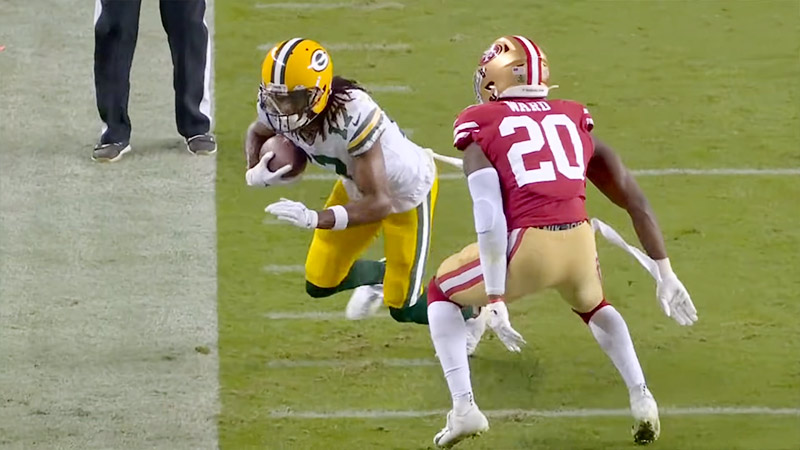
In professional gridiron football, linear velocity is often treated as the ultimate metric of potential.
When talent evaluators, coaches, and analysts look to project the impact of a wide receiver, the stopwatch during the forty-yard sprint is frequently given disproportionate weight.
Yet, year after year, athletes with world-class track times struggle to translate that speed into on-field production, while players with modest linear metrics establish themselves at the pinnacle of the sport.
Perhaps no athlete in modern football history better exemplifies this paradox than Davante Adams.
At the scouting combine, his straight-line velocity did not turn heads; instead, his performance was the definition of average for a professional receiver.
Despite this, his ability to consistently generate space against elite defensive coverage has made him a masterclass study in technical efficiency.
To understand how an athlete can dominate the position without relying on elite raw velocity, we must deconstruct the mechanics of play, analyzing how explosive power, precise footwork, and cognitive speed manipulation supersede pure linear speed.
Deconstructing the Testing Metrics: The Athletic Foundation
To analyze how an athlete wins without elite track speed, we must first examine the quantitative physical metrics recorded during his entry into the professional ranks.
During the 2014 scouting showcase, a clear picture emerged: while his linear sprint was unexceptional, his explosive power and lateral change-of-direction metrics were highly elite.
The table below breaks down the testing data and illustrates how these numbers translate to specific, high-level movements on the field.
Athletic Profile & On-Field Translation Table
| Scouting Metric | Recorded Value | Performance Classification | On-Field Mechanical Translation |
|---|---|---|---|
| Forty-Yard Dash | 4.56 seconds | Average for professional wide receivers | Linear, vertical speed; vertical clear-out routes. |
| Vertical Jump | 39.5 inches | Highly Elite / Upper Tier | High-pointing the ball; winning contested catch scenarios in tight windows. |
| Broad Jump | 123 inches (10’3″) | Strong / Explosive | Horizontal displacement; explosive drive off the line of scrimmage. |
| Three-Cone Drill | 6.82 seconds | Elite / Advanced Agility | Lateral change of direction; fluid weight transfer during sharp route cuts. |
This quantitative framework reveals that focusing solely on the forty-yard sprint misses the true athletic engine of a wide receiver.
A 4.56-second time represents functional, sufficient speed, but the 39.5-inch vertical leap and the sub-seven-second three-cone drill point to a rare combination of lower-body power and multi-directional fluidity.
The Core Mechanisms of Route Separation
Separation in professional football is a game of inches, won or lost in fractions of a second. Because defenders at the highest level possess world-class recovery speed, a receiver cannot rely merely on running past coverage. Instead, they must utilize advanced mechanical principles to create throwing windows.
Based on the documented athletic data, we can isolate three distinct physical pillars that allow a receiver to generate separation without relying on high, straight-line speed:
- Explosive Initial Releases: Overcoming physical press coverage at the line of scrimmage using lateral bursts and hand-combat techniques.
- Variable Throttle Control: Manipulating defensive backpedals by constantly changing gears and running speeds mid-route.
- Precise Change-of-Direction Mechanics: Executing sharp, sudden cuts that use the defender’s own momentum against them.
Pillar 1: Winning at the Line of Scrimmage (The Release)
The battle between a wide receiver and a cornerback begins the instant the ball is snapped.
In press-man coverage, a defender will attempt to use their hands and body weight to disrupt the receiver’s path, throwing off the timing of the entire passing play.
Without elite linear speed to simply blow past a defender, a receiver must use quickness, footwork, and upper-body leverage to win immediately.
- The Split Release: By widening the stance at the snap, the receiver forces the defender to declare their leverage. The receiver can then exploit the defender’s positioning with a swift lateral step.
- The Footfire / Press-Release: Utilizing rapid, short foot-strikes to freeze the defensive back before exploding into the route stem. This mechanical quickness relies directly on lateral agility and foot coordination.
- Upper-Body Hand Combat: Combining footwork with precise hand-swipes to prevent the defender from landing a physical jam on the receiver’s chest plate.
By mastering these short-area movements, a receiver can gain a half-step of advantage within the first five yards of the play, rendering the defender’s top-end track speed irrelevant from the start.
Gearing Changes: The Art of Speed Manipulation
One of the most cognitively demanding aspects of defensive backplay is matching the cushion—the distance between the defender and the receiver.
Cornerbacks are trained to maintain a specific buffer to prevent giving up deep passes while remaining close enough to contest short routes.
A master class in route-running involves disrupting this defensive calculus. Instead of sprinting at a single, continuous speed, elite route-runners excel at pacing and shifting velocities mid-route.
Receiver Velocity Profiles During a Route Stem:

Linear Receiver:   [Constant Speed: 100%] -------------------------------------> (Predictable)
Elite Route-Runner: [60% Speed] ===> [90% Speed] ===> [40% Cut] ===> [100% Burst] (Unpredictable)
The Psychological and Physical Impact of Speed Pacing
When a receiver runs a route at a uniform velocity, the defender can easily match their tempo, calculate their trajectory, and brace for the break.
However, when a receiver deliberately alters their pace, they introduce chaos into the defender’s decision-making process.
- Lulling the Defender: The receiver starts the route at an estimated 60% to 70% of their maximum speed. This controlled tempo convinces the defensive back that they have easily matched the receiver’s speed, causing them to settle into their backpedal.
- The Sudden Accelerator Burst: Once the defender’s hips are turned or their cushion is closed, the receiver suddenly gears up to 100% velocity. This sudden burst of acceleration forces the defender to panic, turning their run and opening up their leverage.
- The Hard Stop (Deceleration): At the exact moment the defender overcommits to defending the deep pass, the receiver drops their hips and halts their momentum to break back toward the quarterback.
This “throttle control” is highly demanding on an athlete’s physical frame. It requires tremendous core strength, lower-body deceleration capabilities, and the spatial awareness to execute these transitions at the perfect depth.
Sharp Cuts and the Physics of Deceleration
While the sports world is infatuated with acceleration, the secret to elite route separation is actually deceleration.
The faster an athlete can stop, the sharper their cuts can be, and the more distance they can put between themselves and a defender.
Consider the physical forces at play when a wide receiver runs a 15-yard comeback route:
- A defender must match the receiver’s vertical depth while backpedaling or running in a hip-to-hip position.
- When the receiver decides to make a cut, they must dissipate their forward kinetic energy as rapidly as possible.
- If a receiver takes four or five steps to slow down, the defender has time to read the deceleration, plant their feet, and drive on the ball.
- If the receiver can drop their center of gravity and stop completely in two steps, the defender’s forward momentum will carry them yards past the play.
This is where the elite 3-cone drill time of 6.82 seconds translates directly to game film. The lateral stability, ankle strength, and hip flexibility required to navigate tight angles at high velocities are the same physical traits needed to snap off a route at a perfect 90-degree or 45-degree angle.
Aerial Mechanics, Body Control, and Contested Catches
Even with elite route-running, there are instances where defensive coverage is tight, or the quarterback must throw into a congested area. In these highly contested scenarios, straight-line sprint speed is entirely useless. Success becomes a matter of physical leverage, body control, and catch mechanics.
Contested Catch Success Factors:
│
├── Physical Leverage (Box-Out Positioning)
│
├── Vertical Elevation (39.5-Inch Leap)
│
├── Spatial Tracking (Eye-to-Ball Coordination)
│
└── Hand Strength (Securing the Ball Away from the Body)
The Leaping Mechanics
With an elite vertical leap of 39.5 inches, an athlete can elevate above defenders who may possess superior height or linear speed.
This explosive verticality allows a receiver to jump over a trailing defender, catching the football at its apex before the defensive back can make a play on it.
Horizontal Displacement
The 123-inch broad jump indicates massive horizontal power. On the field, this metric represents the ability to dive, extend, and maintain body control while parallel to the turf.
This explosive horizontal reach allows the receiver to secure passes thrown outside their frame, keeping the football safely away from the reach of nearby defenders.
Spatial Awareness and Body Control
Once in the air, the receiver must track the football’s trajectory, adjust their body positioning relative to the oncoming defender, and secure the catch.
This requires remarkable core strength and physical coordination to absorb contact in mid-air while ensuring their hands remain firmly clamped on the football.
By winning at the catch point, the receiver effectively neutralizes deep coverage, eliminating the need to outrun defenders on deep routes.
Comparative Analysis: Linear Speed vs. Technical Agility
To put Davante Adams’ athletic profile into perspective, we must compare his performance style with a traditional deep-threat receiver.
This comparison highlights why technical mastery is often a more sustainable path to long-term success than raw, unrefined physical traits.
Style Comparison: Technical Route Mastery vs. Linear Deep Threat
| Mechanical Attribute | The Technical Master (e.g., Davante Adams Profile) | The Linear Deep Threat |
|---|---|---|
| Primary Speed Metric | 4.56-second 40-yard dash (Average) | Sub-4.40-second 40-yard dash (Elite) |
| Primary Agility Metric | 6.82-second 3-cone drill (Elite) | 7.05+ second 3-cone drill (Average to Below Average) |
| Release Strategy | Complex footwork, lateral releases, hand combat | Speed release, relying on pure physical acceleration to blow past press |
| Separation Style | Sharp cuts, sudden deceleration, speed manipulation | Stacking the defender vertically, running deep post or go routes |
| Dependency on Scheme | High versatility; can run any route on the route tree in any offensive system | System-dependent; often requires clear-out routes or specific play-action designs |
| Longevity Outlook | High; technique, footwork, and cognitive leverage do not decline rapidly with age | Moderate; highly vulnerable to any drop in raw physical speed or lower-body injuries |
While a deep threat can occasionally hit big plays by running past coverages, they are highly dependent on perfect conditions, deep protection from the offensive line, and highly accurate deep throws.
Conversely, a technical route master can generate separation on almost every play, providing the quarterback with a reliable target on critical third-down situations and in tight red-zone spaces.
Conclusion: The Ultimate Triumph of Technique
The career of Davante Adams is a compelling proof of concept for sports science: technical mastery, cognitive acuity, and refined mechanics will always triumph over raw, unrefined physical metrics.
While a 4.56-second forty-yard dash might suggest a limited ceiling to a casual observer, the deeper metrics tell a story of rare explosive power, lateral agility, and outstanding body control.
By combining these physical gifts with elite route-running, speed manipulation, and precise footwork, Adams has built a legendary career that serves as a blueprint for the modern wide receiver.
In a sport obsessed with track times, he remains a definitive reminder that the game of football is won not on a track, but in the micro-battles of route separation, body leverage, and mechanical mastery.