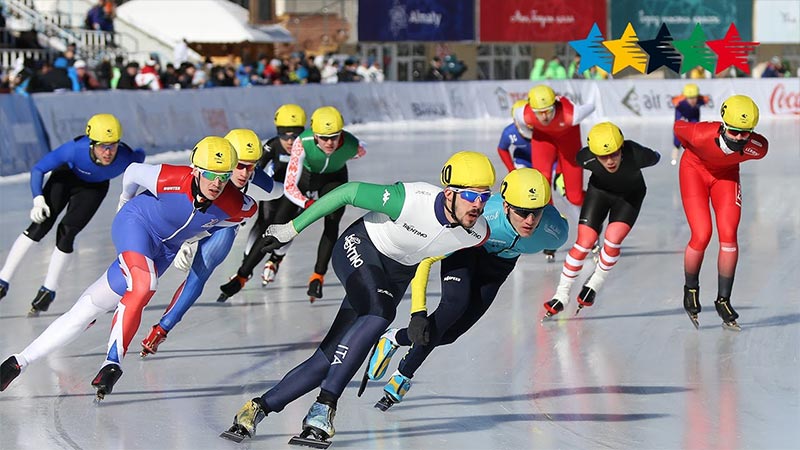
Short track speed skating is often described as “NASCAR on ice,” but when you add the element of a relay, the intensity reaches a fever pitch. It is a sport defined by razor-thin margins, high-speed physical contact, and complex strategies that happen in the blink of an eye.
Unlike traditional track and field relays, where a baton is passed, the speed skating relay relies on raw physical force and synchronized timing.
In this guide, we will dive deep into the mechanics, rules, and strategies that make the speed skating relay a fan favorite at the Winter Olympics and World Championships.
The Fundamentals: What Defines a Speed Skating Relay?
At its core, a short track speed skating relay is a 4-person team event where athletes take turns racing around a 111.12-meter oval track.
The primary goal is simple: be the first team to cross the finish line after completing the required distance. However, the execution is anything but simple.
The distances for these events vary based on the category:
- Women’s Relay: 3000 meters.
- Men’s Relay: 5000 meters.
- Mixed Relay: 2000 meters.
While one skater is actively racing on the track, their three teammates are not just waiting on the sidelines.
They are skating slowly on the inside of the track, staying out of the way of the active racers while preparing for their next entry. This constant movement requires incredible spatial awareness to avoid obstructing other teams.
The Mechanics of “The Push”: Passing the Torch at 30 MPH
The most iconic and visually striking element of the speed skating relay is the exchange. In most relay sports, athletes pass a baton. In short track, they use their bodies.
The Exchange Process: Instead of handing over an object, the incoming skater—who is already moving at a high velocity—positions themselves behind the outgoing teammate.
As they meet, the incoming skater provides a powerful physical push from behind to propel the teammate forward into the race. This “slingshot” effect is critical because it helps the new skater maintain or even increase the team’s momentum without having to accelerate from a standstill.
Note: The following technical details regarding the “crouch” position and hand placement are based on general sports knowledge and are not explicitly detailed in the provided sources.
During this push, the skater being pushed often stays in a low, aerodynamic crouch to stabilize their center of gravity. A poorly timed push can result in a “dead” exchange, where momentum is lost, or worse, a collision that takes out multiple teams.
Team Composition and Rotation Strategy
A team’s success depends on how well they manage fatigue and capitalizes on individual strengths. Each team consists of four skaters who can technically exchange at any time throughout the majority of the race.
The 1-2 Lap Rotation
To keep the pace at a maximum, teams typically rotate their active skater every one to two laps. This ensures that each athlete is performing at their peak anaerobic capacity during their “shift” before returning to the inside of the track to rest.
The Specialized Closer
While rotations are frequent in the middle of the race, the strategy changes as the finish line approaches. A critical rule in the relay is that the final two laps must be completed by a single skater.
Because of this, teams almost always save their fastest or most experienced athlete for this final leg to ensure a strong finishing sprint.
The Mixed Relay: A Modern Evolution
In 2018, the sport introduced a new, faster format: the Mixed Relay. This event covers 2,000 meters (18 laps) and features a unique team structure consisting of two women and two men.
The mixed relay has gained massive popularity because it forces teams to integrate different skating styles and speeds. The shorter distance means the pace is even more frantic than the traditional 3000m or 5000m events, leaving almost zero room for error during the exchanges.
Navigating the Rulebook: Penalties and Disqualifications
Because the track is crowded and the speeds are high, the relay is governed by strict regulations to ensure safety and fair play.
Improper Exchanges: One of the most technical rules involves the center red line. Teams can be penalized for improper exchanges—for instance, if an exchange occurs after the center red line when only three laps are remaining. Timing the final “push” to the “closer” is a high-stakes moment that officials watch closely.
Collisions and Impeding: In the chaos of four teams (16 skaters) being on the ice at once, contact is inevitable. However, penalties are strictly enforced for:
- Causing collisions: If a skater’s movement is deemed reckless or causes another skater to fall.
- Impeding: If a resting skater on the inside of the track gets in the way of an active racer from another team.
Note: General sports officiating knowledge suggests that “Kicking Out” (leading with the blade during a finish) is also a common cause for disqualification, though not mentioned in the provided sources.
The Strategic “Resting” Phase
While it may look like the three skaters on the inside are simply waiting, they are actually performing a complex tactical dance.
Recovery on the Fly: The skaters on the inside must keep their legs moving to prevent lactic acid buildup while simultaneously tracking the position of their active teammate.
They must time their entry into the “relay zone” perfectly so they are at the right speed when their teammate arrives for the push.
Note: The following information on “lane tracking” is from general sports analysis and is not in the sources. Teams often use the “inner lane” of the resting area to communicate. You will often see skaters pointing or shouting to let their teammate know when to “dive in” for the next exchange.
Why the Relay is the Ultimate Test of Teamwork?
The speed skating relay is unique because it transforms an individual sport into a collective effort. It’s not just about who has the fastest 500m time; it’s about synergy.
- Trust: The skater being pushed must trust that their teammate will provide the right amount of force without causing a stumble.
- Awareness: Skaters must navigate a crowded track while exhausted, avoiding the “traffic” of other teams’ exchanges.
- Versatility: Athletes must be able to adapt to changing race leads and sudden falls, often adjusting their rotation strategy mid-race.
Conclusion: The Fastest Game on Ice
The speed skating relay is a masterclass in momentum, physics, and strategy. From the 5000m tests of endurance to the 2000m mixed-gender sprints, every lap is a high-stakes gamble.
Whether it’s the physicality of the push or the tactical brilliance of the final two laps, understanding these mechanics allows fans to truly appreciate the “controlled chaos” that happens on the short track.
The next time you watch a relay, look past the lead skater and watch the “inside track”—that is where the race is truly won or lost.