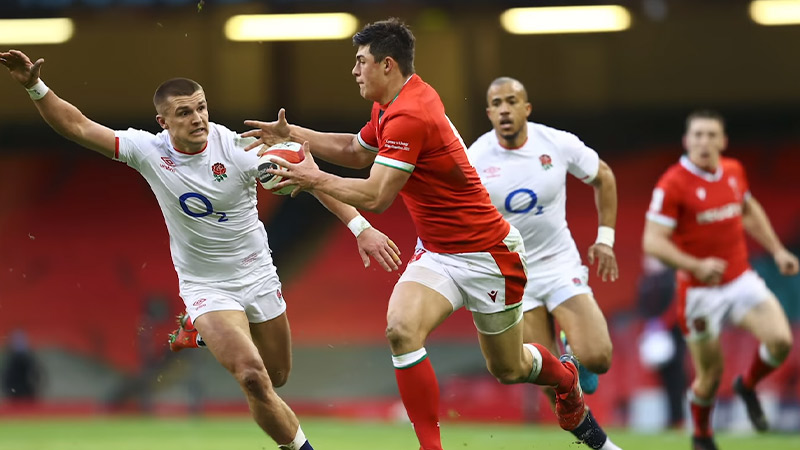
In the world of professional rugby, few moments elicit a more collective reaction from the stadium than the sharp blast of a referee’s whistle following a fumble.
That specific groan from the crowd signifies one of the game’s most frequent and disruptive infringements: the knock-on.
To the uninitiated, it may seem like a minor handling error; however, the knock-on rule is a fundamental pillar of rugby union, designed to preserve the strategic integrity of the sport.
This analysis explores the mechanics of the knock-on, its tactical implications, and the severe penalties associated with deliberate violations.
By understanding these nuances, players and spectators alike can better appreciate the precision required to compete at the highest levels of the game.
Defining the Infringement: What Constitutes a Knock-On?
At its core, a knock-on occurs when a player loses possession of the ball, or accidentally hits it forward with their hand or arm, and the ball subsequently touches the ground or another player before the original handler can regain control.
This rule is a direct extension of rugby’s primary directive: the ball must generally be played in a backwards or sideways direction.
The Three Criteria for a Knock-On
For a referee to signal an infringement, three specific conditions must typically be met:
- Hand or Arm Involvement: The ball must make contact with the player’s hand or arm.
- Forward Trajectory: The ball must travel toward the opponent’s dead-ball line.
- Loss of Control: The ball must hit the ground or another player before the initial player can catch it again.
If a player fumbles the ball but it travels backward, play continues without interruption.
This distinction is vital for maintaining the flow of the game, as it rewards players who can manage “messy” possession without violating the forward-motion principle.
The Anatomy of Contact: Body Parts and Boundaries
One of the most common points of confusion for new fans is the distinction between a handling error and a legal deflection.
The official rules are very specific about which body parts can trigger a knock-on.
The “Off the Head” and “Off the Knee” Rule
A knock-on is only called if the ball involves the hand or arm. If a player receives an “unsympathetic” high pass that ricochets forward off their head, it is considered a legal play.
In such instances, referees are trained to provide a clear visual cue—often patting their own head and shouting “off the head”—to signal to both teams that they should continue playing.
Similarly, if the ball is knocked forward off a player’s knee or foot (provided it is not a deliberate kick that involves a hand-to-foot transition that fails), it is not a knock-on.
While players have less control using their knees, making these instances usually accidental, the lack of an infringement allows for chaotic, exciting periods of play where teams scramble for a loose ball.
The Charge-Down Exception
Perhaps the most notable exception to the knock-on rule is the charge-down.
This occurs when a defending player—often a tall forward—leaps to block an opponent’s kick at close range. Even if the ball hits the defender’s palms and ricochets forward, it is explicitly excluded from being a knock-on in the law books.
This exception encourages defensive pressure and rewards players like Maro Itoje, who use their reach to disrupt the opposition’s kicking game.
Environmental and Psychological Catalysts
Even world-class athletes are susceptible to handling errors. The documentation identifies three primary reasons why these errors occur at the professional level.
1. Adverse Weather Conditions
Rugby is traditionally a winter sport, often played in rain, sleet, or high humidity. Commentators frequently refer to a wet ball as a “bar of soap”.
In these conditions, the leather or synthetic surface of the ball becomes incredibly slippery, making even routine catches a high-risk maneuver.
Professional teams mitigate this by practicing with wet balls—sometimes using hoses on the training pitch—and applying “grip spray” to their hands to enhance friction.
2. Tactical Pressure and Lack of Focus
“Taking one’s eyes off the ball” is a common critique from analysts. This occurs when a player, anticipating a heavy tackle or spotting a gap in the defensive line, looks away from the ball just a split second before it hits their hands.
At the international level, where defensive lines close gaps at lightning speed, this mental lapse is frequently the cause of fumbles near the try line.
3. High-Pressure Kicking Scenarios
Teams often use the “high ball” or “bomb” as a tactical weapon. By launching a spiral kick deep into opposition territory, the kicking team forces a defender to catch the ball under immense physical pressure.
If the defender spills the catch forward due to the sun, wind, or an incoming chaser, the kicking team is rewarded with a scrum in an attacking position.
The Consequences: From Scrums to the Sin-Bin
The penalty for a knock-on depends entirely on whether the referee deems the act accidental or deliberate.
The Accidental Knock-On: The Scrum Restart
The standard result of an accidental fumble is a scrum awarded to the non-offending team.
The scrum serves as a way to restart the game while giving the non-offending side the “put-in,” which is a significant tactical advantage.
The Deliberate Knock-On: A Cynical Infringement
A deliberate knock-on is a much more serious offense. It usually occurs when a defender, faced with an attacking overlap, realizes they cannot make a legal tackle or interception. Instead, they “bat” the ball down to stop the pass from reaching its target.
Because this prevents the attacking team from exercising their tactical advantage, the penalties are severe:
- Penalty Kick: The opposition is awarded a penalty.
- Yellow Card: The offender is often sent to the “sin-bin” for ten minutes.
- Penalty Try: If the referee believes a try would “probably” have been scored if not for the deliberate knock-on, a penalty try is awarded.
Controversial cases, such as Jonny May’s red card for two deliberate knock-ons in 2017, highlight how strictly these rules are enforced to prevent cynical play.
Advanced Match Dynamics: Advantage and Double Errors
Rugby referees prioritize “continuity of play” through the advantage rule.
The Advantage Rule
When a knock-on occurs, the referee will not always blow the whistle immediately. If the non-offending team gathers the ball and has a chance to gain territory or a tactical lead, the referee will signal “advantage”.
If that team makes significant progress or kicks the ball effectively, the referee calls “advantage over,” and play continues.
However, advantage for a knock-on is typically shorter than advantage for a penalty. If no gain is made, the referee brings play back to the original spot for a scrum.
The “Two Knock-Ons” Scenario
In the chaos of a loose ball, it is common for a player from the second team to fumble the ball while trying to recover it.
If both teams commit a knock-on in quick succession, the referee stops play for “two knock-ons”. The team that committed the first error is deemed the offending party, and the scrum is awarded to the other side.
High-Stakes Errors: The Scoring Zone
A knock-on is never more heartbreaking than when it occurs in the act of scoring. For a try to be awarded, a player must maintain control of the ball until it is pressed onto the ground in the in-goal area.
The materials cite high-profile examples, such as Scotland’s Stuart Hogg, who famously lost control of the ball just before touching it down against Ireland.
Even legendary players can suffer from these “howlers,” particularly when they attempt flamboyant finishes—sometimes called an “Ash Splash”—or when a defender manages to bat the ball out of their hands at the last possible second. In all such cases, the try is disallowed, and the defense is relieved with a scrum.
Why Handling Matters?
The knock-on rule ensures that rugby remains a game of skill, territory, and earned possession. Without it, the game could devolve into a series of forward fumbles that lack the tactical depth of passing and running.
For organizations and teams looking to dominate on the field, the data-driven decision is clear: handling precision is non-negotiable.
From the use of grip-enhancing technology to the thousands of hours spent on “catch-pass” drills, professional rugby is a constant battle against the knock-on.
By mastering these mechanics, players ensure that their team stays on the right side of the referee’s whistle, maintaining the momentum needed to secure victory.
Resources for Further Excellence
- Official Laws of the Game: For a deep dive into Law 11 (Knock-on or Throw-forward).
- Performance Training: Explore drills focused on high-ball retention and wet-weather handling.
- Case Study Review: Analyze the 2018 Calcutta Cup “Farrell Try” to see how defensive contact can force a knock-on.
By internalizing these principles, you move from being a casual observer to an expert of the game’s most intricate dynamics. The next time you hear that whistle and the crowd groans, you won’t just be seeing a dropped ball—you’ll be seeing the complex machinery of rugby union in motion.