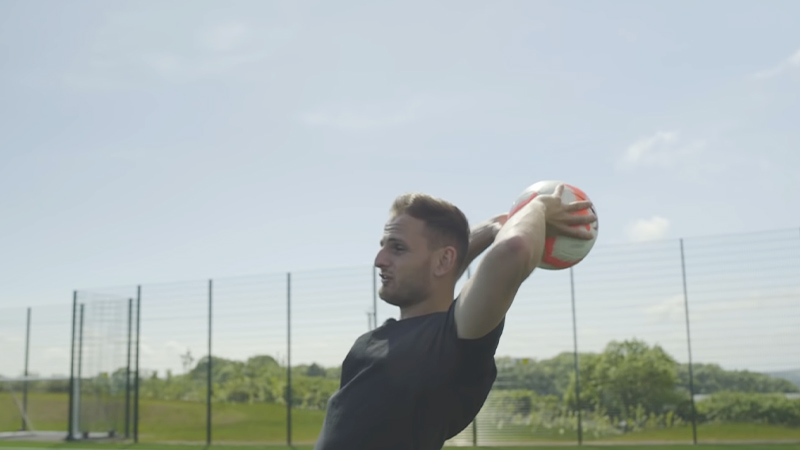
In the sophisticated landscape of modern football, restarts often dictate the rhythm and outcome of a match. Among these, the throw-in is the most frequent yet frequently misunderstood component of the game.
While it may seem like a simple transition, the throw-in is governed by specific regulatory frameworks that ensure fairness and technical consistency.
Understanding exactly when a throw-in occurs and how to execute it within the legal parameters of the sport is essential for players, coaches, and analysts aiming for elite-level performance.
The Defining Moment: When the Ball Leaves Play
A throw-in is the method used to restart play after the ball has exited the field of play via the sidelines, technically known as the touchlines.
However, the determination of this exit is not subjective; it is defined by a rigorous set of conditions that officials monitor with precision.
The Complete Clearance Standard
The most fundamental rule regarding the exit of the ball is the requirement of “Complete Clearance.” In soccer, the boundary lines are considered part of the playing area.
Therefore, a ball is not out of play simply because it touches the line or because the majority of its volume has crossed the plane.
For a throw-in to occur, the ball must completely cross the touchline, whether it is traveling along the ground or through the air.
If any part of the ball is still overhanging the outer edge of the touchline, the ball remains in play, and the match continues without interruption.
This “all-or-nothing” approach prevents ambiguity and requires Assistant Referees to have a perfect line of sight to confirm that the entire circumference of the ball has passed over the outer edge of the boundary.
Determining Possession: The Last Touch Rule
Once the ball has cleared the field of play, the official must immediately identify which player was the last to make contact with it. A throw-in is always awarded to the opponents of the player who last touched the ball before it crossed the line.
This rule places a high premium on “ball security” near the touchlines. In professional matches, defenders often attempt to shield the ball, allowing it to roll out of play while ensuring the attacker is the last to touch it, thereby gaining a restart for their team.
Conversely, attackers may attempt to “carom” the ball off a defender’s legs to force a turnover of possession via a throw-in.
The Geometry of the Restart: Location and Precision
A throw-in cannot be taken from any arbitrary point along the sideline. It must be taken from the exact point where the ball left the field of play.
While referees often allow a small margin of error (usually a yard or two) in the defensive half, they become increasingly strict as the play moves toward the attacking third.
Gaining “unfair yardage” by walking several meters up the line before throwing is a common tactical foul that officials are trained to penalize. In a high-stakes environment, the location of the throw dictates the available passing lanes and the proximity to the opponent’s goal.
Technical Mastery: The Anatomy of a Legal Throw-In
The execution of a throw-in is one of the few moments in soccer where a field player is legally permitted to handle the ball.
Because this is an exception to the primary rules of the sport, the mechanics of the delivery are strictly regulated to prevent players from gaining an unnatural advantage.
1. The Requirement of Two Hands
The integrity of the throw-in depends on a balanced delivery. A player is required to throw the ball using both hands.
This prevents players from using a one-handed “baseball-style” throw, which would allow for significantly more distance and velocity, potentially turning every sideline restart into a dangerous cross. The two-handed requirement ensures a more controlled and predictable trajectory.
2. The Path of Delivery: Behind and Over the Head
The ball must be delivered from behind and over the head of the thrower. This specific motion is designed to ensure that the power is generated from the core and the arms in a standardized fashion.
A common mistake at the amateur level is a “short release,” where the ball is flicked from the forehead or chest. At the professional level, such a delivery is immediately whistled as a “foul throw,” resulting in the loss of possession to the opposing team.
3. Structural Stability: The “Both Feet” Rule
Perhaps the most scrutinized aspect of the throw-in is the positioning of the feet. At the moment of releasing the ball, the thrower must have part of both feet touching the ground. Furthermore, these feet must be positioned either on the touchline or on the ground outside the touchline.
This rule prevents players from jumping during the throw to generate extra momentum. While a “drag-toe” technique is common—where one foot remains planted while the other drags behind to maintain contact—the moment both feet leave the ground, the throw becomes illegal.
4. Orientation: Facing the Field of Play
The thrower must be facing the field of play at the moment the ball is released. This ensures that the restart is transparent and that the thrower is not attempting to hide the direction of the play from the opponents or the officials.
While the thrower can twist their torso to aim the ball in a different direction, their primary stance must be oriented toward the pitch.
Strategic Constraints and Prohibitions
Even a technically perfect throw-in must adhere to specific “Laws of the Game” that govern what happens immediately after the ball enters the pitch. These rules prevent the throw-in from being exploited in ways that undermine the spirit of the game.
The No Self-Pass Restriction
To maintain the flow of a team-based sport, the thrower is prohibited from touching the ball a second time until it has been touched by another player. This “no self-pass” rule prevents a player from simply dropping the ball at their own feet and dribbling away.
If a player touches the ball twice in succession without an intervening touch from a teammate or opponent, an indirect free kick is awarded to the opposing team.
Scoring Directly from a Throw-In
One of the most unique aspects of the throw-in is its status regarding goals. A goal cannot be scored directly from a throw-in.
If a player throws the ball directly into the opponent’s goal without it touching any other player (teammate or opponent) on the way, the goal is disallowed, and play is restarted with a goal kick.
Similarly, if a player throws the ball into their own goal, a corner kick is awarded to the opposition. This rule reinforces the concept of the throw-in as a method of putting the ball back into play rather than a direct scoring opportunity.
Tactical Analysis: The Throw-In as a Set Piece
In elite soccer, the throw-in is no longer viewed as a simple way to return the ball to the pitch; it is treated as a specialized set piece.
Data-driven coaching has revealed that teams often lose possession within three touches of a throw-in, leading to a surge in “throw-in coaches” across top-flight European leagues.
The Long Throw-In
While a goal cannot be scored directly, a long throw-in that reaches the “six-yard box” acts as a functional equivalent to a corner kick or a wide free kick.
By utilizing a “flick-on” header from a teammate, teams can create chaotic scoring opportunities. The technical requirement to keep both feet on the ground makes the strength of the thrower’s lumbar and core muscles paramount in these scenarios.
Creating Space and Triangles
Because the thrower is technically “out of play” until they step back onto the pitch, teams often use the throw-in to create numerical advantages. By drawing defenders toward the sideline, the thrower can exploit the space behind the defensive line.
However, the thrower must remain cognizant of the “no self-pass” rule, ensuring their movement back into the field is timed to receive a return pass rather than touching the ball prematurely.
Enhanced FAQ
Can a player be offside on a throw-in?
No. According to the Laws of the Game, there is no offside offense committed if a player receives the ball directly from a throw-in.
This makes the throw-in a powerful tool for stretching an opponent’s defensive line, as attackers can stand behind the defenders without fear of being penalized.
What happens if the ball never enters the field of play?
If a player performs the throw-in motion but the ball fails to cross the outer edge of the touchline, the throw is retaken.
This is because the ball never officially entered the field of play. However, if the ball enters the field and then immediately curves out of play, the throw-in is awarded to the opposing team at the new exit point.
Can a goalkeeper pick up a throw-in from a teammate?
No. The back-pass rule applies to throw-ins. If a player throws the ball directly to their own goalkeeper, the goalkeeper is prohibited from handling the ball with their hands. If they do, an indirect free kick is awarded to the opposition at the spot of the infringement.
Why do referees sometimes allow players to take a “run-up”?
A run-up is permitted as long as the player’s momentum does not result in an illegal foot position at the moment of release. Both feet must be on or behind the touchline and in contact with the ground when the ball leaves the hands.
Common Technical Errors to Avoid
The following are the most common reasons for a turnover of possession via a foul throw:
- Lifting the Back Foot: In an attempt to gain power, players often lift their trailing foot. Even a microscopic gap between the shoe and the turf is grounds for a foul throw.
- The “Side-Arm” Delivery: If the ball comes over the shoulder rather than directly over the head, it violates the requirement for an overhead delivery.
- Step-In Infractions: If a player steps completely over the touchline and into the field of play before releasing the ball, they have failed to take the throw from the boundary.
- Improper Grip: If one hand does more work than the other, causing the ball to spin or be released unevenly, a referee may judge that it was not thrown with “both hands”.
Conclusion: Mastering the Restart
The soccer throw-in is a prime example of how specific regulations create the framework for professional play.
By ensuring that the ball has completely cleared the touchline and that the restart is executed with both feet on the ground and both hands on the ball, the game maintains its balance between athleticism and structured rules.
For organizations and athletes dedicated to excellence, mastering these fundamentals is non-negotiable. A throw-in is not merely a pause in the action; it is a strategic opportunity to retain possession, shift the point of attack, or create a scoring chance.
By adhering to the precise mechanics of the “behind and over the head” delivery and respecting the tactical boundaries of the pitch, teams can transform a routine restart into a competitive advantage.