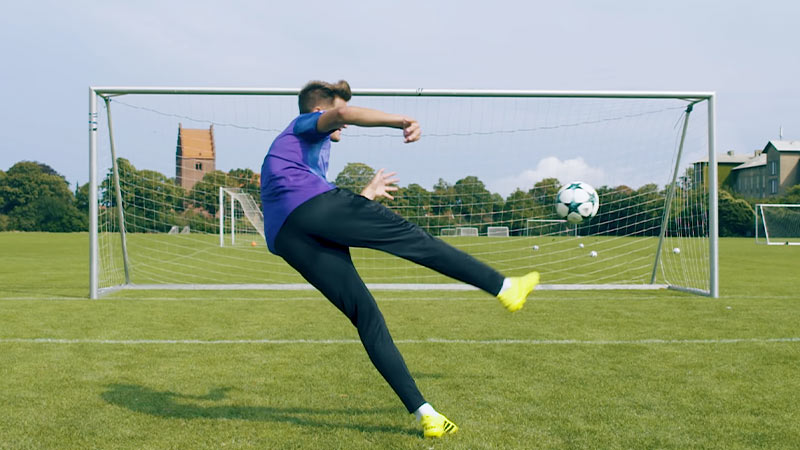
A volley in soccer is an air-borne strike where a player kicks the ball before it touches the ground. It stands as one of the most technically difficult and spectacular skills in the sport, requiring exceptional timing and coordination to redirect the ball’s momentum.
Beyond its visual appeal, the volley is a clinical tool used by elite attackers to capitalize on crosses and loose balls instantly.
Mastering this skill transforms a standard player into a goal-scoring threat from almost any aerial delivery, making it a cornerstone of advanced offensive play in professional leagues around the globe today.
The Technical Anatomy of an Elite Soccer Volley
To execute a successful volley, a player must synchronize multiple physical movements within a split-second window of opportunity. Understanding the biomechanics of the strike is the first step toward moving from a purely reactive player to a deliberate finisher who can control high-velocity aerial balls.
Mastering Body Alignment and Gravity
To keep the ball from flying over the goal, professional coaching emphasizes specific body positioning: leaning slightly forward over the ball to keep the trajectory low.
This forward tilt ensures the player’s center of gravity is positioned to drive through the ball rather than underneath it. If a player leans backward, the natural arc of the kicking leg will lift the ball high into the stands.
By staying “over” the ball, the player can use their body weight to compress the shot, ensuring it remains on target.
The Precision of Foot Contact
Most successful volleys utilize the “laces,” or the instep of the foot, with the toe pointed down and the ankle locked to provide a firm striking surface.
Locking the ankle is non-negotiable; a “loose” foot will absorb the ball’s energy like a sponge, leading to a weak and unpredictable trajectory.
By creating a rigid surface with the instep, the player maximizes the transfer of kinetic energy from their leg to the ball, resulting in a powerful strike that is difficult for goalkeepers to parry.
Visual Tracking and Cognitive Focus
The mental aspect of the volley is as critical as the physical. Players must keep their eyes fixed on the ball until the exact moment of impact to ensure proper timing. This requires intense concentration to filter out the movement of defenders and the goalkeeper.
The “quiet eye” technique—a steady gaze on the target—allows the brain to calculate the ball’s descent rate and speed accurately, enabling the muscles to trigger the strike at the perfect millisecond.
Categorizing the Strike: The Four Essential Volley Types
The term “volley” acts as an umbrella for several distinct techniques. Each variation is dictated by the ball’s height, the angle of its approach, and the player’s position relative to the goal. Mastering each type allows an attacker to remain dangerous regardless of how the service arrives.
| Volley Type | Execution Mechanics | Primary Tactical Application |
|---|---|---|
| Full Volley | Striking the ball while it is completely in the air before any bounce. | Immediate goal-scoring from crosses or high defensive clearances. |
| Half Volley | Striking the ball immediately after it bounces, hitting it “on the rise”. | Low-trajectory power shots that skip off the turf, making saves difficult. |
| Side Volley | Positioning the body “side-on” and swinging the leg horizontally. | Redirecting wide crosses while maintaining a view of the target. |
| Bicycle Kick | An advanced acrobatic strike with the player’s back to the goal. | High-reward surprise attacks when the ball is behind the attacker. |
The Complexity of the Full Volley
The full volley represents the purest form of the air strike. Because the ball has no contact with the ground to stabilize its rotation, the player must account for every variable in its flight path.
It is often the preferred choice when an attacker is in a crowded penalty area and cannot afford the time for a bounce.
Executing this requires the highest level of coordination, as the player must time their jump or step to meet the ball at the apex of their leg’s swing.
The Strategic Utility of the Half Volley
While often overlooked, the half volley is one of the most effective tools for long-range shooting. By striking the ball just as it leaves the grass, the player uses the ground as a stabilizing force.
This technique often produces a “dipping” effect, where the ball starts high and drops sharply as it nears the goal. Professionals prefer the half volley for its consistency, as the brief bounce provides a clearer “read” on the ball’s eventual trajectory.
Advanced Acrobatics: The Side Volley and Bicycle Kick
The side volley requires the player to rotate their hips nearly 90 degrees to the incoming ball. This lateral movement allows for a wider “whip” of the leg, generating significant torque.
The bicycle kick (or overhead kick) is the pinnacle of soccer artistry. It involves a mid-air scissoring motion where the player is completely inverted.
While rare, it remains the most effective way to strike a ball that has traveled behind the attacking player’s line of sight.
Why the Volley is a Tactical Game-Changer
In modern soccer, where defensive structures are increasingly disciplined and compact, the volley serves as a “circuit breaker.” It allows an offense to transition from a build-up phase to a finishing phase instantly, bypassing the need for traditional ball control.
Eliminating Defensive Reaction Time
The primary reason volleys are effective is their ability to catch a goalkeeper and defense off guard. Most defensive systems are designed to react when a player takes a “trap” or a control touch.
By eliminating this extra touch, the attacker denies the defenders the 1.5 to 2 seconds they would typically use to close down space or adjust their positioning. This suddenness often leaves the goalkeeper stationary, unable to dive toward the shot.
Maximizing Opportunities in High-Pressure Zones
In the “Zone 14” or the penalty box, space is a luxury. When a ball is cleared by a defender but stays in the air, a player capable of volleying can turn a defensive clearance into a goal in a single motion.
This ability to punish small errors or “scrappy” play is what separates elite strikers from average ones. It forces the defense to be perfect in their clearances, knowing that any ball left in the air is a potential scoring opportunity.
Analyzing Iconic Volleys in Professional History
The history of the sport is defined by moments where a single air-borne strike changed the trajectory of a tournament. These goals are studied by professionals for their technical perfection and the composure shown by the strikers in high-stakes environments.
Zinedine Zidane’s 2002 Champions League Masterpiece
Perhaps the most famous example of the skill is Zinedine Zidane’s goal in the 2002 Champions League final. As a high, looping cross descended toward the edge of the box, Zidane pivoted his entire body to face the side-on trajectory.
He struck a full volley with his non-dominant left foot, sending the ball into the top corner. This goal is the ultimate case study in body positioning and the importance of keeping the chest over the ball to maintain a controlled path.
Marco van Basten’s Impossible Angle in 1988
Another legendary strike is Marco van Basten’s goal for the Netherlands in the 1988 European Championship. Positioned at an extremely tight angle near the goal line, van Basten opted for a side volley instead of a cross.
By swinging his leg horizontally and meeting the ball with his laces, he created a looping arc that bypassed the goalkeeper and settled in the far corner.
This strike highlighted how the volley can create scoring chances from positions that appear statistically impossible.
Advanced Training Drills to Perfect Your Technique
Developing a reliable volley requires moving beyond theory and into structured, high-repetition training. The goal is to build muscle memory so that the “toe-down, ankle-locked” position becomes an instinctive reaction rather than a conscious thought.
Solo Wall Volleys for Repetition
One of the most effective ways to train alone is using a solid wall. Start by dropping the ball and striking it into the wall on the first bounce (half volley).
As you improve, throw the ball against the wall and try to strike the rebound before it hits the ground (full volley).
Focus entirely on your foot contact; if the ball makes a “thud” sound and travels straight, your ankle is locked. If it makes a “slap” sound and spins wildly, you need to firm up your contact point.
Partner-Assisted Wing Delivery
To simulate match conditions, work with a partner who can provide service from the wings. Have the partner cross balls into the box at varying heights and speeds.
Your objective is not just to hit the goal, but to focus on your “prep steps”—the small adjustments your feet make as the ball is in flight.
This drill teaches you how to judge spatial awareness and how to adjust your body angle relative to the goal while the ball is still in the air.
Common Challenges and Troubleshooting
Even professional players struggle with the volley if their fundamentals slip. Recognizing the signs of poor technique can help you self-correct during a match or training session.
Correcting Vertical Trajectory Issues
If your volleys consistently fly over the crossbar, the issue is almost certainly your posture. You are likely leaning back or taking your eyes off the ball too early. To fix this, consciously exaggerate your “lean-in” during your next ten strikes.
Ensure your knee is positioned directly over the ball at the moment of impact. This physical barrier prevents the foot from scooping under the ball, forcing it into a more linear, downward path.
Improving Timing and Spatial Awareness
Many players miss the ball entirely or “shin” it because they are trying to kick too hard. Speed comes from the ball’s existing momentum and your technique, not the raw force of your swing.
If your timing is off, slow down your leg motion and focus on “meeting” the ball rather than “smashing” it. Once you are consistently making clean contact with the center of your laces, you can gradually increase the speed of your leg swing.
Frequently Asked Questions
What is the difference between a volley and a half volley?
A full volley is struck while the ball is still in the air and hasn’t touched the turf. A half volley is struck a fraction of a second after the ball bounces off the ground, catching it “on the rise”.
The half volley is generally easier to control because the ground stabilizes the ball’s rotation just before impact.
Why is the laces (instep) the best part of the foot for a volley?
The instep provides the largest and flattest bone structure in the foot. By pointing the toe down and locking the ankle, you create a solid “club” that can redirect a high-speed ball with maximum power.
Using the side of the foot offers more control for short distances but lacks the velocity needed to beat a professional goalkeeper from distance.
Can a volley be used for passing instead of shooting?
Absolutely. While most highlights focus on goals, volleys are essential for “first-time” passing. A cushioned volley can redirect a long ball to a teammate, maintaining the speed of an attack and preventing the defense from resetting. The same rules of body position and eye contact apply to passing as they do to shooting.
Conclusion: Elevating Your Offensive Game
The soccer volley is more than just a highlight-reel moment; it is a sophisticated technical skill that defines the highest levels of play.
By focusing on the core principles of leaning forward, locking the ankle, and maintaining visual focus, you can master a technique that catches even the best defenses off guard.
Whether you are performing a disciplined half volley or a spectacular bicycle kick, adding this air strike to your arsenal makes you a versatile and unpredictable threat on the pitch.
Consistent practice and an understanding of these mechanics will ensure that the next time the ball is in the air, you are ready to turn it into a masterpiece.