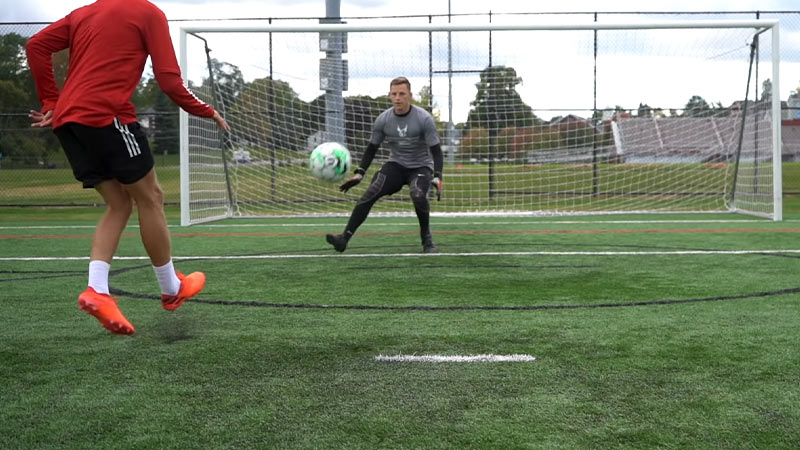
In the high-stakes world of modern football, power often takes center stage, yet the most devastating weapon in a striker’s arsenal is frequently the most delicate.
A chip shot, often referred to as a “lob” or “dink,” represents the pinnacle of technical finesse on the pitch. It is a specialized technique where the ball is lofted in a high, parabolic arc to bypass goalkeepers or defenders.
Understanding the mechanics of this “U-shaped” trajectory is essential for any player aiming to transition from a standard goal-scorer to an elite tactical finisher who prioritizes precision over force.
Defining the Chip Shot: Technical Characteristics and Visuals
To truly master the chip shot, one must first understand that it is fundamentally different from a traditional strike.
While a standard shot relies on the transfer of kinetic energy from a full leg swing, the chip shot (also known as a lob or dink) is a skillful soccer technique where a player kicks the ball with a delicate, scooping motion.
This motion is designed to loft the ball high into the air in a specific parabolic arc. The goal is not to break the net, but rather to exploit the positioning of an opponent by using height as a tool for evasion.
The Unique Trajectory and Physics
A defining characteristic of a successful chip is its trajectory, which follows a steep, “U-shaped” arc. This means the ball rises quickly to clear an obstacle—usually the goalkeeper’s outstretched arms—and then drops sharply into the goal.
Unlike a chip-and-run or a standard long ball, the scoring chip requires the ball to descend rapidly once it has cleared the peak of its arc.
The Science of Backspin
Beyond the height, the spin of the ball plays a critical role in the shot’s success. Successful chips often utilize backspin, which helps the ball stay in the air longer. This aerodynamic property allows the ball to defy gravity for a split second longer at the peak of its arc.
Furthermore, backspin ensures the ball stops quickly or “bites” once it hits the ground, preventing it from rolling out of play or too far ahead if used as a pass.
Executing the Perfect Chip: A Step-by-Step Technical Guide
Mastering the mechanics of the “dink” requires a departure from traditional shooting habits. Because the focus is on finesse rather than force, the player must adjust their body positioning, contact point, and follow-through to achieve the desired lift.
Step 1: Foundational Positioning and Body Lean
The setup for a chip shot is subtle, often disguising the player’s intent until the final microsecond.
- The Approach: Stand at a slight angle relative to the ball rather than approaching it dead-on.
- The Plant Foot: Place your non-kicking foot approximately one foot away from the ball.
- The Lean: To provide the necessary elevation, lean your body slightly back during the contact phase. This backward lean naturally helps the foot get underneath the ball’s center of gravity.
Step 2: The “Stabbing” Strike and Contact Point
The actual strike is where most players struggle, as it requires a “stabbing” or “jamming” motion rather than a fluid swing.
- Target Area: You must identify the bottom half of the ball as your primary target.
- The Contact Point: The player strikes the ball underneath its center, often “stabbing” or “jamming” their toes into the ground beneath the ball to create immediate lift.
- The Tool: Use a short, quick motion with your toe or the top of your foot to generate the necessary scoop.
Step 3: Managing the Follow-Through
The most common mistake in executing a chip is a full, swinging follow-through. To maintain the “U-shaped” trajectory, you must keep the follow-through short and quick.
Instead of swinging through the ball as you would for a standard power shot, you should focus on lifting your foot upward immediately after contact.
This abrupt stop in the leg’s motion is what imparts the backspin and ensures the ball rises steeply rather than traveling forward with too much velocity.
Strategic Implementation: When to Use the Chip Shot
Knowing how to chip is only half the battle; knowing when to execute it is what separates world-class players from the rest. The chip is a tactical response to a specific defensive error or goalkeeper movement.
The 1v1 Breakaway Scenario
The best time to use a chip is during a 1v1 breakaway when the goalkeeper advances to “close down the angle”. As a striker approaches the goal, a proactive goalkeeper will often come off their line to reduce the amount of net the striker can see.
By coming off their line, the keeper leaves a significant amount of space behind them, making them vulnerable to a shot that goes over their head.
Overcoming Defensive Blocks
While primarily a scoring technique, the chip is also used to pass the ball over the heads of defenders. In a crowded penalty area or when a defensive line is sitting deep, a delicate chip can loft the ball over a “bus” of defenders to a teammate making a run into the space behind.
This application requires the same “stabbing” motion and “U-shaped” arc to ensure the ball drops perfectly for the receiver.
The Anatomy of Success: Why the Chip Shot Works
| Feature | Description | Tactical Benefit |
|---|---|---|
| Motion | Delicate, scooping “stabbing” motion | Disguises intent and creates rapid lift |
| Arc | High, parabolic “U-shaped” path | Clears goalkeepers who are off their line |
| Spin | Consistent backspin | Ensures the ball drops sharply and stops quickly |
| Philosophy | Precision and finesse over force | Exploits keeper positioning rather than beating them with speed |
Common Pitfalls and How to Avoid Them
Even professional players can fail a chip shot if their technique is slightly off. The margin for error is much smaller than a power shot because the ball must clear an obstacle and fall within a specific 8-yard window (the goal).
Excessive Power and “The Blast”
The primary reason chips fail is the instinctual urge to kick the ball hard. Because a chip focuses on precision and finesse rather than force, any extra power usually flattens the trajectory.
This results in a shot that hits the goalkeeper in the chest or sails far over the crossbar because it lacked the steep “U-shaped” drop.
Incorrect Foot Placement
If the plant foot is too close or too far from the ball, the player cannot lean back sufficiently to get “underneath” the center. Without that “stabbing” motion into the ground beneath the ball, the foot cannot create the necessary scoop to generate height.
Practice should focus on the “jamming” of the toes into the turf to ensure the ball is lifted, not pushed.
Why Mastery of the Chip Shot Matters
In elite coaching circles, the chip shot is seen as a sign of high “footballing IQ.” It requires a player to remain calm in high-pressure situations, such as a 1v1 with a charging goalkeeper. Instead of panicking and shooting directly at the keeper, the player analyzes the space behind the keeper and executes a technical “dink”.
This demonstrates a level of expertise and trustworthiness in one’s own ability that can demoralize an opposing team.
Furthermore, mastering this shot adds a layer of unpredictability to a player’s game. If a goalkeeper knows a player only shoots with power, they will stay low and ready for a drive.
If the player is known for the “lob,” the goalkeeper must hesitate, creating even more opportunities for the attacker to exploit.
Frequently Asked Questions About Soccer Chip Shots
Is a chip shot the same as a lob?
Yes, in the context of soccer, a chip shot is also known as a lob or a dink. While “lob” is often used for longer distances (like a long ball over a defense), and “dink” usually refers to a very short-range chip over a diving keeper, they all describe the same basic scooping technique that creates a parabolic arc.
Can you chip the ball with the side of your foot?
While the traditional chip uses a “stabbing” motion with the toe or the top of the foot to get underneath the center, some advanced players use the inside of the foot for more control at close range.
However, the “stabbing” motion into the ground is the most effective way to generate the rapid lift needed for a true “U-shaped” trajectory.
What is the most important part of the follow-through?
The most important part is keeping it short and quick. You must resist the urge to swing through the ball. By lifting your foot upward rather than forward, you ensure the energy is used for height and backspin rather than forward velocity.
Why do goalkeepers hate being chipped?
Goalkeepers rely on cutting down angles and using their reaction speed to block shots. A chip shot renders their height and wingspan useless by going over them.
Once the ball is in the air in a steep arc, the keeper is often “rooted” to the spot, unable to retreat fast enough to catch a ball dropping sharply behind them.
Conclusion: Elevating Your Game Through Technical Finesse
The chip shot is more than just a flashy trick; it is a vital technical skill that rewards intelligence and composure.
By mastering the “stabbing” motion, understanding the necessity of backspin, and recognizing when a goalkeeper has left their line, you transform yourself into a multi-dimensional threat on the field.
Remember, the most effective path to the back of the net isn’t always the fastest—sometimes, it’s the highest.
Ready to take your finishing to the next level? Download our “Elite Striker’s Training Blueprint” to access specific drills designed to perfect your stabbing motion and lift. Don’t just play the game; master the artistry of the arc.
Sign up for our newsletter today for weekly tactical breakdowns and professional training insights delivered straight to your inbox.